How to Write a High-Scoring AP English Language Rhetorical Analysis Essay: Step-by-Step Template
Last Updated: October 2026 | By EdFlik Education Team
For high school students preparing for the Advanced Placement (AP) English Language and Composition exam across international schools and American curriculum academies in the United Arab Emirates and worldwide, Free-Response Question 2 (FRQ 2): The Rhetorical Analysis Essay is often considered the most formidable challenge of the test.
Unlike standard literary analysis essays that focus on theme, plot symbolism, or character development, an AP Lang rhetorical analysis requires you to dissect how a historical speech, letter, opinion column, or essay achieves its purpose. You are placed in the role of an analytical critic, evaluating the author's rhetorical choices, stylistic devices, argumentative structure, and direct engagement with the audience.
Many students struggle not because they cannot read the text, but because they lack a systematic structural framework. They fall into the trap of summarizing the passage or listing random literary terms without connecting them to an overarching thesis.
In this comprehensive, masterclass guide, our expert AP English educators break down the official College Board rubric, unveil a foolproof step-by-step writing template, and share high-impact strategies to secure a top score of 5.
Part 1: Decoding the AP English Language FRQ 2 Rubric (6 Points)
To write a top-scoring essay, you must understand how AP readers evaluate your work across three distinct scoring domains:
1. Row A: Thesis (0–1 Point)
- The Requirement: You must articulate a defensible thesis that does more than merely restate the prompt. It must identify the author's specific purpose or message and preview the core rhetorical choices or strategies you will analyze.
- Pro Tip: Place your thesis as the final sentence of your introductory paragraph. Never hide it in the conclusion.
2. Row B: Evidence and Commentary (0–4 Points)
- The Requirement: This is where 4 out of your 6 possible points are earned. You must provide specific, textually accurate evidence (via direct quotes or tight paraphrases) and—most importantly—provide robust commentary explaining how that evidence supports your thesis.
- The Pitfall: Merely dropping quotes into a paragraph without explaining their rhetorical mechanics will cap your score at 1 or 2 points. Every piece of evidence must be unpacked.
3. Row C: Sophistication (0–1 Point)
- The Requirement: The elusive 6th point is awarded for exceptional sophistication of thought or style. This can be achieved by demonstrating a nuanced understanding of the text's complexities, analyzing rhetorical tensions or counterarguments, or maintaining a consistently vivid, compelling prose style throughout the essay.
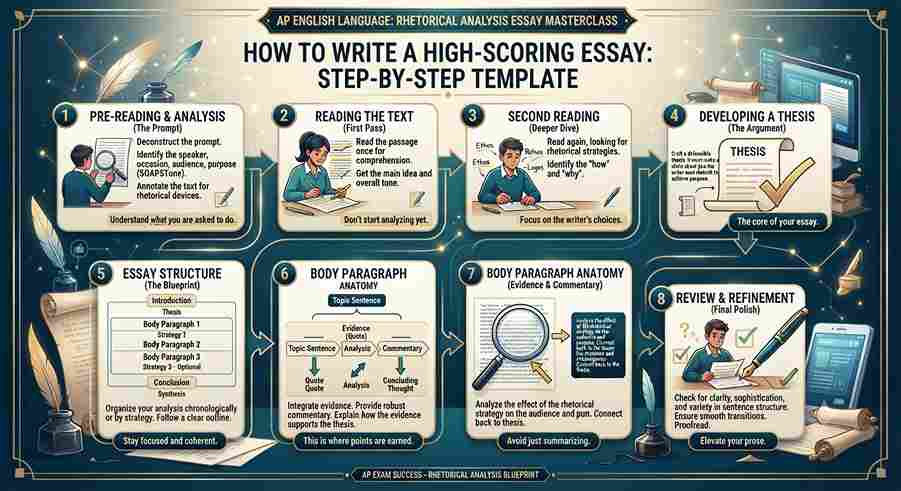
Part 2: The Essential 5-Paragraph Rhetorical Analysis Blueprint
When the exam timer starts, you have approximately 40 minutes to read the prompt, annotate the passage, outline, and write your essay. Following a rigorous 5-paragraph structure ensures you hit every expectation of the rubric without running out of time.
Paragraph 1: The Introduction (Context, Occasion, Thesis)
Your introduction should be concise (3 to 4 sentences maximum) and set the stage for your analytical argument:
- Hook & Context: Identify the author, title, historical context, and intended audience.
- Subject & Purpose: State what the text is about and what the author is trying to achieve, persuade, or provoke.
- Defensible Thesis: State the specific rhetorical strategies the author employs to accomplish this purpose.
- Template: "In his [speech/letter/essay] [Title], [Author] [verb describing action, e.g., meticulously constructs/urgently appeals] to [Audience] in order to [Author's Purpose]. [Author] achieves this through the use of [Strategy 1], [Strategy 2], and [Strategy 3]."
Paragraph 2: Body Paragraph 1 (First Rhetorical Choice)
Focus your first body paragraph on the opening or early section of the text:
- Topic Sentence: Introduce the first rhetorical choice and its immediate function.
- Concrete Evidence: Integrate a precise, well-chosen quote from the text.
- Deep Commentary: Unpack the mechanics. What specific diction, syntax, or rhetorical appeal (ethos, pathos, logos) is at play here?
- The "So What?" Link: Explain how this specific choice manipulates the audience's emotional or intellectual state to advance the author's overarching purpose.
Paragraph 3: Body Paragraph 2 (Second Rhetorical Choice)
Shift to the middle development of the text, often where the author shifts tone, introduces a counterargument, or ramps up emotional intensity:
- Topic Sentence: Identify the second shift or strategy.
- Evidence & Analysis: Provide fresh textual evidence from the middle section.
- Audience Impact: Analyze how the audience receives this shift and why the author structured the argument in this specific sequence.
Paragraph 4: Body Paragraph 3 (Third Rhetorical Choice / Synthesis)
Focus on the conclusion or final structural movement of the text:
- Topic Sentence: Highlight how the author seals their argument or leaves a lasting impression on the audience.
- Evidence & Analysis: Examine final stylistic devices, such as a powerful concluding anaphora, a striking metaphor, or an appeal to shared values.
- Holistic Integration: Connect this final element back to your main thesis statement.
Paragraph 5: The Conclusion (Synthesis and Broader Implications)
Keep your conclusion brief (2 to 3 sentences):
- Restate your thesis in a fresh way (do not copy and paste word-for-word).
- Synthesize how the interplay of your analyzed strategies collectively achieved the author's purpose.
- (Optional for Sophistication) Briefly touch upon why this text matters historically or rhetorically.
Part 3: Top 4 Traps That Prevent Students From Earning a 5
- Summarizing Instead of Analyzing: If your essay reads like a plot summary or a historical retelling of what the author said, you will fail to earn points under Row B. Always ask yourself not just what the author said, but how and why they said it that way.
- Using Hollow Formulaic Acronyms Blindly: While acronyms like SPACE CAT or CHAMPS are helpful during pre-reading analysis, do not structure your essay around rigid acronym templates. Let the author's argument dictate your paragraph divisions.
- Treating Rhetorical Appeals as Techniques: Saying "The author uses pathos here" is too vague. Pathos is an effect, not a tool. Explain the specific mechanism that creates that pathos—such as visceral imagery, loaded anecdotal diction, or hyperbole.
- Running Out of Time: Pace yourself strictly. Spend 10 to 12 minutes reading and annotating, 25 minutes writing your three robust body paragraphs and intro/conclusion, and 3 minutes proofreading.
Preparing for the AP English Language exam across international schools in Dubai, Abu Dhabi, or worldwide? EdFlik connects students globally with expert, 1-to-1 online AP English tutors, helping you master rhetorical analysis, refine your essay structure, and achieve top scores of 5.Book a Free Demo Class Today!
Frequently Asked Questions (FAQs)
Q1: How long should an AP Lang Rhetorical Analysis essay be?
Ans: Most high-scoring essays span approximately 3 to 4 pages of clear, well-structured handwriting (roughly 500 to 750 words). Quality and depth of commentary matter far more than raw word count.
Q2: Should I mention ethos, pathos, and logos in my essay?
Ans: Yes, but use them as supporting descriptors rather than the core focus of your paragraphs. Focus your topic sentences on specific authorial actions (e.g., juxtaposition, historical allusion, high-modality syntax), and explain how those actions establish ethos, evoke pathos, or deploy logos.
Q3: Can I write a 4-paragraph essay instead of 5?
Ans: Absolutely. Many top-scoring students write two deeply developed body paragraphs instead of three, provided each body paragraph covers multiple well-integrated textual examples and extensive commentary.
Q4: How does EdFlik support AP English students?
Ans: EdFlik connects international school students worldwide with vetted, expert 1-to-1 online tutors specializing in AP English Language and Composition. Our personalized coaching focuses on mastering passage annotation, essay outlining, timed writing, and rigorous past-paper practice.