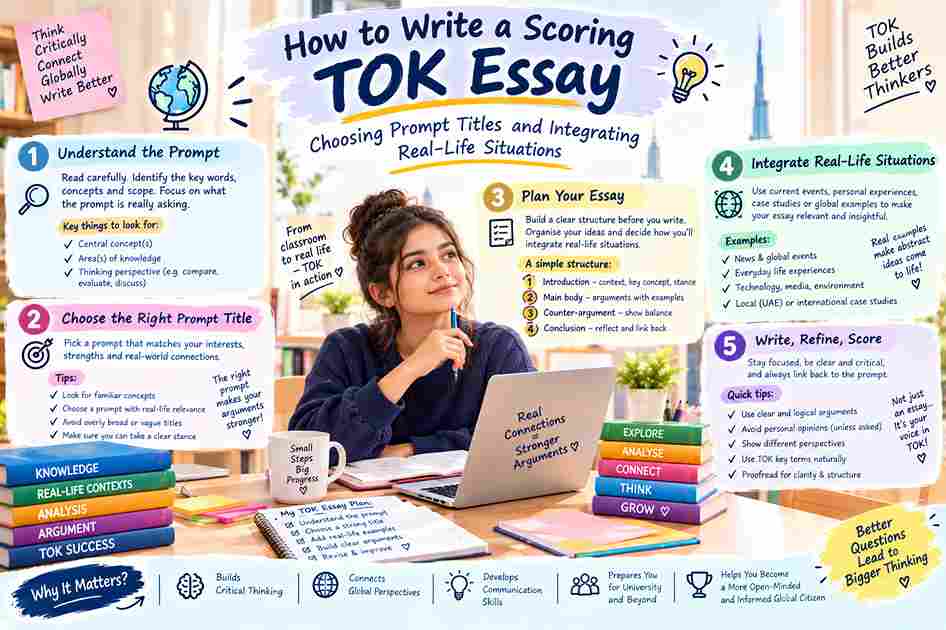
How to Write a Scoring TOK Essay: Choosing Prompt Titles and Integrating Real-Life Situations
Last Updated: September 2026 | By EdFlik Education Team
For students enrolled in the International Baccalaureate (IB) Diploma Programme (DP), Theory of Knowledge (TOK) is one of the most intellectually stimulating yet intimidating components of the core. While the TOK Exhibition tests your ability to connect knowledge concepts to objects in the real world, the 1,600-word TOK Essay is a rigorous philosophical exercise that demands deep analytical thinking, careful prompt selection, and seamless integration of real-life situations.
Scoring a top Band (an A) on your TOK essay requires much more than a collection of random knowledge questions and loosely related examples. It requires precise navigation of the prescribed title, rigorous engagement with the TOK framework, and nuanced exploration of knowledge claims.
In this comprehensive guide, our expert IB TOK tutors break down how to choose the right essay prompt, dissect knowledge questions, and integrate real-life situations to secure top marks.
Part 1: Choosing Your Prescribed Title (PT) Wisely
Every May or November exam session, the IB releases six prescribed titles. Choosing the right title is the single most important decision you will make in your TOK journey.
1. Match Your Strengths and Areas of Knowledge (AOKs)
- Analyze the Core Concepts: Look closely at the recurring concepts embedded in the titles—such as bias, consensus, justification, evidence, interpretation, or truth. Choose a title where these concepts resonate with subjects you genuinely enjoy studying (e.g., History, Natural Sciences, or The Arts).
- Avoid "Comfort Zone" Traps: While it is tempting to pick a title because it mentions a subject you love, make sure the prompt actually allows you to compare two distinct Areas of Knowledge. If a title pigeonholes you into discussing subjects you find difficult to contrast, look elsewhere.
2. Deconstruct the Prompt for Embedded Knowledge Questions (KQs)
Never write about the title literally; you must unpack the underlying Knowledge Question.
- Example Prompt: "To what extent is the pursuit of knowledge more important than the product?"
- Deconstructed KQ: How do the methods used to acquire knowledge in [AOK 1] influence the reliability of the final knowledge claims compared to [AOK 2]?
Part 2: Integrating Real-Life Situations (RLSs) Effectively
A common pitfall for students is treating real-life situations like descriptive anecdotes from a history textbook or a science documentary. In TOK, your real-life situations serve as evidence to test your knowledge claims.
1. The Anatomy of a Good TOK Example
Your RLSs must be specific, authentic, and directly tied to how knowledge is constructed, evaluated, or used.
- Weak Example: "A scientist did an experiment about gravity." (Too vague, no context).
- Strong Example: "The controversy surrounding the imaging of the first black hole by the Event Horizon Telescope collaboration in 2019, where petabytes of raw radio telescope data required complex algorithmic cleaning before consensus could be reached." (Specific, rich in implications about data interpretation and peer review).
2. Diversifying Your Examples
Across your essay (which typically features 2 to 3 main AOKs):
- Ensure your examples are drawn from different Areas of Knowledge to fulfill the comparative requirements of the rubric.
- Incorporate both macro-level examples (global scientific discoveries, major historical historiography debates) and micro-level examples (personal or local experiences with language and perception) to show breadth.
Part 3: Structuring Your 1,600-Word Essay for Maximum Impact
A top-scoring TOK essay follows a rigorous argumentative structure rather than a chronological narrative.
1. The Introduction (Approx. 150–200 words)
- Hook the reader by addressing the core premise of the prescribed title.
- Define key terms and concepts (e.g., what does justification mean in this context?).
- Explicitly state your thesis statement: How will you answer the prompt across your chosen AOKs?
2. Body Paragraphs — The Claim/Counterclaim Model
For each AOK, structure your arguments using a rigorous dialectical approach:
- Claim: Make a clear knowledge claim answering the prompt (e.g., "In the Natural Sciences, empirical observation is considered the primary foundation for knowledge production").
- Evidence (RLS 1): Introduce your specific real-life situation to support this claim.
- Counterclaim: Challenge your own claim or explore an alternative perspective (e.g., "However, without theoretical models to guide observation, data is meaningless—as noted by philosophers like Thomas Kuhn regarding paradigm shifts").
- Counter-Evidence (RLS 2): Introduce a second real-life situation that supports the counterclaim.
- Synthesis/Mini-Conclusion: Evaluate how the tension between the claim and counterclaim answers the central Knowledge Question.
3. The Conclusion (Approx. 150–200 words)
- Synthesize your findings across all AOKs without repeating yourself.
- Highlight key differences and similarities in how knowledge is established across the disciplines you analyzed.
- End with a thought-provoking final sentence that reflects the broader implications of your thesis.
Part 4: Top 4 Strategies to Secure an A in TOK
- Stay Focused on the Prompt: Every single paragraph must tie back to the exact wording of the prescribed title. If a paragraph does not address the prompt, cut it—even if it's an interesting discussion.
- Use Precise TOK Vocabulary: Embed core TOK terminology naturally into your writing: perspectives, scope, methods and tools, ethics, reliability, bias, paradigms, and shared vs. personal knowledge.
- Acknowledge Counter-Perspectives: Examiners heavily penalize one-sided essays. Top-band scripts actively seek out limitations, exceptions, and alternative ways of knowing.
- Adhere Strictly to the Word Count: The IB imposes a strict 1,600-word limit. Exceeding this limit means examiners will stop reading at 1,600 words, which can leave your conclusion unfinished. Edit ruthlessly for conciseness.
Struggling to unpack your TOK prescribed title, structure your arguments, or integrate real-life situations? EdFlik offers expert, 1-to-1 online tutoring customized specifically for the IB Diploma Programme, helping you build philosophical clarity and secure an A.Book a Free Demo Class Today!
Frequently Asked Questions (FAQs)
Q1: Can I use personal experiences as real-life situations in my TOK essay?
Ans: While personal experiences (personal knowledge) can be used, they should be used sparingly and balanced with shared knowledge (publicly validated claims from disciplines like History, Science, or Art). Relying entirely on personal anecdotes makes it difficult to achieve top IB assessment bands.
Q2: How many Areas of Knowledge (AOKs) should I include in my essay?
Ans: Most successful TOK essays focus on two well-developed Areas of Knowledge. Attempting to cram three or four AOKs into 1,600 words often results in superficial analysis. Depth of argument always beats breadth of coverage.
Q3: Do I need a separate bibliography for my TOK essay?
Ans: Yes. All sources, quotes, and real-life situations referenced in your essay must be properly cited using a consistent academic referencing style (such as MLA or APA) in a bibliography appended to the end of your document.
Q4: How can EdFlik help me achieve an A in TOK?
Ans: EdFlik connects you with experienced, certified 1-to-1 online tutors specializing in the IB DP Theory of Knowledge curriculum. Our tutors guide you through prompt selection, thesis development, and essay structuring to ensure your ideas shine.