IB Internal Assessment (IA) Help UAE — Subject-by-Subject Guide for Dubai Students (2026)
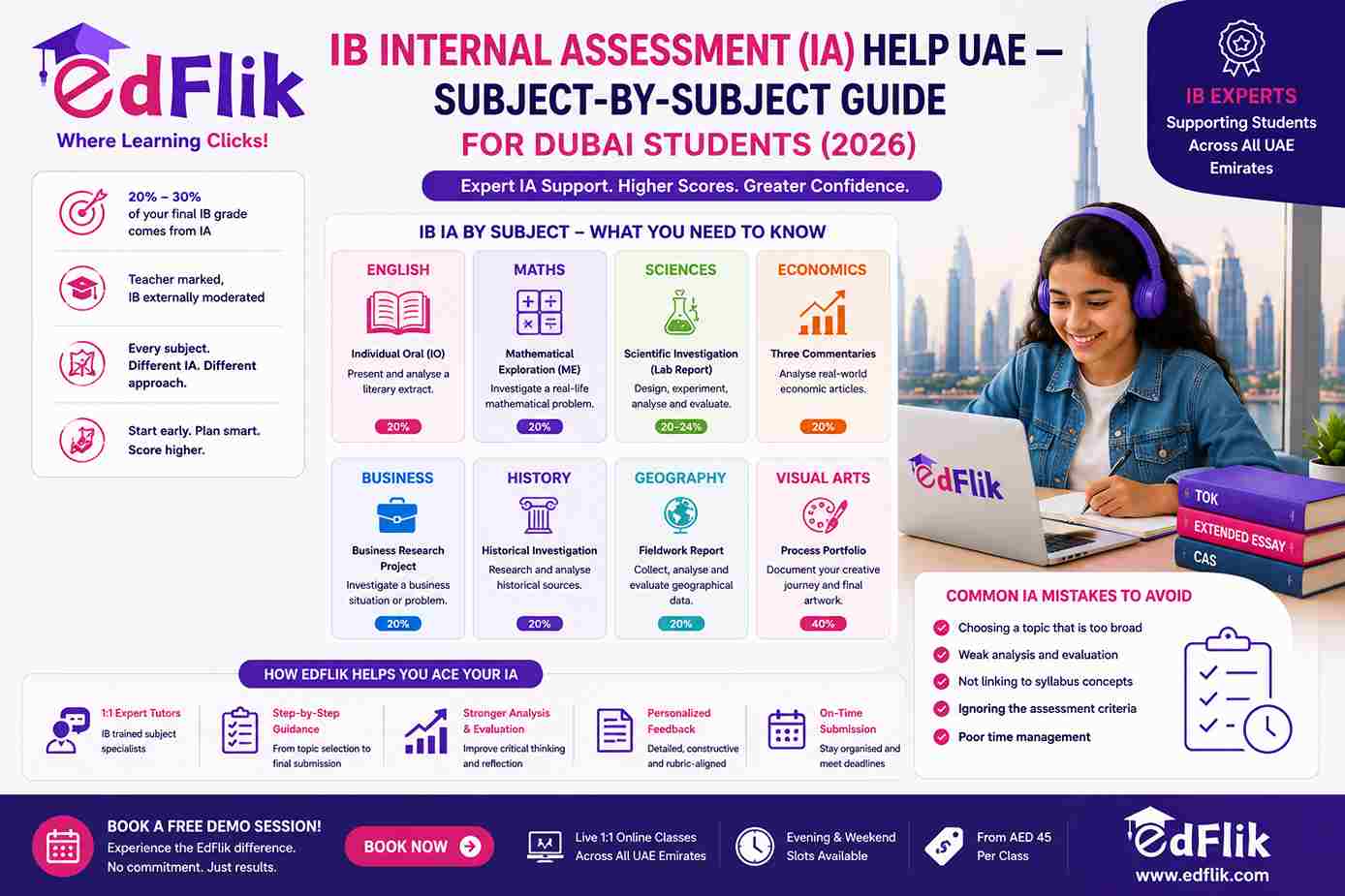
The IB Internal Assessment is one of the most consequential pieces of work a student produces during the IB Diploma Programme — and one of the most consistently mismanaged. Worth between 20% and 30% of each subject's final grade, the IA is not an afterthought or a minor coursework component. For a student targeting a 7 in IB Chemistry HL, the IA is worth up to 24 marks in a subject scored out of 45 at the final examination session. Done well, the IA becomes a reliable source of marks that reduces pressure on the final exams. Done poorly — or left too late — it can drag down an otherwise strong examination performance and cost a student the Diploma bonus points that TOK and EE contribute.
In the UAE, where IB students at schools including GEMS World Academy, Kings' School, Repton, and Raha International face the same global IB deadlines as students everywhere, the challenge is managing IA work across six demanding subjects simultaneously while maintaining exam preparation. This guide covers exactly how each subject's IA works, what examiners look for, the most common mistakes UAE students make, and how EdFlik tutors provide targeted, academically honest support.
Direct Answer — What Makes a High-Scoring IB IA?
A high-scoring IB IA demonstrates three things that examiners consistently reward: a precisely focused research question that is achievable within the format and word limit; genuine personal engagement with the topic — not a generic investigation that any student could have produced; and analytical depth that connects findings to subject theory, evaluates methodology honestly, and reflects on wider implications. The specific way these are demonstrated differs completely by subject.
IB IA Fundamentals — Key Facts Every UAE Student Must Know
• The IA contributes 20–30% of the final grade per subject, depending on the subject group.
• It is marked first by the student's own teacher, then externally moderated by IB examiners worldwide. Moderation can increase or decrease the teacher's marks.
• Academic Honesty applies fully. No tutor, parent, or peer may write any part of the IA. Support must be limited to guidance on approach, structure, and criteria — not content production.
• Every subject has different IA requirements, assessment criteria, word limits, and submission formats. There is no single IA 'template' that works across subjects.
• Exceeding the word or page limit is penalised — examiners stop reading at the stated limit, meaning work beyond it earns no marks.
IB IA by Subject — Detailed Breakdown
Mathematics Analysis & Approaches (AA) / Applications & Interpretation (AI)
The Maths IA is called the Mathematical Exploration: a written investigation of a mathematical topic chosen by the student. The expected length is 12–20 pages, excluding front matter and bibliography. There is no strict word count, but the page range implies thorough written explanation alongside mathematical working. The five assessment criteria are:
• Criterion A — Presentation (4 marks): Is the work well-organised, easy to follow, and appropriately formatted?
• Criterion B — Mathematical Communication (4 marks): Are mathematical symbols, notation, and diagrams used correctly and consistently?
• Criterion C — Personal Engagement (3 marks): Is there genuine personal interest in the topic? Does the student make it their own?
• Criterion D — Reflection (3 marks): Does the student critically evaluate their approach, acknowledge limitations, and discuss implications?
• Criterion E — Use of Mathematics (6 marks): Is the mathematics appropriate, accurate, and commensurate with the level of the course?
The most common topic selection errors among UAE students: choosing a topic so simple that Criterion E cannot be awarded full marks (e.g., a basic statistics investigation using only mean and standard deviation); choosing a topic so advanced that the student cannot explain it accurately (e.g., advanced university-level number theory without the prerequisite knowledge to communicate it clearly). The best Maths IAs explore a topic the student genuinely finds interesting, investigate an unexpected relationship or result, and demonstrate mathematics at IB Diploma level — not below it and not above it.
Recommended topic approach: think of a real-world phenomenon that involves patterns or relationships, then ask 'how can I model or investigate this mathematically?' Topics from physics, music, architecture, sport, or economics often produce strong IAs when the student has genuine prior interest.
Biology, Chemistry, and Physics
Science IAs are scientific investigations: students design, conduct (or sometimes simulate or use secondary data), analyse, and evaluate an experiment. Expected length: 6–12 pages. The five criteria are:
• Personal Engagement (2 marks): Is there genuine interest? Does the student take intellectual ownership?
• Exploration (6 marks): Is the background clearly established? Is the research question focused? Is the methodology justified and controlled?
• Analysis (6 marks): Is the data presented clearly? Is statistical analysis appropriate and accurately applied? Are results discussed in relation to the hypothesis?
• Evaluation (6 marks): Are conclusions valid? Are limitations of the methodology identified honestly and with specificity? Are genuinely useful improvements suggested?
• Communication (4 marks): Is the report well-structured? Are diagrams, graphs, and tables correctly formatted? Is scientific language used accurately?
UAE students frequently lose marks in Exploration by failing to clearly justify variable control and apparatus selection, in Analysis by using only descriptive statistics without error analysis, and in Evaluation by listing generic limitations ('human error') rather than specific, quantified ones ('the ±0.01 g balance uncertainty introduced a 2.3% error in concentration calculations').
UAE-relevant Biology IA topics include enzyme kinetics (catalase and hydrogen peroxide), osmosis in potatoes or beetroot, germination rates and pH, and heart rate responses to exercise. Chemistry IAs frequently investigate reaction kinetics (temperature and concentration effects on rate), electrochemical cells, and water quality analysis. Physics IAs often explore pendulum mechanics, projectile motion, or the relationship between angle and range.
Economics
The Economics IA is a portfolio of three individual commentaries, each analysing a different real-world news or media article using economic theory. Key specifications:
• Total word limit: 2,250 words — maximum 750 words per commentary.
• Each commentary must address a different section of the IB Economics syllabus: Microeconomics, Macroeconomics, International Economics, or the Economics of Development.
• Diagrams must be drawn correctly and fully labelled, and must be the student's own work — not copied from the article.
• Effective evaluation must include genuine analysis of limitations, alternative perspectives, or economic trade-offs — not a simple summary of the article.
UAE students most commonly lose marks by: spending too many words summarising the article and not enough on economic analysis; drawing diagrams without referencing them in the written commentary; and failing to achieve two-sided analysis (identifying multiple perspectives) within the tight word limit.
Article selection matters. The strongest commentaries use specific, recent articles from quality outlets (BBC, Financial Times, The Economist, Gulf News Business) with concrete data that can be used in analysis. Vague opinion pieces without data make economic analysis difficult within the word limit.
English Language and Literature / Literature (Group 1)
For both Group 1 English subjects, the IA is an Individual Oral (IO): a 15-minute oral assessment in which the student analyses a literary work and one non-literary text through the lens of a global issue. The IO is recorded, internally marked by the teacher (10 marks), and externally moderated. The breakdown is:
• 10 minutes of prepared analysis: the student presents structured commentary on both texts through the chosen global issue.
• 5 minutes of teacher-led discussion: the teacher asks questions to probe the student's understanding.
IB English IO marks are frequently moderated downward in moderation because students make broad, unsupported claims about both texts rather than anchoring analysis in specific, textual evidence with precise quotation and commentary. The highest-scoring IOs are precise, quotation-anchored, and genuinely personal — the student's own reading of the texts, not a summary of existing criticism.
History
The History IA is an Historical Investigation of 2,200 words examining a focused historical question using primary and secondary sources. Assessment has three sections:
• Section A (500 words): Identification and Evaluation of Sources — two primary or secondary sources are introduced and evaluated for their origin, purpose, value, and limitation.
• Section B (1,300 words): Investigation — a structured analytical essay investigating the research question using a range of evidence.
• Section C (400 words): Reflection — consideration of how the methods used by historians to investigate the past affected the inquiry.
UAE IB History students often choose topics related to Gulf political history, British mandate history in the Middle East, the Suez Crisis, or 20th-century global conflicts. The most common error is writing a narrative essay in Section B rather than a focused analytical investigation — a history IA must argue a claim and use evidence to support it, not simply recount events
IB IA Timeline for UAE Students
|
Timing |
Action
Required |
|
Sep–Oct (Grade 11) |
Begin exploring IA topics. Discuss ideas with teachers. Start
Maths IA topic selection and personal engagement angle. |
|
Nov–Dec (Grade 11) |
Confirm Maths IA topic; begin writing exploration. Science:
finalise research question and design methodology. Econ: identify first
article and draft Commentary 1. |
|
Jan–Feb (Grade 11) |
Maths IA first draft to teacher. Science: conduct experiment,
collect and process data. History: complete Section A source evaluation
draft. |
|
Mar–Apr (Grade 11) |
Submit Maths IA draft for teacher feedback and revise. Science IA
draft complete; submit for teacher feedback. Econ: draft Commentaries 2 and
3. English: conduct IO practice sessions. |
|
May–Aug (Grade 11–12 break) |
Refine all IA drafts based on teacher feedback. Do not submit
final versions yet. |
|
Sep–Oct (Grade 12) |
Finalise and submit all IAs for teacher marking. This is the IB
submission window for most UAE schools. |
|
Nov (Grade 12) |
IB selects samples for external moderation. No further changes
possible after teacher submission. |
Frequently Asked Questions — IB IA Help UAE
Q: What is the IB Internal Assessment and how much does it count?
A: The IB Internal Assessment (IA) is a coursework component embedded in every IB Diploma subject, contributing 20–30% of the final subject grade. It is marked internally by the teacher and moderated externally by IB examiners. Each subject has a different format: Maths uses a written Mathematical Exploration (12–20 pages), Sciences require a Scientific Investigation, Economics requires a three-commentary portfolio (750 words each), and English Group 1 subjects require a recorded Individual Oral. The IA is a significant academic undertaking that runs across both years of the Diploma.
Q: What are the most common IB IA mistakes UAE students make?
A: The most frequent errors across subjects: choosing a topic too broad for the word/page limit; failing to connect results to syllabus theory; writing a generic Evaluation without specific, quantified methodology limitations; exceeding the word limit (examiners stop at the limit); low Personal Engagement that feels mass-produced rather than genuinely individual; leaving IA drafts until Grade 12 when teacher feedback time is limited. In Maths, the most common error is using mathematics below IB Diploma level. In Sciences, inadequate statistical analysis is the leading mark-loser in the Analysis criterion.
Q: When should UAE IB students start the Internal Assessment?
A: IB students in UAE should begin IA planning at the start of Grade 11 (September/October). Maths IA first drafts should be with the teacher by March of Grade 11. Science IAs need experiment completion by February/March of Grade 11. Economics commentaries should be drafted progressively through Grade 11 and early Grade 12. All IAs are typically submitted to the school in September/October of Grade 12 for teacher marking before IB moderation. Starting early allows time for genuine revision based on teacher feedback — the single most effective way to improve IA scores.
Q: Can a tutor write the IB IA for a student?
A: No. IB Academic Honesty policy strictly prohibits anyone other than the student from producing IA content. Any tutor who offers to write, ghost-write, or substantially paraphrase IA content on behalf of a student is facilitating academic malpractice, which IB investigates and penalises with Diploma withdrawal. EdFlik tutors follow IB academic integrity guidelines fully. We guide research question selection, criteria understanding, methodology planning, draft feedback, and analytical depth — but all written content is the student's own work.
Q: How long does the IB Maths IA need to be?
A: The IB Maths IA (Mathematical Exploration) should be 12–20 pages in length excluding cover page, table of contents, and bibliography. There is no official word count target. The page range implies thorough written explanation alongside mathematical working. The IA is assessed against five criteria totalling 20 marks, contributing approximately 20% of the final Maths grade. Exceeding 20 pages does not earn extra marks and can negatively affect the Presentation criterion score.
Q: How does EdFlik support IB IA students in UAE?
A: EdFlik IB tutors guide students through every legitimate stage of the IA: research question selection and narrowing, criteria unpacking so students understand exactly what each mark requires, methodology planning for Science IAs, source selection and evaluation for History and Economics, draft review and feedback to identify where marks are being lost, and timeline management. All support is within IB Academic Integrity guidelines. Sessions are live 1:1 online, available evening and weekend slots across all UAE emirates. From AED 45 per class.
How EdFlik Supports IB IA Students in UAE
EdFlik provides structured IA guidance for IB Diploma students across all seven UAE emirates. Our IB tutors are matched by subject and year level — a Maths AA IA specialist has different expertise from a Chemistry IA tutor, and we maintain these distinctions carefully.
For each student, we build a session plan around their specific IA, the criteria for their subject, and their school's submission deadline. Students who start IA tutoring in September of Grade 11 consistently produce stronger work than those who begin in Grade 12, simply because the most impactful teacher feedback comes when there is time to genuinely revise.
Sessions from AED 45 per class. Free trial available. Book at www.edflik.com.
You May Also Like To Read:-