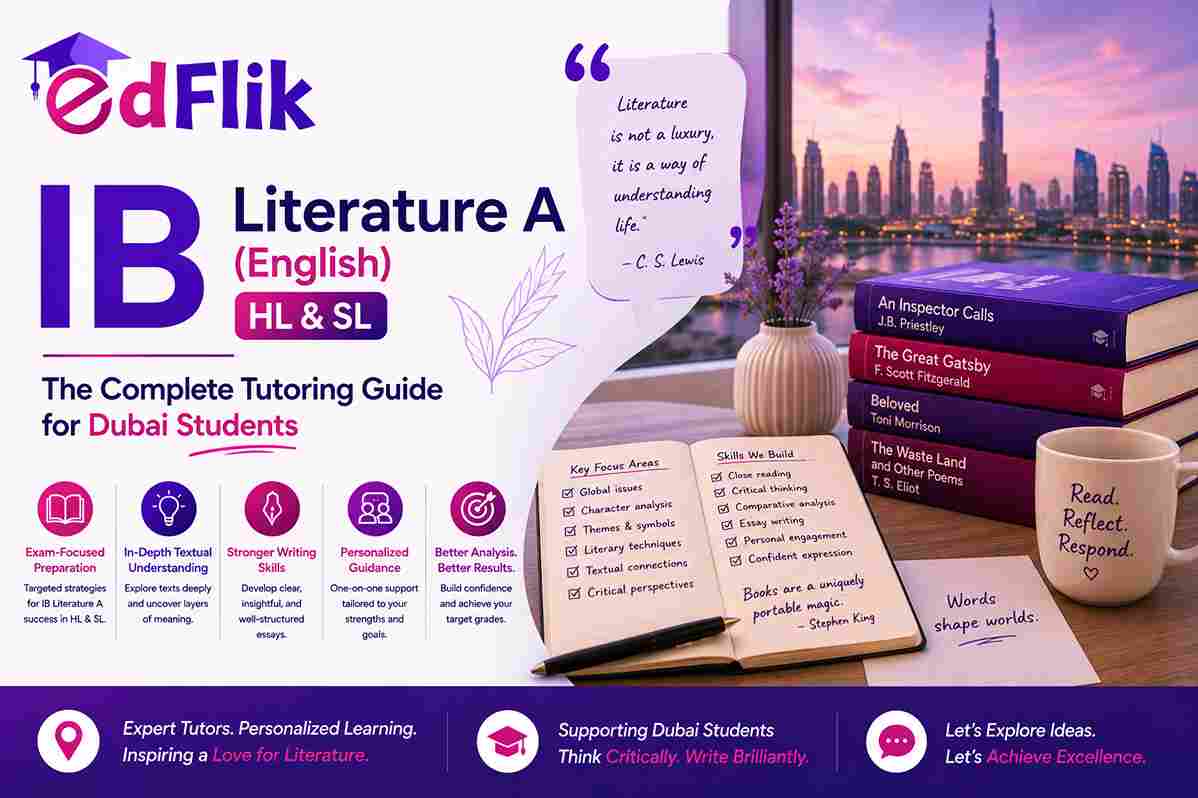
IB Literature A (English) HL & SL: The Complete Tutoring Guide for Dubai Students
The Challenge: Why IB Literature Intimidates Even Strong Readers
Your child reads voraciously. They love novels and understand characters deeply. Then IB Literature starts and they're lost.
Why? Because IB Literature isn't about *loving* books — it's about *analyzing* them using specific literary techniques and structured essay formats. The IB asks:
· How does the author use symbolism to explore themes?
· Analyze the significance of this passage.
· Compare how two texts treat the concept of power.
Strong readers often feel paralyzed because they've never been taught the *system* for textual analysis. They can say "I liked this passage" but can't explain *why* in exam-standard language.
**EdFlik's IB Literature tutors teach the system** — the close reading techniques, the essay structures, the vocabulary of literary analysis that separates 5s from 7s.
What Makes an Effective IB Literature Tutor
1. Close Reading & Textual Analysis Expertise
IB Literature is built on close reading — the ability to extract meaning from specific words, phrases, and structures in a text.
A good tutor teaches students to:
· **Identify literary techniques** — metaphor, simile, alliteration, assonance, personification, oxymoron, paradox, irony, etc.
· **Analyze their effect** — *how* does a metaphor change the reader's understanding? *Why* did the author choose this word instead of a synonym?
· **Connect technique to theme** — how does the technique support the overall meaning of the text?
· **Support claims with evidence** — every argument backed by specific textual reference
By exam day, your child can look at an unfamiliar passage and identify 3–4 techniques and their effects within minutes.
2. Comparative Analysis Across Texts
Paper 2 (HL & SL) requires comparing two texts (books, poems, plays from the IB's recommended list). This isn't just listing similarities and differences — it's exploring *how* the texts treat a common theme differently.
A good tutor teaches:
· **How to develop a comparative thesis** — not "both books explore identity" (too vague), but "while Text A presents identity as fluid and socially constructed, Text B portrays it as fixed and internally determined"
· **How to structure comparisons** — comparing by topic (both texts treat identity in paragraph 1, both treat power in paragraph 2, etc.) vs. comparing by text (Text A's treatment in paragraph 1, Text B's treatment in paragraph 2, comparison in paragraph 3)
· **How to balance comparison** — ensuring equal analysis of both texts, not 70/30 imbalance
· **How to use specific textual evidence** — quotations and scenes that illuminate the comparison
By exam day, your child has written 8–10 comparative essays and feels comfortable with the format.
3. Essay Structure and IB Rubric Mastery
IB essays are graded on:
· **Knowledge and comprehension** — understanding the texts accurately
· **Interpretation and analysis** — explaining textual meaning and technique
· **Evaluation** — making judgments about literary quality and significance
· **Focus and organization** — staying on topic and structuring ideas logically
· **Style** — using sophisticated vocabulary and varied sentence structure
Many students have ideas but can't structure them to hit all these criteria. A tutor who teaches the rubric explicitly wins.
Book Your Free Trial Now
Master IB Literature Analysis.
Book a free trial class with an IB Literature specialist. WhatsApp **+91 88788 96600** or www.edflik.com
Most students see essay clarity improve within 3–4 weeks.
5 Tutoring Mistakes Dubai Parents Make (And How to Avoid Them)
Mistake 1: Treating Literature Study as Pure Reading
Parent assigns the novel and hopes their child reads carefully. Mistake. IB Literature requires active annotation, technique identification, and structured note-taking. A tutor teaches the *method*.
Mistake 2: Over-Relying on SparkNotes or Cliff Notes
Some students use study guides instead of reading the actual text. Then exam questions ask about specific passages and they're lost. IB Literature demands knowing the texts intimately.
Mistake 3: Confusing HL and SL Requirements
HL students analyze 4 individual texts + 1 non-English text. SL students analyze 3 texts. The analysis depth differs too. Ensure your tutor specializes in your child's level.
Mistake 4: Skipping Comparative Essays Until Late
Comparative analysis is hard. Leaving it until March means only 2–3 comparative essays before the exam. Start comparative practice in January.
Mistake 5: Not Focusing on Unseen Texts (Paper 1)
Paper 1 asks students to analyze a poem or passage they've never seen before. Many students panic because they've only practiced analysis on texts they've studied all year. Tutors should include unseen text practice.
Why EdFlik IB Literature Tutors Get Results
Certified Literature Teachers
Our tutors have taught IB Literature for 5+ years. They know the IB's recommended text list. They've marked hundreds of student essays and know exactly what examiners are looking for.
Close Reading Framework
We teach a systematic approach to analyzing any passage:
1. Identify literary techniques (list all techniques visible)
2. Analyze each technique's effect (what does it make the reader think or feel?)
3. Connect to broader themes (how does this moment illuminate the overall meaning?)
4. Use precise vocabulary (avoid vague descriptions like "sad" — use "melancholic," "sorrowful," "despondent")
By exam day, students can apply this framework to any unfamiliar text.
Comparative Essay Structure
We teach students to write comparative essays using a proven structure:
· Introduction: thesis comparing the two texts' treatment of a theme
· Body paragraphs: alternating between texts or comparing topic-by-topic
· Conclusion: synthesizing the comparison and evaluating significance
· Throughout: specific textual evidence
By exam day, students have written 8–10 comparative essays and feel confident.
Paper 1 Unseen Text Practice
We do monthly unseen text practice (poems and passages students have never seen). By exam day, analyzing an unfamiliar text feels manageable, not terrifying.
Monthly Progress Tracking & Essay Feedback
Every month, students submit an essay. Tutors provide feedback using the IB rubric, showing which criteria are strong and which need work. This targeted feedback drives improvement.
IB Literature A (English) Curriculum
Individual Texts (4 for HL, 3 for SL):
· Typically 1–2 novels, 1 play, 1 collection of poetry (or equivalent)
· From the IB's recommended list or approved alternatives
Paper 1 — Unseen Text Analysis (1 hour):
· Analyze a poem or prose passage you've never seen before
· Identify techniques and explore their effects
Paper 2 — Comparative Essay (1.5 hours):
· Compare two studied texts (books, plays, poems) on a theme
Paper 3 — Individual Oral (HL) or Oral Presentation (SL):
· Discuss a passage from a studied text with guidance from the teacher
· Recorded presentation graded by external examiners
IA — Individual Investigation Essay (1,200–1,500 words):
· Analyze a passage from a studied text in depth
· Demonstrate critical thinking and close reading
How It Works: 6 Steps to Literature Mastery
Step 1: Contact EdFlik
WhatsApp +91 88788 96600 or www.edflik.com. Tell us you're doing IB Literature (HL or SL) and which texts you're studying.
Step 2: Tutor Matching
Within 24 hours, we match an IB Literature specialist familiar with your specific texts.
Step 3: Free Trial
Your child attends 1–2 free classes to judge the tutor's teaching style and expertise.
Step 4: Structured Text Analysis
2 sessions per week (2–3 hours total). Early focus on close reading and technique identification. Later focus on essay structure and practice.
Step 5: Comparative & Unseen Text Practice (January–March)
Monthly essay submissions with tutor feedback. Monthly unseen text practice. Oral presentation coaching (HL).
Step 6: Final Essay Refinement & Exam Readiness
April–May focuses on last-minute essay refinement and IA support.
What Students Say
*"Close reading seemed vague until my tutor showed me the technique-effect-meaning framework. Then every passage made sense."*
— Aisha Al-Mansouri, Dubai
*"I used to write vague essays. My tutor's comparative structure made it clear how to organize my ideas."*
— Hassan Al-Mazrouei, Sharjah
*"Unseen text analysis scared me until my tutor did monthly practice. By the exam, I felt ready."*
— Priya Nair, Ajman
FAQs:-
Q: How much tutoring is needed?
A: 2 sessions per week (2–3 hours total) is standard for maintaining engagement with texts and essay writing.
Q: Should I hire a tutor before or after reading the first text?
A: After reading the first text (so the tutor can assess your child's current analysis level). But before finishing all texts (so tutoring can guide understanding of later texts).
Q: What if my child is taking non-English Literature (e.g. in French or Spanish)?
A: EdFlik tutors specialize in English Literature primarily. For other languages, we can refer specialist tutors. WhatsApp for more info.
Q: How long does it take to improve essay grades?
A: With consistent tutoring and monthly essay feedback, students typically see improvement within 4–6 weeks.
Q: What's the cost?
A: Starting at 45 AED per hour. Most families invest 180–270 AED per week.
Q: Can my child score a 7 on the exam?
A: With consistent tutoring from the start of the course and strong effort, a 7 is achievable. Grades depend on starting point and dedication.