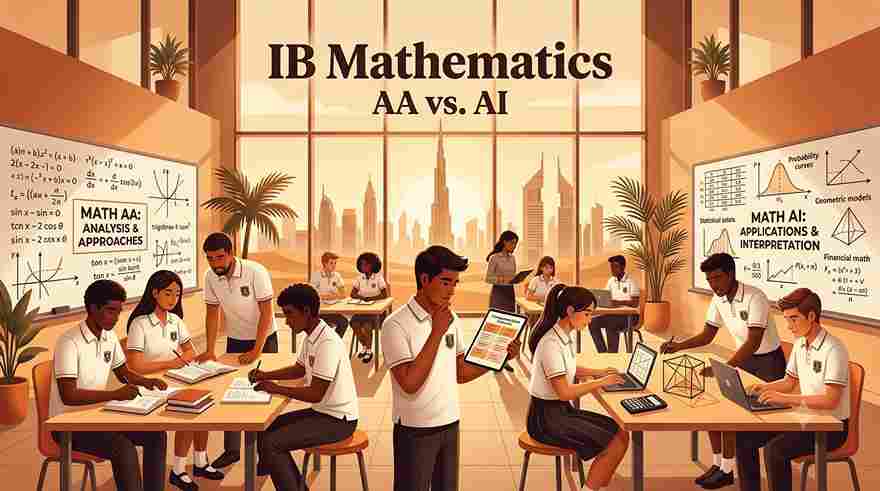
IB Mathematics AA vs AI: Which Course Fits Your University Plans in the UAE?
By EdFlik Team | November 2, 2026
For students entering the International Baccalaureate (IB) Diploma Programme across private international schools in Dubai, Abu Dhabi, Sharjah, and the Northern Emirates, selecting the right IB Mathematics pathway is one of the most critical academic decisions of DP1 (Year 12).
Under the IB curriculum structure, mathematics is divided into two distinct subjects, each offered at Standard Level (SL) and Higher Level (HL):
- Mathematics: Analysis and Approaches (AA)
- Mathematics: Applications and Interpretation (AI)
Choosing between AA SL, AA HL, AI SL, and AI HL is not simply a matter of picking what sounds interesting or choosing the "easiest" option. Global university admissions offices—including UK Russell Group universities (UCAS), US Ivy League colleges, European institutions, and top UAE universities—have strict, non-negotiable prerequisite requirements for specific degree paths. Selecting the wrong math course can inadvertently disqualify a student from competitive programs in Engineering, Medicine, Computer Science, Economics, or Business.
This masterclass guide breaks down the core differences between IB Math AA and AI, maps each course to specific degree prerequisites, provides a 4-step decision framework, exposes top selection traps, and includes 100% copy-paste JSON-LD schema markup.
Part 1: Core Course Philosophy & Content Comparison
While both courses develop logical reasoning and mathematical problem-solving skills, they cater to fundamentally different mathematical mindsets and applications:
                  THE TWO IB MATHEMATICS PATHWAYS
                                 |
  +------------------------------+------------------------------+
  |                                                             |
1. ANALYSIS AND APPROACHES (AA)                              2. APPLICATIONS AND INTERPRETATION (AI)
• Focus: Abstract reasoning, calculus, proofs,               • Focus: Practical modeling, statistics, financial math,
  algebraic manipulation, and continuous math.                 matrices, and technology-driven problem solving.
• Orientation: Theoretical & Rigorous                        • Orientation: Applied & Contextual
Breakdown of Course Differences
| Course Metric | Mathematics: Analysis & Approaches (AA) | Mathematics: Applications & Interpretation (AI) |
| Primary Focus | Classical, pure mathematics, algebraic rigor, and deep calculus. | Applied mathematics, statistics, data modeling, and practical applications. |
| Technology Use (GDC) | Technology is used, but non-calculator algebraic fluency is heavily tested (Paper 1 is Non-Calc). | Heavy reliance on the Graphic Display Calculator (GDC) across all papers. |
| Key Topic Strands | Advanced calculus, complex numbers, proof by induction, vectors, algebraic manipulation. | Voronoi diagrams, network analysis, financial math, Chi-squared tests, probability distributions, matrices. |
| Ideal Mindset | Students who enjoy theoretical abstraction, algebraic proofs, and pure mathematics. | Students who prefer contextual real-world data analysis, visual statistics, and computer-assisted modeling. |
Part 2: Degree Prerequisite Mapping for Universities
Global universities evaluate IB Math pathways based on the mathematical demands of their academic disciplines. Below is a breakdown of how top admissions offices view each option:
                      DEGREE PREREQUISITE MATRIX
                                   |
  +--------------------------------+--------------------------------+
  |                                |                                |
1. STEM, ENGINEERING & PHYSICS           2. COMPUTER SCIENCE & AI
  • **AA HL (Mandatory)**          • **AA HL (Preferred)** or **AI HL (Check Uni)**
  • AA SL / AI HL (Rare exceptions) • AA SL / AI SL (Insufficient for top tiers)
  +--------------------------------+--------------------------------+
  |                                |                                |
3. MEDICINE & LIFE SCIENCES              4. ECONOMICS, FINANCE & BUSINESS
  • **AA SL** or **AI SL** (Usually sufficient)• **AA HL** / **AI HL** (Top UK Unis like LSE/Warwick)
  • Chemistry/Biology HL are primary focus • **AA SL** / **AI SL** (Standard Business/Management)
1. Engineering, Physics & Physical Sciences
- Required Level: AA HL (Mandatory at top universities).
- Why: Engineering degrees at institutions like Imperial College London, Cambridge, University of Manchester, or Khalifa University in the UAE require high-level calculus, 3D vectors, and differential equations—topics covered extensively in AA HL.
- Admissions Status: AI HL is rarely accepted for Engineering at top UK/US institutions; AA SL and AI SL are universally insufficient.
2. Computer Science, Artificial Intelligence & Data Science
- Required Level: AA HL (Preferred) or AI HL.
- Why: Computer science relies on discrete mathematics, abstract algebra, linear algebra (matrices), and statistics. While AA HL is favored for its rigorous calculus and logic proofs, some universities accept AI HL due to its coverage of matrices and graph theory.
- Admissions Status: Always check individual university entry criteria. Top-tier Computer Science programs generally mandate AA HL.
3. Economics, Business, Finance & Accounting
- Required Level: AA HL or AI HL (for Quantitative Economics); AA SL or AI HL (for General Business/Finance).
- Why: University Economics has become increasingly quantitative. Elite institutions (e.g., LSE, UCL, Oxford, Warwick) require AA HL or AI HL. However, general Business Administration, Marketing, and Management programs usually accept AA SL or AI SL.
4. Medicine, Dentistry, Nursing & Life Sciences
- Required Level: AA SL or AI SL (alongside HL Chemistry and HL Biology).
- Why: Medical admissions prioritize Higher Level Chemistry and Biology. Math requirements are typically satisfied by either AA SL or AI SL, provided the student meets the overall diploma score threshold (typically 38+ points for UK medicine).
5. Law, Humanities, Psychology & Creative Arts
- Required Level: AI SL or AA SL.
- Why: Non-quantitative degrees focus primarily on critical writing, research, and analysis. AI SL provides a solid grounding in statistics and data analysis, which is particularly beneficial for Psychology and Social Sciences.
Part 3: The 4-Step Course Selection Framework
To ensure your IB Math selection aligns perfectly with your post-16 goals, follow this 4-step decision protocol:
                 THE 4-STEP DECISION FRAMEWORK
                                   |
  Step 1: Identify Career Track ---> Determine if your target degree is STEM/Quantitative or Non-Quantitative.
  Step 2: Check University Portals--> Search UCAS, Common App, and regional uni entry requirements.
  Step 3: Evaluate Past Math Performance---> Review Grade 9/10 (IGCSE/MYP) math marks and teacher feedback.
  Step 4: Balance Diploma Points---> Ensure your HL choices don't jeopardize your overall 45-point potential.
- Identify Your Career & Degree Path: Determine whether your intended major is quantitative (Engineering, Computer Science, Economics) or non-quantitative (Law, Design, Media).
- Audit Target University Entry Requirements: Search entry requirements for target universities in your destination countries (UK, US, Canada, UAE). Pay close attention to wording like "IB Math AA HL required" versus "Any IB Math at SL accepted".
- Review Your Key Stage 4 / MYP Baseline:
- Students transitioning from IGCSE Extended Mathematics or Additional Mathematics with Grade 7–9 ($A/A^*$) are strong candidates for AA HL.
- Students with Grade 4–6 ($C/B$) in IGCSE Core/Extended Math should carefully consider AA SL or AI SL.
- Balance Your Diploma Point Strategy: An IB Diploma score out of 45 depends on overall consistency. If taking AA HL risks pulling your grade down to a 3 or 4, but your target degree only requires AA SL, taking the SL option allows you to allocate more study time to your other Higher Level subjects.
Part 4: Top 4 Selection Traps That Cost UAE Students Offers
- Assuming AI SL is an "Easy Option" for STEM Majors: Choosing AI SL because it sounds easier, only to realize in DP2 that target engineering or computer science programs strictly require AA HL.
- Confusing AI HL with AI SL: Assuming that because AI SL is applied, AI HL is also non-rigorous. AI HL is a demanding, fast-paced course that includes advanced calculus, differential equations, and complex statistical modeling.
- Ignoring UK UCAS Course-Specific Requirements: Assuming all UK universities treat AA and AI equally. While US universities evaluate math contextually within the high school transcript, UK universities enforce rigid, non-negotiable course prerequisites.
- Selecting Math Without Consulting Your Counselor: Finalizing IB subject selections without reviewing your school’s historical student performance data and university destination trends.
For expert 1-on-1 tutoring support to master IB Mathematics (AA SL/HL or AI SL/HL), refine your Internal Assessment (IA), navigate past-paper mark schemes, and secure top grade bands, book a class on EdFlik.
Frequently Asked Questions (FAQs)
Q1: Is IB Math AA harder than IB Math AI?
Ans: Neither course is universally "harder"—they test different skill sets. AA HL is generally considered more abstract and algebraically rigorous due to its emphasis on non-calculator proofs and pure calculus. AI HL is equally challenging for many students because of its fast-paced coverage of advanced statistics, financial modeling, and complex GDC operations.
Q2: Do US universities care whether I take IB Math AA or AI?
Ans: US universities review applications holistically. For competitive STEM majors (Engineering, Physics, CS), US admissions officers look for the most rigorous math available at your school, which is typically AA HL. For non-STEM majors, taking AA SL or AI SL and achieving a high grade (Grade 6 or 7) is completely acceptable.
Q3: Can a student swap between AA and AI during DP1?
Ans: Most UAE IB World Schools permit course swaps during the first 4 to 6 weeks of Term 1 in DP1, provided timetable space exists. Swapping later in the year is strongly discouraged due to cumulative content gaps and distinct Internal Assessment (IA) requirements.
More on University Admissions
- University Admissions from the UAE: A Guide to UK, US and UAE Applications
- University Options UAE 2026 — Dubai & Abu Dhabi for IGCSE, A-Level & IB Students
- IB Diploma Points Guide UAE 2026 — How Scoring Works and University Thresholds
- IB Diploma Programme UAE — A Parent's Complete Guide to Subjects, Workload and University Entry (2026)
- All University Admissions articles