
IB Mathematics AI Tutor UAE — Applications and Interpretation HL & SL Guide (2026)
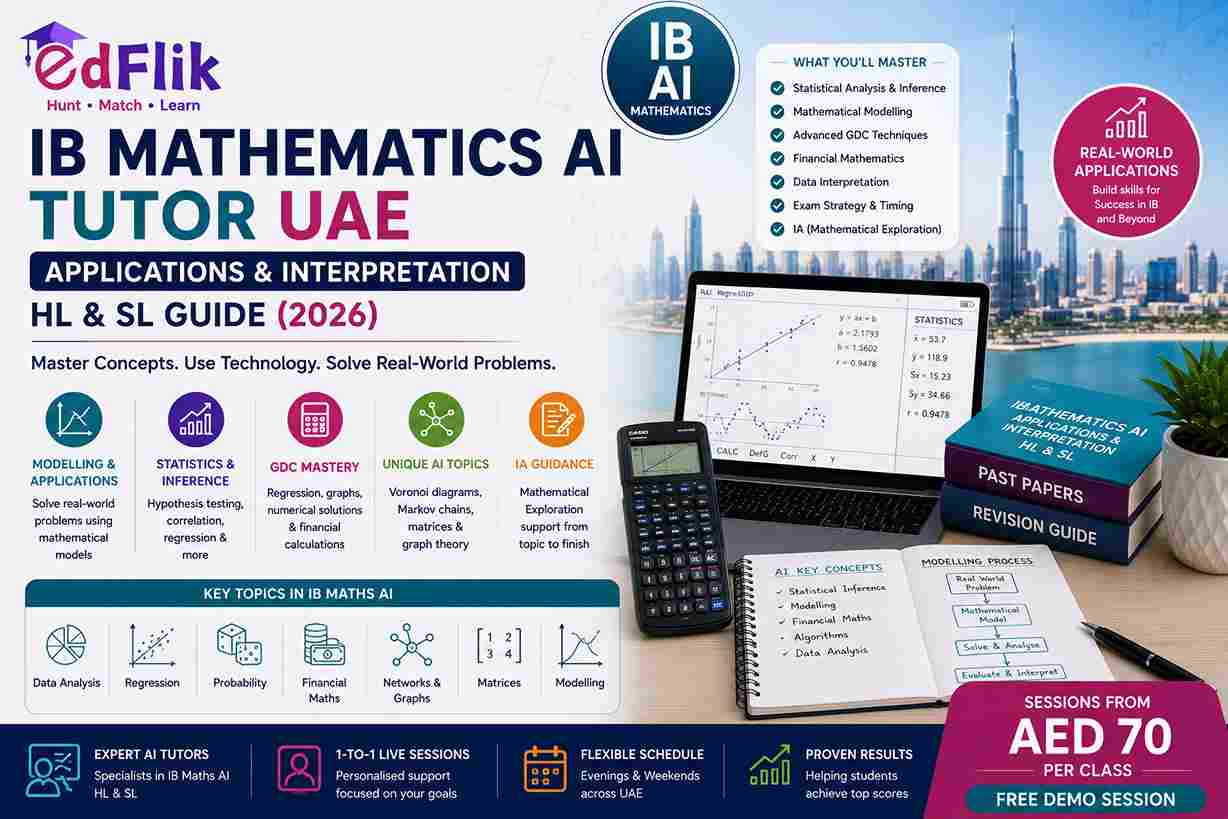
IB Mathematics Applications and Interpretation (AI) is the second IB Maths course — distinct from Analysis and Approaches (AA) in both content and philosophy. While AA emphasises abstract proof and calculus, AI focuses on mathematical modelling, real-world applications, statistical analysis, and technology-assisted problem-solving. In the UAE, AI is offered at many IB schools including GEMS World Academy, GEMS Dubai American Academy, Dubai International Academy, and others — and it creates specific tutoring needs that are meaningfully different from AA tutoring.
This guide covers what makes AI distinct from AA, the topics unique to the AI syllabus, GDC skills required, and the IA approach appropriate for AI students.
IB Maths AI vs AA — Which Should UAE Students Choose?
|
Factor |
IB Maths AI
(Applications and Interpretation) |
IB Maths AA
(Analysis and Approaches) |
|
Core emphasis |
Mathematical modelling; real-world applications; statistics |
Abstract reasoning; proof; calculus depth |
|
GDC use |
Permitted throughout all non-Paper 1 exams |
Permitted in Papers 2 and 3 (HL only) |
|
Statistics content |
Extensive — regression, hypothesis testing, Spearman's rank |
Limited — descriptive and normal distribution |
|
Calculus content |
Basic integration and differentiation (SL); some HL extension |
Core focus — derivatives, integrals, differential equations |
|
Unique AI topics |
Voronoi diagrams; transition matrices; financial maths depth |
Complex numbers; formal proof; vectors in 3D |
|
University recognition |
Accepted for social sciences, business, biology, psychology |
Required or preferred for maths, physics, engineering, CS |
|
Best for |
Social scientists; business; biology; economics students |
Mathematicians; physicists; engineers; computer scientists |
IB Maths AI HL — Topics UAE Students Find Most Challenging
Voronoi Diagrams
Voronoi diagrams are a unique AI topic with no equivalent in AA or IGCSE. A Voronoi diagram divides a plane into regions based on proximity to a set of given points — every location in a region is closer to that region's point than to any other. Applications include finding the nearest hospital, coverage areas for mobile towers, and market catchment areas. The IB examines: constructing Voronoi diagrams by perpendicular bisectors; identifying nearest points; and the toxic waste problem (maximising minimum distance from all waste sites).
Transition Matrices and Markov Chains
A transition matrix models the probability of moving between states over time. IB AI HL extends this to Markov chains — sequences of events where the probability of each event depends only on the current state. UAE students typically find the matrix multiplication straightforward but struggle with: interpreting what a steady-state (equilibrium) distribution means physically; setting up transition matrices from word-based probability problems; and using GDC matrix powers efficiently.
Statistical Inference — t-tests and Chi-Squared
AI HL and SL both require hypothesis testing using t-tests (comparing means) and chi-squared tests (testing for association or goodness of fit). The process: state null and alternative hypotheses; calculate the test statistic using GDC; compare to critical value or interpret p-value; state conclusion in context. UAE students most commonly err by: not stating hypotheses formally before testing; using the wrong test (t-test vs chi-squared); and not stating the conclusion in the context of the original problem.
Mathematical Modelling with Functions
AI students must fit mathematical models to real-world data — selecting the appropriate function type (linear, quadratic, exponential, logarithmic, sinusoidal, logistic) and using GDC regression to find parameters. Understanding which model is appropriate for which real-world situation is tested in both Paper 2 and the Mathematical Exploration IA. A logistic model suits population growth with a carrying capacity; an exponential model suits compound interest or bacterial growth; a sinusoidal model suits temperature variation or tidal patterns.
GDC Efficiency — The AI Student's Core Tool
Unlike AA, where GDC use is restricted in Paper 1, IB Maths AI is designed to be attempted with GDC support in Papers 2 and 3. A student who cannot use their GDC efficiently will be slow and error-prone even on questions where the mathematical concept is understood. EdFlik AI tutors build GDC fluency as a core session component, covering: regression (STAT menu on TI-84 or equivalent); matrix multiplication and powers; hypothesis testing functions; financial mathematics (TVM solver); numerical integration; and graphical equation solving.
Frequently Asked Questions — IB Maths AI Tutor UAE
Q: What is the difference between IB Maths AI and AA?
A: AI focuses on real-world modelling, statistics, and technology use. AA focuses on abstract reasoning, proof, and calculus depth. AI suits social science, business, biology, and economics students. AA is preferred or required for mathematics, physics, engineering, and computer science at university. Both are available at HL and SL. Key difference: AI allows GDC throughout; AA restricts GDC use in Paper 1.
Q: What topics are unique to IB Maths AI?
A: Voronoi diagrams; transition matrices and Markov chains; graph theory (adjacency matrices); extensive financial mathematics (compound interest, depreciation, loans, annuities); statistical inference (t-tests, chi-squared, Spearman's rank); and mathematical modelling with exponential, logarithmic, logistic, and sinusoidal functions. These topics require AI-specific teaching — AA tutors are not trained on these.
Q: What GDC skills do IB Maths AI students need?
A: Regression analysis (linear, quadratic, exponential, logarithmic, sinusoidal); summary statistics; hypothesis testing (t-test, chi-squared); equation solving graphically; numerical integration; financial calculations (TVM solver). AI papers are designed with GDC support — students who use GDC inefficiently lose time and marks throughout Papers 2 and 3.
Q: How does the AI IA differ from the AA IA?
A: Both are Mathematical Explorations assessed against the same five criteria. The key difference: AI students should use statistical analysis, regression, modelling, and mathematical tools appropriate to the AI course for Criterion E (Use of Mathematics). Calculus-based IAs from AI students are assessed on appropriateness — AI-appropriate mathematics is expected.
Q: Does EdFlik provide IB Maths AI tutoring in UAE?
A: Yes. AI-specific tutors matched to HL or SL — not AA tutors teaching AI. Sessions cover Voronoi diagrams, transition matrices, statistical inference, mathematical modelling, and GDC technique. From AED 70 per class. Free demo at www.edflik.com.
How EdFlik Supports IB Maths AI Students Across UAE
EdFlik IB Maths AI tutors are matched specifically to the AI course at HL or SL — distinct from AA tutors. Sessions from AED 70. Free demo. Book at www.edflik.com.