
IB Maths AA HL Tutor UAE — Analysis and Approaches Higher Level Guide (2026)
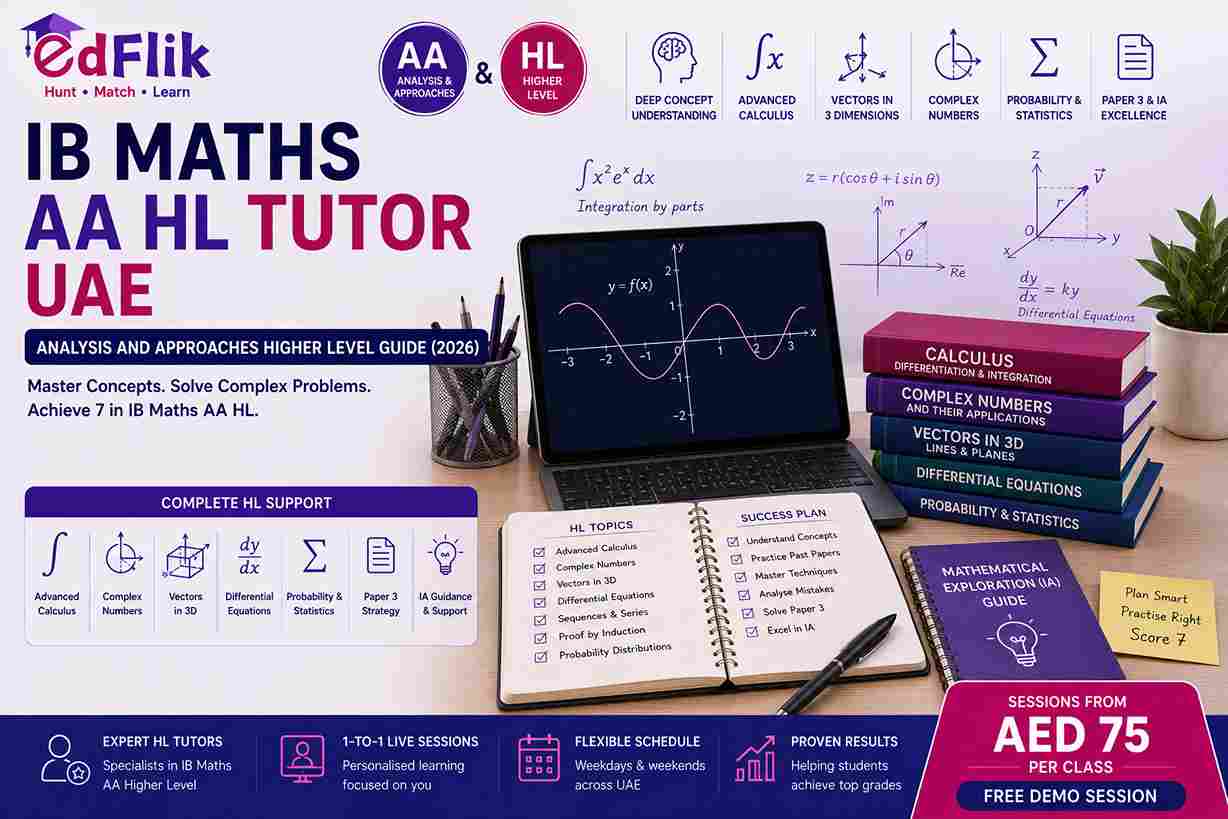
IB Mathematics Analysis and Approaches Higher Level is consistently the most requested and most challenging IB tutoring subject in the UAE. At Dubai schools including GEMS World Academy, GEMS Wellington, Dubai International Academy, NLCS Dubai, Repton Dubai, and Nord Anglia, IB AA HL is a prerequisite or strong recommendation for university courses in Mathematics, Physics, Engineering, Computer Science, and Economics. The content reaches early university level, and the combination of its difficulty with the Diploma's other demands creates consistent tutoring demand among the UAE's highest-achieving IB students.
IB Maths AA HL — Assessment Structure
|
Paper |
Duration |
Marks |
Calculator |
Content Focus |
|
Paper 1 |
2 hrs |
110 |
No calculator |
Algebra, functions, geometry, calculus, proof — no technology
support |
|
Paper 2 |
2 hrs |
110 |
GDC permitted |
Same topics — technology-assisted questions; numerical methods |
|
Paper 3 |
1 hr |
55 |
GDC permitted |
Extended problem-solving; exploration of mathematical ideas;
multi-topic linking |
|
IA — Mathematical Exploration |
n/a |
20% of grade |
n/a |
12 to 20 pages; 5 criteria; HL-level mathematics required |
The HL-Only Content — What Separates HL from SL
IB Maths AA HL contains substantial additional content beyond SL. These HL-specific topics are the most commonly requested tutoring areas from UAE IB families:
Complex Numbers (HL Extension)
HL students must master complex numbers in three forms: Cartesian (a + bi); polar (r(cos θ + i sin θ)); and Euler form (re^{iθ}). Operations include: multiplication and division in polar form; De Moivre's theorem (raising complex numbers to powers); finding nth roots of complex numbers geometrically; and the fundamental theorem of algebra (every polynomial has roots in the complex number field). The most common UAE HL student error: forgetting to include all n roots when finding nth roots — a 3rd root always has 3 solutions, evenly spaced at 2π/3 intervals on the Argand diagram.
Differential Equations (HL Extension)
HL students must solve: first-order separable differential equations (separate variables, integrate both sides); first-order differential equations using an integrating factor; and second-order differential equations with constant coefficients (auxiliary equation method; complementary function + particular integral). Second-order differential equations are the topic most frequently cited as the single most challenging HL topic by UAE tutors and students. The auxiliary equation method — m² + pm + q = 0 and the three cases (real distinct roots, repeated roots, complex conjugate roots) — requires systematic practice over at least 4 to 6 weeks to become reliable under timed exam conditions.
Vectors in 3D
HL extends vector work to three dimensions. Key requirements: write vector equations of lines in 3D (r = a + λb form); find the equation of a plane (normal vector form and Cartesian form); find the intersection of two lines (or determine they are skew); find the angle between two planes; and find the distance from a point to a plane. UAE HL students typically have strong 2D vector knowledge from SL but struggle with the additional spatial reasoning demands of 3D geometry.
Proof by Induction
HL students must prove mathematical statements using proof by induction with rigorous formal language. The structure: (1) prove the base case (usually n = 1); (2) assume true for n = k (the inductive hypothesis); (3) prove true for n = k + 1 using the assumption; (4) conclude using formal language ('By the principle of mathematical induction, the statement is true for all positive integers n'). The most common error: stating the inductive step without clearly using the assumption that the statement is true for n = k — the 'assuming' step must be explicitly used in the algebraic manipulation.
Paper 3 Strategy — The HL Problem-Solving Paper
Paper 3 consists of two extended problems, each exploring a mathematical concept in depth. Unlike Papers 1 and 2 where students recognise question types from practice, Paper 3 regularly introduces mathematical ideas that look unfamiliar at first. The strategy:
1. Read the entire problem first — Paper 3 questions provide scaffolding through part (a), (b), (c), etc. Later parts build on earlier ones. Understanding where the problem is going helps interpret early parts correctly.
2. Part (a) is usually approachable — designed to establish the foundational idea. Even if you are unsure of later parts, always attempt part (a).
3. Use results from earlier parts — Paper 3 is designed so that each part's answer leads to the next. If your part (b) answer looks very different from what you expected based on part (a), review your working.
4. Show all working — Paper 3 marks include method marks. Partial credit is available even if the final answer is wrong.
5. Practise all available Paper 3 past papers — they are the best training for the thinking style required.
Frequently Asked Questions — IB Maths AA HL Tutor UAE
Q: Why is IB Maths AA HL considered the hardest IB subject?
A: It covers first-year university level mathematics: advanced calculus (integration by parts, differential equations), complex numbers (polar, Euler, De Moivre's theorem), vectors in 3D, formal proof by induction, and probability distributions — all simultaneously across six IB subjects plus IA and EE. The breadth and depth together make it uniquely demanding.
Q: What HL topics do UAE students find hardest?
A: Integration techniques (by parts, substitution for complex integrands); second-order differential equations (auxiliary equation, three cases); complex numbers (polar and Euler forms, De Moivre's theorem, nth roots); vectors in 3D (line and plane equations, intersection, distance); proof by induction (formal language in every step); and Paper 3 extended problem-solving strategy.
Q: What is Paper 3 in IB Maths AA HL?
A: A 60-minute, 55-mark HL-only paper with two extended problem-solving questions exploring mathematical concepts in depth. Questions often link multiple topic areas and may present unfamiliar mathematical ideas. Paper 3 rewards mathematical intuition and flexible thinking. Strategy: read the whole problem first; attempt part (a) always; use earlier parts' results in later parts; show all working.
Q: What should an IB Maths AA HL IA be about?
A: The exploration must demonstrate HL-level mathematics for Criterion E. For AA HL, this means calculus, proof, complex numbers, vector geometry, or other HL-specific content. Strong UAE HL IA topics: projectile motion modelling with differential equations; nth derivative patterns of trigonometric functions; Fourier series exploration; generalised sequence theorem proofs.
Q: Does EdFlik provide IB Maths AA HL tutoring in UAE?
A: Yes. AA HL-specific tutors — not SL tutors extended into HL. Sessions cover complex numbers, differential equations, vectors in 3D, proof by induction, Paper 3 strategy, and IA guidance. From AED 75 per class. Free demo at www.edflik.com.
How EdFlik Supports IB Maths AA HL Students Across UAE
EdFlik IB Maths AA HL tutors are matched to HL specifically and hold HL-level subject expertise. Sessions from AED 75. Free demo. Book at www.edflik.com.