IB MYP Personal Project UAE 2026 — How to Score 7/7
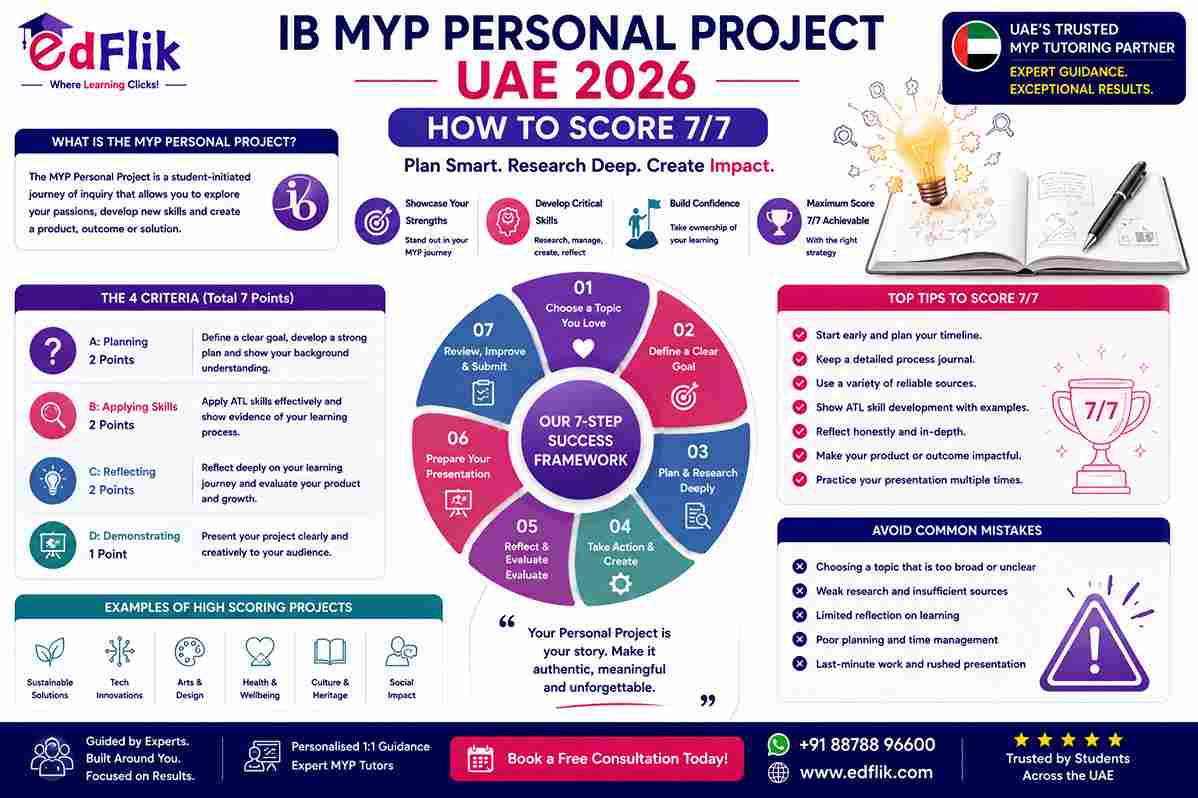
The IB MYP Personal Project is the most significant independent work a Grade 10 student will complete in their school career. Externally moderated by the IB, assessed on five criteria, and worth the equivalent of one subject grade on the MYP Certificate, it rewards students who begin early, choose their topic carefully, and understand what each criterion actually asks for. This guide explains all five criteria, the most common scoring mistakes at UAE MYP schools, and the month-by-month timeline that produces the strongest reports.
What the IB MYP Personal Project Is
The Personal Project is an independent, self-directed project in which every Grade 10 IB MYP student creates a product or outcome based on a personal interest and documents the process in a structured report. It is not a school assignment — it is an independent project supervised by a school mentor, moderated externally by the IB, and assessed against published criteria.
The project has two physical components:
• The product or outcome — something the student actually creates, makes, codes, composes, performs, writes, or builds
• The report — approximately 1,500–3,500 words documenting the research, planning, process, and reflection across all five criteria
The 5 Assessment Criteria — What Examiners Actually Reward
|
Criterion |
Marks |
What Gets 7–8
Marks |
Common
Mistake |
|
A:
Investigating |
8 |
Specific
research question; synthesis of multiple sources; clear connection to prior
knowledge and Global Context |
Vague research
question ("I want to make a video") with no measurable goal or
connection to learning |
|
B: Planning |
8 |
Detailed
step-by-step plan with timeline; specific success criteria that can be
evaluated; justification of ATL skill focus |
Generic plan
with no dates; success criteria that cannot be evaluated ("I will make a
good product") |
|
C: Taking
Action |
8 |
Product
demonstrably meets the success criteria; thoughtful self-evaluation of what
worked and what changed during the process |
Product is
described but not evaluated against success criteria; no evidence of
problem-solving during the process |
|
D: Reflecting |
4 |
Specific
reflection on ATL skill development; evidence of how the project changed the
student's thinking or abilities |
Generic
reflection ("I learned to manage my time") without specific
evidence or examples |
|
E:
Communicating |
4 |
Clear
structure, accurate language, correct academic referencing; report is focused
and within recommended length |
Report is
unfocused, over-length, or uses informal language; referencing is
inconsistent or absent |
Choosing the Right Topic — The Decision That Determines Everything
The most important Personal Project decision is the topic — because it determines the quality of Criterion A (research), the realism of Criterion B (planning), and the richness of Criterion C (the product). Students who choose vague or overly ambitious topics produce weak projects regardless of how hard they work.
Strong Topic Characteristics
• Specific product — not "a film about climate change" but "a 3-minute short documentary about water scarcity in Sharjah, UAE, using three interviews and original data"
• Personal connection — IB examiners assess Criterion A for genuine personal engagement; the topic should genuinely interest the student, not their parents
• Achievable in one academic year — mobile app for 12 school months: feasible; full-stack website with 500 users: not feasible
• Connected to a Global Context — the six MYP Global Contexts are the IB's framework for connecting personal work to wider meaning
Strong Example Topics from UAE MYP Schools
• Designing and coding a study-time tracker app for IB students (Scientific and Technical Innovation)
• Writing and illustrating a bilingual Arabic-English children's storybook about UAE heritage (Personal and Cultural Expression)
• Composing and recording a 4-track EP drawing on Arabic musical scales (Personal and Cultural Expression)
• Building and testing a solar-powered prototype for a school garden irrigation system (Globalization and Sustainability)
The Process Journal — What It Is and How Much Is Enough
The process journal is a running record of the student's decisions, challenges, and reflections throughout the project. It is not assessed directly — but it provides evidence for all five criteria in the report. Examiners look for evidence that the process journal was used genuinely throughout, not written in one sitting at the end.
What a good process journal entry looks like:
• Date and specific project activity ("Week 4 — interviewed my supervisor about changing the app interface design")
• What decision was made and why ("I decided to use a simpler colour scheme because user feedback showed the original was confusing")
• Reflection on what this means for the plan ("This pushed the coding phase back by one week — I updated my Gantt chart")
How much is enough: 10–15 substantive entries over the project timeline. More is not better — examiners value quality of reflection over quantity of entries.
Month-by-Month UAE Timeline — September to April
|
Month |
Milestone |
What to
Complete |
|
September |
Project launch |
Choose topic
area; identify Global Context; discuss with supervisor |
|
October |
Topic approval |
Submit formal
topic proposal; begin Criterion A research from at least 3 sources |
|
November |
Research
complete |
Finalise
research question; complete Criterion A section of report; begin detailed
planning (Gantt chart, success criteria) |
|
December |
Criterion B
due |
Complete
Criterion B (planning section); begin creating the product |
|
January |
Mid-project
check |
Supervisor
meeting; product at 50% completion; process journal entries documenting
decisions |
|
February |
Product
complete |
Finish the
product or outcome; begin Criterion C report section; complete Criterion D
reflection |
|
March |
First report
draft |
Full draft of
all 5 criteria submitted to supervisor for feedback |
|
April |
Final
submission |
Revised report
submitted; product presented or exhibited; supervisor signs off |
|
EdFlik
provides IB MYP Personal Project guidance across all UAE emirates — topic
selection, criterion-by-criterion report feedback, process journal coaching,
and product planning. From AED 65 per session. Book at www.edflik.com or
WhatsApp +91 88788 96600. |
Frequently Asked Questions
Q: What is the IB MYP Personal Project?
An independent project completed by all Grade 10 MYP students — creating a product or outcome based on personal interest, documented in a 1,500–3,500 word report assessed on five criteria totalling 32 marks, externally moderated by the IB.
Q: How is the IB MYP Personal Project assessed?
Five criteria: A Investigating (8 marks), B Planning (8 marks), C Taking Action (8 marks), D Reflecting (4 marks), E Communicating (4 marks). Total 32 marks.
Q: When does the Personal Project start in UAE schools?
September of Year 10 at most UAE IB MYP schools. Topic approval October–November. Report submission February–April. Starting topic research before September significantly improves Criterion A quality.
Q: What is a good Personal Project topic?
Specific, genuinely interesting to the student, achievable in one year, connected to an IB Global Context, and producing a clear evaluable product. Examples: app development, bilingual storybook, musical composition, engineering prototype.
Q: How long should the Personal Project report be?
1,500–3,500 words recommended by IB. Over 3,500 words does not earn more marks and may indicate unfocused writing in Criterion E.