IB Theory of Knowledge (TOK) — How to Score Well in UAE (2026 Student Guide)
Theory of Knowledge is the IB Diploma component that confuses students the most — and surprises them the most when they discover how much it matters. Worth up to 3 bonus points toward the IB total score of 45, TOK can be the difference between a 38 and a 41, between receiving the Diploma and not, and between a borderline university offer and a confirmed one. Yet in Dubai, Abu Dhabi, and Sharjah, many IB students treat TOK as an administrative requirement to be managed rather than an intellectual opportunity to be seized.
This guide is written for IB students and parents in UAE who want a clear, honest understanding of what TOK actually requires, how the 2026 assessment works, what the difference is between a Grade A and a Grade D response, and how to build the habits that produce strong TOK work from the start of Grade 11.
Direct Answer — What Is the Quickest Route to a Strong TOK Score?
Build a bank of specific, personal, genuinely interesting real-world examples from your own IB subjects and life experiences from the very start of Grade 11. When the TOK Essay titles are released in September of Grade 12, the student who already has ten specific, well-understood examples to draw from will write a substantially stronger essay than the student who begins searching for examples after seeing the title. The TOK score is determined almost entirely by the quality of thinking, not by breadth of knowledge — and genuine thinking is only possible when examples are truly understood.
What Is IB Theory of Knowledge? A Plain-Language Explanation
Theory of Knowledge is a core component of the IB Diploma Programme that runs alongside all six DP subjects through Grades 11 and 12. It is not a subject in the traditional sense — there is no fixed syllabus of content to memorise. Instead, TOK asks students to step back from their subjects and reflect on a fundamental question: how do we know what we claim to know?
This question is the engine of TOK. In IB History, you learn what happened. In TOK History, you ask: how do we know what happened? What counts as historical evidence? Who decides which sources are reliable? How does the position of the historian affect what history is produced? These are not rhetorical questions — they are genuine epistemological inquiries that IB examiners assess for depth, precision, and genuine personal engagement.
The five Areas of Knowledge (AOK) in the 2026 framework are: History; Human Sciences (Economics, Psychology, Anthropology); Natural Sciences (Biology, Chemistry, Physics); Mathematics; and The Arts.
The core themes explored in TOK include: Knowledge and Language; Knowledge and Technology; Knowledge and Politics; Knowledge and Religion; and Knowledge and Indigenous Societies. Students are not required to address all themes but should demonstrate familiarity with at least two or three in their Exhibition and Essay work.
TOK Assessment 2026 — The Two Components Explained
Component 1: TOK Exhibition (Internal Assessment — Grade 11)
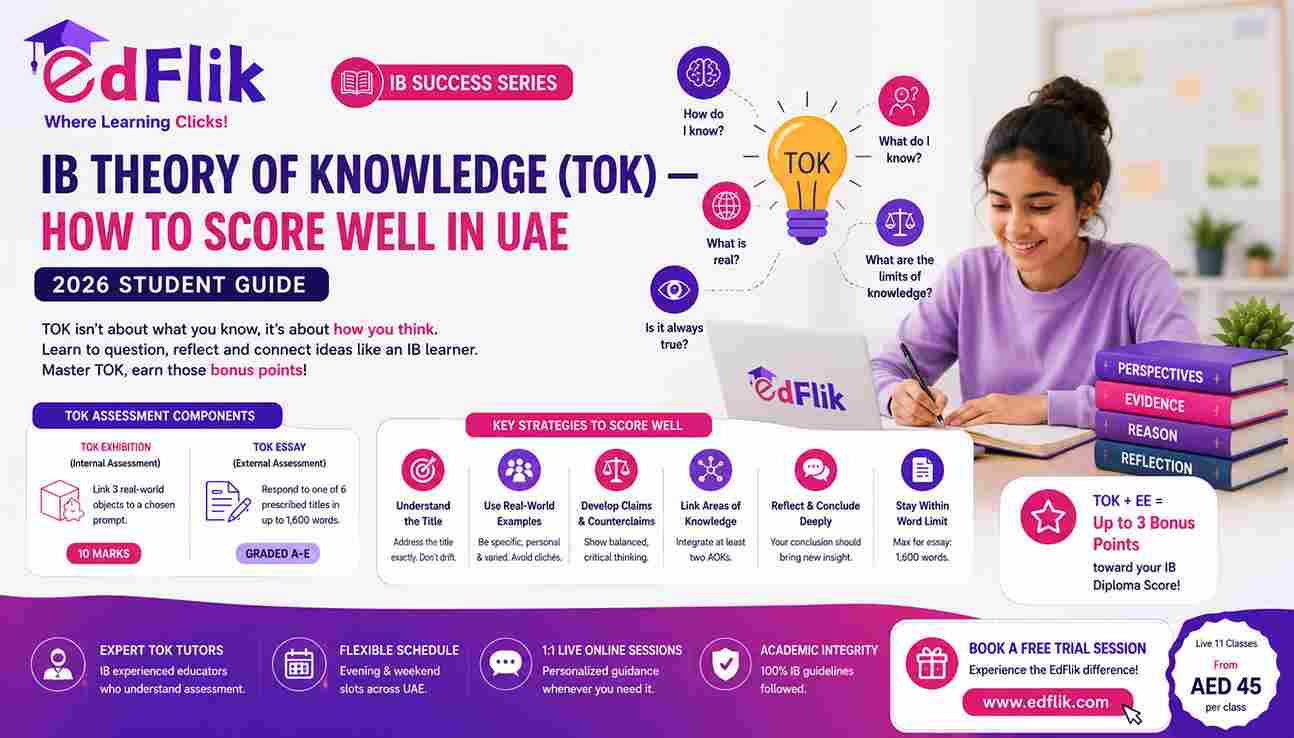
The TOK Exhibition asks students to select three objects from the real world and connect all three to a single IA prompt chosen from IB's published list of 35 prompts. The Exhibition demonstrates how TOK concepts manifest in real-world contexts.
Key specifications:
• Commentary per object: maximum 950 words (markers stop reading at the limit).
• All three objects must be genuine, real, and identifiable — photographs, artefacts, artworks, documents, data sets, events.
• The connection between each object and the prompt must be argued specifically, not described generally.
• The three objects must represent three distinct TOK-relevant connections to the same prompt — not three versions of the same connection.
• No bibliography or word count for images/captions — only the written commentary counts toward the word limit.
The Exhibition is internally marked by the student's TOK teacher against a rubric with three achievement bands and then sent to IB for external moderation. The maximum score is 10 marks.
Most UAE schools set the Exhibition deadline in March or April of Grade 11. Starting in September of Grade 11 and building the Exhibition progressively across two terms is strongly recommended. Many students leave it until January or February, which produces rushed, superficial connections that score poorly in moderation.
Component 2: TOK Essay (External Assessment — Grade 12)
The TOK Essay is a 1,600-word response to one of six prescribed titles published by IB in September of Grade 12. The essay is written under the guidance of a teacher (who may not edit or comment on drafts beyond confirming the student understands the assessment criteria) and submitted to IB in March of Grade 12. It is marked externally by IB examiners on an A to E scale, with A representing outstanding work and E representing the minimum standard required to avoid nullifying the TOK/EE bonus point combination.
Grade breakdown and marks: A = Excellent (9–10 marks); B = Good (7–8 marks); C = Satisfactory (5–6 marks); D = Basic (3–4 marks); E = Elementary (1–2 marks). A student who scores E in both TOK Essay and Extended Essay does not receive the IB Diploma regardless of their subject totals.
The TOK/EE bonus point matrix: EE A + TOK A = 3 points; EE A + TOK B = 3 points; EE B + TOK A = 3 points; EE B + TOK B = 3 points; EE C + TOK A = 2 points; EE C + TOK B = 2 points; EE C + TOK C = 2 points; EE D + TOK D = 1 point; and so on down to 0 points for combinations involving an E in either.
What Makes a Grade A TOK Essay — The Examiner's Perspective
Based on published IB examiner reports and the official TOK Assessment Rubric, Grade A essays consistently demonstrate:
1. Precise engagement with the prescribed title — every word of the title is addressed, and the essay does not drift into adjacent topics.
2. Genuine knowledge claims — the student articulates what is claimed to be known, not just what is known. The epistemological lens is present throughout.
3. Substantive counterclaims — not 'some would disagree' but a genuine alternative position, fully developed, that the essay must then address.
4. Specific, personal, varied real-world examples — examples that are concrete enough that another student could not have chosen them. The specificity signals genuine personal engagement rather than borrowed ideas.
5. Area of Knowledge integration — at least two AOKs are explored, and the essay investigates how the same knowledge question produces different answers depending on which AOK is applied.
6. A genuine concluding insight — not a summary of what was said, but a new thought or position generated by the essay's exploration.
What Grade A TOK Essays never do:
• Describe the topic rather than examining how it is known.
• Use the same example in multiple ways rather than bringing in fresh examples.
• Confuse TOK with general philosophy (TOK is not about what is true; it is about how we claim to know what is true).
• Exceed 1,600 words — examiners mark what they can read within the limit.
The Most Common TOK Mistakes UAE IB Students Make
Writing a Subject Essay Instead of a TOK Essay
The single most common failure mode in IB TOK is writing a well-structured, coherent essay that is entirely about a topic rather than about how knowledge of that topic is produced and justified. A student who writes about whether social media is beneficial or harmful has written a Social Studies essay, not a TOK essay. A student who writes about how social media has changed what counts as credible evidence for knowledge about public opinion — and who explores this through the Human Sciences and History AOKs — has written a TOK essay.
Using Generic Examples
IB examiners read thousands of TOK Essays every year. They are immediately familiar with the appearance of 'Einstein and the photoelectric effect', 'Darwin's theory of natural selection', and 'Picasso changed how we see art' as examples. These are not wrong choices — but they are not specific and personal, which is one of the two highest-scoring criteria. The most effective examples are personal: a moment in an IB Biology IA where the student's data contradicted the expected result; a passage from an IB History source that revealed how historian perspective shapes interpretation; a mathematical proof encountered in IB Maths that seemed obviously true but could not be proven within the axioms of the system.
Treating the Exhibition as an Afterthought
Because the Exhibition is internally marked and most UAE IB teachers are patient with deadlines, many students treat it as a minor box-ticking exercise. This is a strategic mistake. The Exhibition contributes 10 marks toward the TOK/EE bonus point matrix. A poorly executed Exhibition that scores 4/10 combined with a strong Essay that scores 8/10 produces the same bonus point result as different combinations — and a strong Exhibition creates the habit of specific, argued TOK thinking that makes the Grade 12 Essay substantially easier to produce.
TOK Timeline for UAE IB Students — Grade-by-Grade
|
Timing |
TOK Milestone |
|
Sep–Oct (Grade 11) |
Introduction to TOK concepts: Areas of Knowledge, knowledge
claims, counterclaims. Begin building a personal example bank from your own
IB subjects and life. |
|
Oct–Nov (Grade 11) |
Explore Exhibition prompts. Select one prompt and begin
identifying potential real-world objects with genuine personal relevance. |
|
Dec–Jan (Grade 11) |
Draft Exhibition commentaries for all three objects. Focus on
argued connections, not descriptions. Review against the assessment rubric. |
|
Feb–Mar (Grade 11) |
Revise Exhibition based on teacher feedback. Finalise and submit
by the school's deadline (typically March/April at most UAE IB schools). |
|
Sep (Grade 12) |
IB releases six prescribed Essay titles. Read all six carefully.
Choose the title for which you have the most specific, personal, genuinely
interesting examples — not the one that sounds easiest. |
|
Oct–Nov (Grade 12) |
Write TOK Essay plan and first draft. Focus on precision of
knowledge claim, specificity of examples, and genuine counterclaim
development. |
|
Dec–Jan (Grade 12) |
Revise Essay based on understanding of the marking rubric. Count
words carefully — stay at or below 1,600. |
|
Feb (Grade 12) |
Final review and submission preparation. Teacher confirms student
understands assessment criteria. Submit to school. |
|
March (Grade 12) |
School submits TOK Essay to IB. No further changes possible. |
Frequently Asked Questions — IB TOK Tutor UAE
Q: What is IB Theory of Knowledge (TOK) and how is it assessed?
A: IB TOK is a core component of the IB Diploma running across Grades 11 and 12. It is assessed through a TOK Exhibition (10 marks, internally assessed, Grade 11) and a TOK Essay (graded A–E, externally marked, Grade 12). Together with the Extended Essay, TOK contributes up to 3 bonus points to the IB Diploma score. The Exhibition connects three real-world objects to a core prompt. The Essay is a 1,600-word response to one of six IB prescribed titles.
Q: How do you score an A in IB TOK?
A: Grade A TOK Essays address the prescribed title precisely; use specific, personal, varied real-world examples; develop genuine knowledge claims and substantive counterclaims; integrate at least two Areas of Knowledge; and produce a genuine concluding insight. The essay must stay within 1,600 words. Grade A responses feel genuinely authored — the student's own thinking is visible throughout, not borrowed ideas or generic observations.
Q: What are the most common TOK mistakes UAE IB students make?
A: The most common errors: treating TOK like a standard subject essay (arguing facts rather than examining knowledge claims); using generic examples (Einstein, Newton, Shakespeare) that appear in thousands of other essays; writing a descriptive Exhibition rather than arguing a specific connection to the chosen prompt; exceeding the 1,600-word Essay limit; and leaving the Grade 11 Exhibition until it is too late for meaningful revision.
Q: When should IB students in UAE start working on TOK?
A: From September of Grade 11. The Exhibition is typically due in March/April of Grade 11 at most UAE IB schools — leaving it until January or February produces rushed work. The Essay titles are released in September of Grade 12 with submission in March. Students who build their example bank and deepen their understanding of Areas of Knowledge progressively through Year 1 write substantially stronger Grade 12 Essays.
Q: What is the difference between the TOK Exhibition and the TOK Essay?
A: The Exhibition (Grade 11) is internally assessed: students connect three real-world objects to one IA prompt, writing up to 950 words per object. The Essay (Grade 12) is externally marked by IB: 1,600 words responding to one of six prescribed titles, graded A to E. Both contribute to the bonus point matrix alongside the Extended Essay. The Exhibition demonstrates TOK in the real world; the Essay develops an epistemological argument in response to a specific prescribed question.
Q: Can EdFlik provide IB TOK tutoring for UAE students?
A: Yes. EdFlik provides live 1:1 TOK tutoring for IB Diploma students across all UAE emirates. Tutors guide students through knowledge question development, claim and counterclaim structuring, real-world example selection, Exhibition object justification, and Essay draft review — all within IB academic integrity guidelines. Sessions from AED 45 per class. Free trial at www.edflik.com.
How EdFlik Supports IB TOK Students Across UAE
EdFlik TOK tutors are experienced IB educators who understand what IB examiners reward — and what they penalise. Sessions are structured around the student's current TOK task: Exhibition draft review, essay title analysis, example bank development, or essay structure planning.
All tutoring is within IB Academic Integrity Policy. Students produce all Exhibition and Essay content themselves. EdFlik tutors guide, challenge, and provide rubric-aligned feedback — they do not write for students.
Sessions from AED 45 per class. Free trial available. Book at www.edflik.com.
You May Also Like To Read:-