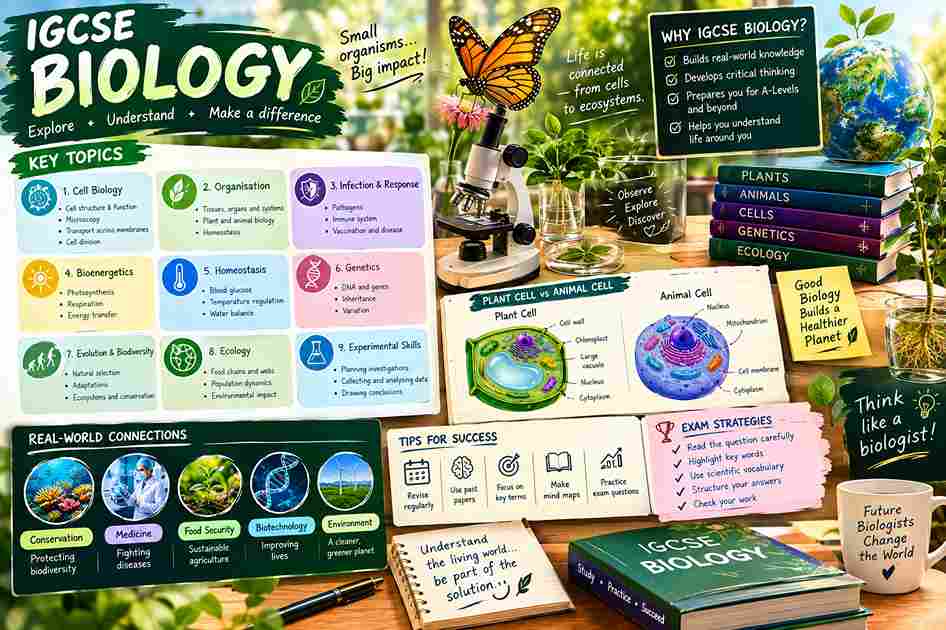
IGCSE Biology Tutor Online: Preparing for the Exam Papers

Biology is a subject that many students enjoy at first. There are fascinating topics, from cells and inheritance to ecosystems and the human body. Then the exam papers arrive, and the questions ask for more than memory. Students need to explain processes clearly, read the command words carefully and apply their knowledge to unfamiliar situations. This guide explains how an online IGCSE Biology tutor can help with exam preparation, and what UAE parents can look for when choosing one.
What IGCSE Biology exam papers usually test
Exam papers test several skills at once. Students must recall facts accurately, explain how biological systems work, interpret data from graphs or tables, and apply ideas to new contexts. Some questions are short and direct. Others are longer and ask the student to build an argument step by step.
Because the details of papers, timings and weightings can differ between exam boards and change over time, always check the current official syllabus or specification for your child's course. Your child's teacher can also show you sample questions and the mark schemes they use in class.
Command words: the small words that decide the marks
Many students lose marks not because they lack knowledge, but because they answer a different question from the one asked. Command words tell the student what kind of answer is needed. "Describe" asks for what happens. "Explain" asks for why it happens. "Compare" asks the student to point out similarities and differences. "Suggest" asks for a sensible idea that may not be in the textbook.
A tutor can help a student learn these words through practice. One useful method is to take a past question and ask the student to underline the command word, then write a short plan before answering. Over time, this habit becomes automatic, and answers become sharper.
Practicals and data questions
Practical skills are a regular feature of IGCSE Biology courses. Students may be asked to describe an experiment, identify variables, comment on the reliability of results or suggest improvements. They may also be given a table of data and asked to calculate a mean, draw a graph or spot a pattern.
These questions reward careful thinking rather than long memorised answers. A useful habit is to explain each step of an experiment aloud, as if to a friend. If the explanation feels muddled, the student usually needs to revisit the method. Ask your tutor to run through a practical question with you, and to show how they would structure a strong answer.
Building a revision routine
Biology revision works best when it is spread out. A short session several times a week beats one long session at the weekend, because the brain has more chances to recall and link ideas. A simple routine might look like this:
- One session to review notes on a topic and write a one-page summary
- One session to answer short questions and check them against the mark scheme
- One session to attempt a longer question under timed conditions
- A short weekly review of the topics that still feel shaky
Diagrams are another strong tool. Cells, the heart, the nervous system and food webs can all be sketched from memory, then checked against notes. Drawing forces a student to think about the structure, which helps them answer explanation questions later.
Building a strong written answer
Many Biology answers are marked on structure as well as content. For a question that asks for an explanation, a clear answer usually names the process, gives the cause and effect, and links the two with a precise scientific term. Students who write in short, connected sentences tend to earn more marks than those who list facts without explaining how they relate.
A useful exercise is to take one past question and write three versions of the answer. The first is a quick list of facts. The second adds the reasons behind each fact. The third links everything back to the question. Comparing the three shows your child how marks are earned, and why explanation matters as much as recall.
Keyword accuracy matters too. Words such as "diffusion", "osmosis", "active transport" or "natural selection" have precise meanings. Using them correctly, rather than describing the idea in everyday language, can make a real difference. Build a small glossary of key terms, and test your child on it each week by asking them to define each one in a single sentence.
Working through a past question together
When your child is stuck on a past question, resist the urge to give the answer straight away. Ask them to read the question twice, underline the command word and the topic, and say in their own words what the question is asking. Then ask them what they already know that is relevant. This small process often reveals whether the problem is a gap in knowledge or a misreading of the question.
If the gap is in knowledge, revisit the topic with a short diagram or summary, then try a similar question. If the problem is in the question itself, practise reading carefully and marking up the key words. Both approaches build confidence, and both are easier to manage in a short, focused session than in a long, frustrating one.
Making the most of a tutor
A good tutor does more than repeat the textbook. They listen to how the student explains an idea, spot misunderstandings and offer a different way in. For example, a student may memorise the stages of a process without understanding why each stage matters. A tutor can ask simple questions to uncover the gap, then rebuild the explanation step by step.
Ask whether the tutor teaches this course before you book, and ask which resources they use for past papers and mark schemes. You can also ask them to share feedback after each session, so you can see what has been covered and what needs more practice.
A practical checklist for parents
- Check the current official syllabus or specification for your child's course
- Look at recent past papers and the mark schemes together
- Make a list of command words and their meanings, and practise them weekly
- Set aside time for practicals, including how to describe and evaluate them
- Plan short, regular revision sessions rather than one long session
- Ask the tutor which resources they use and how they track progress
- Encourage your child to explain answers aloud, not just write them down
How EdFlik can help
EdFlik offers live, one-to-one online classes for students aged 3 to 18. Each class lasts about one hour, so there is time to work through a past question, practise a data response and review a tricky topic in depth. Classes start from AED 45 per class, and the first step is a free trial class, so you can see how a session feels before you commit.
If your child is preparing for IGCSE Biology, ask whether the tutor teaches this course before you book. Ask, too, which board or resources they use, so the sessions match what your child's school expects. To book a free trial class, visit www.edflik.com, or email support@edflik.com with your questions.
Conclusion
IGCSE Biology rewards clear thinking, careful reading of command words and steady revision. Build a routine with short sessions, use past papers and mark schemes, and practise practical questions as well as factual recall. A tutor can help your child spot gaps and build confidence, while your child does the work of learning. With the right habits in place, exam preparation becomes far less overwhelming.
Frequently Asked Questions
Will an online tutor know the exam board my child follows?
Ask the tutor directly whether they teach the specific course your child follows, as tutors differ in their experience and resources. Check the current official syllabus or specification for your child's course, and ask the tutor which resources they use for it.
How many sessions does IGCSE Biology usually need?
There is no fixed number. It depends on your child's starting point, how much revision they have done and how confident they feel. Many families begin with a free trial class, then decide on a plan based on what the tutor finds in the first sessions.
Does the exam include practical questions?
Practical skills are a common part of IGCSE Biology courses, including describing experiments and analysing data. Check the current official specification for your child's course to confirm how practical content is assessed, and ask the tutor how they cover it.
How do command words affect Biology answers?
Command words tell the student what kind of answer is expected, such as describing, explaining or comparing. Answering the question that was asked, using the right type of response, often earns marks that would otherwise be lost. Practising command words with past questions helps.
Is there a free trial before booking?
Yes. EdFlik offers a free trial class so you can see how the sessions work before you choose a plan. Visit www.edflik.com to book, or email support@edflik.com with any questions.