
IGCSE Chemistry Past Paper Technique UAE — How to Score A* in Cambridge 0620 (2026)
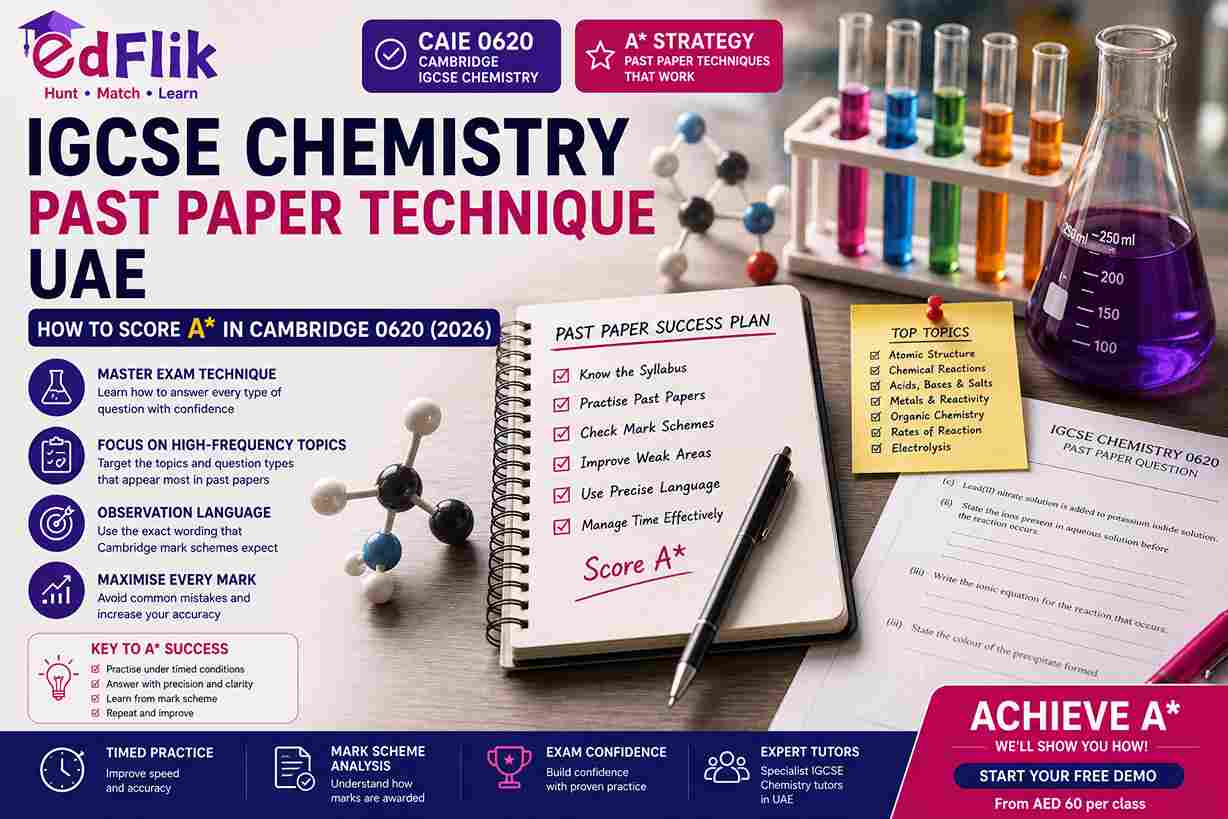
Past papers are the most effective IGCSE Chemistry preparation tool — but only when they are used correctly. UAE students who sit Cambridge IGCSE Chemistry 0620 and use past papers in a passive way (reading answers, checking if they were 'roughly right') see limited improvement. Students who use past papers actively — completing each question under timed conditions, marking against the official Cambridge mark scheme, and categorising every error by type — consistently improve by one to two grade boundaries within 8 to 10 weeks.
This guide covers the specific techniques that Cambridge 0620 rewards, the observation language that is essential for Chemistry questions, and how to build a past paper programme that systematically eliminates errors.
High-Frequency IGCSE Chemistry Topics — Where to Focus Past Paper Practice
|
Topic |
Mark
Proportion |
Key Technique
Requirement |
|
Chemical equations and formulae |
10 to 15% |
Balance equations; include state symbols; write ionic equations
correctly |
|
Acids, bases, and salts |
10 to 12% |
Salt preparation methods; neutralisation; reaction conditions |
|
Metals and reactivity series |
8 to 10% |
Reactivity order recall; displacement reactions; extraction
methods |
|
Organic chemistry |
12 to 15% |
Functional groups; identification tests; addition and
substitution reactions |
|
Electrolysis |
8 to 10% |
Identify products at anode and cathode; write half-equations |
|
Rates of reaction |
6 to 8% |
Collision theory language; factors affecting rate; practical
interpretation |
|
Identification tests |
8 to 10% |
Gas tests; ion precipitation tests; flame test colours — all from
memory |
|
Atomic structure and bonding |
8 to 10% |
Electron configuration; ionic and covalent bonding diagrams;
metallic bonding |
Observation Language — The Most Exact Chemistry Marking Requirement
Cambridge IGCSE Chemistry 0620 mark schemes are extraordinarily specific about observation language. Unlike Physics description answers where cause-effect chains earn marks, Chemistry observations must match the exact colour, form, and specificity that the mark scheme requires. The following list covers the most frequently tested observations:
|
Test |
What is
Observed |
Exact
Mark-Scheme Language |
|
Silver nitrate test for halides (Cl⁻) |
White precipitate forms |
A white precipitate forms (soluble in dilute ammonia) |
|
Silver nitrate test for halides (Br⁻) |
Cream precipitate forms |
A cream precipitate forms (partially soluble in dilute ammonia) |
|
Silver nitrate test for halides (I⁻) |
Yellow precipitate forms |
A yellow precipitate forms (insoluble in dilute ammonia) |
|
Bromine water + alkene |
Colour change |
Orange/brown bromine water becomes colourless |
|
Limewater + CO₂ |
Turbidity |
Limewater turns milky/cloudy |
|
Damp litmus paper + Cl₂ |
Bleaching |
Red and blue litmus paper turns white/bleaches |
|
Burning splint test + H₂ |
Squeaky pop |
Burns with a squeaky pop |
|
Glowing splint + O₂ |
Relights |
Glowing splint relights |
|
Flame test Na |
Yellow flame |
Yellow flame |
|
Flame test Cu |
Green flame |
Green/blue-green flame |
Learning these exact phrases by memory is not optional for IGCSE Chemistry A* performance — the mark scheme is not flexible about approximations. 'The solution goes cloudy' earns 0 marks where 'the limewater turns milky' earns full marks. 'It changes colour' earns 0 marks where 'the orange bromine water becomes colourless' earns full marks.
Organic Chemistry — The Topic with the Highest Mark Density
IGCSE Chemistry organic chemistry accounts for 12 to 15% of marks across both papers — the highest of any individual topic area. UAE students must know: homologous series (alkanes, alkenes, alcohols, carboxylic acids, esters); functional group identification tests (alkene — bromine water decolourisation; alcohol — acidified potassium dichromate turns orange to green; carboxylic acid — pH below 7; effervescence with carbonates); reaction types (addition across C=C double bond for alkenes; substitution reactions of alkanes); combustion products (complete — CO₂ and H₂O; incomplete — CO and H₂O or soot).
Frequently Asked Questions — IGCSE Chemistry Past Paper Technique UAE
Q: Which Cambridge IGCSE Chemistry topics appear most frequently?
A: Chemical equations and formulae (10–15%); organic chemistry (12–15%); identification tests (8–10%); acids, bases, and salts (10–12%); metals and reactivity (8–10%); electrolysis (8–10%); rates of reaction (6–8%). These account for 55–65% of all marks across 0620 papers. Past paper practice organised by topic area in this priority order is the most time-efficient A* preparation strategy.
Q: What observation language does IGCSE Chemistry require?
A: Mark schemes require exact colour, form, and specificity. 'A white precipitate forms' (not 'a solid forms'); 'orange bromine water becomes colourless' (not 'it changes colour'); 'limewater turns milky' (not 'it goes cloudy'). These exact phrases must be learned by memory — approximations earn zero marks in Chemistry observation questions.
Q: How should ionic equations be written in Cambridge 0620?
A: Write the full equation; identify ions in solution; write ions separately; cancel spectator ions; write net ionic equation with state symbols. Example: Pb²⁺(aq) + 2I⁻(aq) → PbI₂(s). State symbols are mandatory — omitting them loses the ionic equation mark.
Q: What is the best way to use past papers for IGCSE Chemistry improvement?
A: Complete one full paper under timed conditions; mark immediately using the official Cambridge mark scheme; categorise every mark lost by error type (knowledge gap, observation language, ionic equation, timing); practise the same question type from 2–3 other past papers; repeat until error patterns are eliminated. Active marking against the Cambridge mark scheme is the critical step that passive revision does not provide.
Q: Does EdFlik provide IGCSE Chemistry past paper technique tutoring in UAE?
A: Yes. Cambridge 0620 specialists using past papers from the last 5–7 years as the primary teaching tool. Every session includes timed past paper practice and detailed mark-scheme correction. From AED 60 per class. Free demo at www.edflik.com.
How EdFlik Supports IGCSE Chemistry Students Across UAE
EdFlik IGCSE Chemistry tutors use Cambridge 0620 past papers in every session. Sessions from AED 60. Free demo. Book at www.edflik.com.