
IGCSE Computer Science Tutor UAE — Cambridge 0478 Programming & Theory Guide (2026)
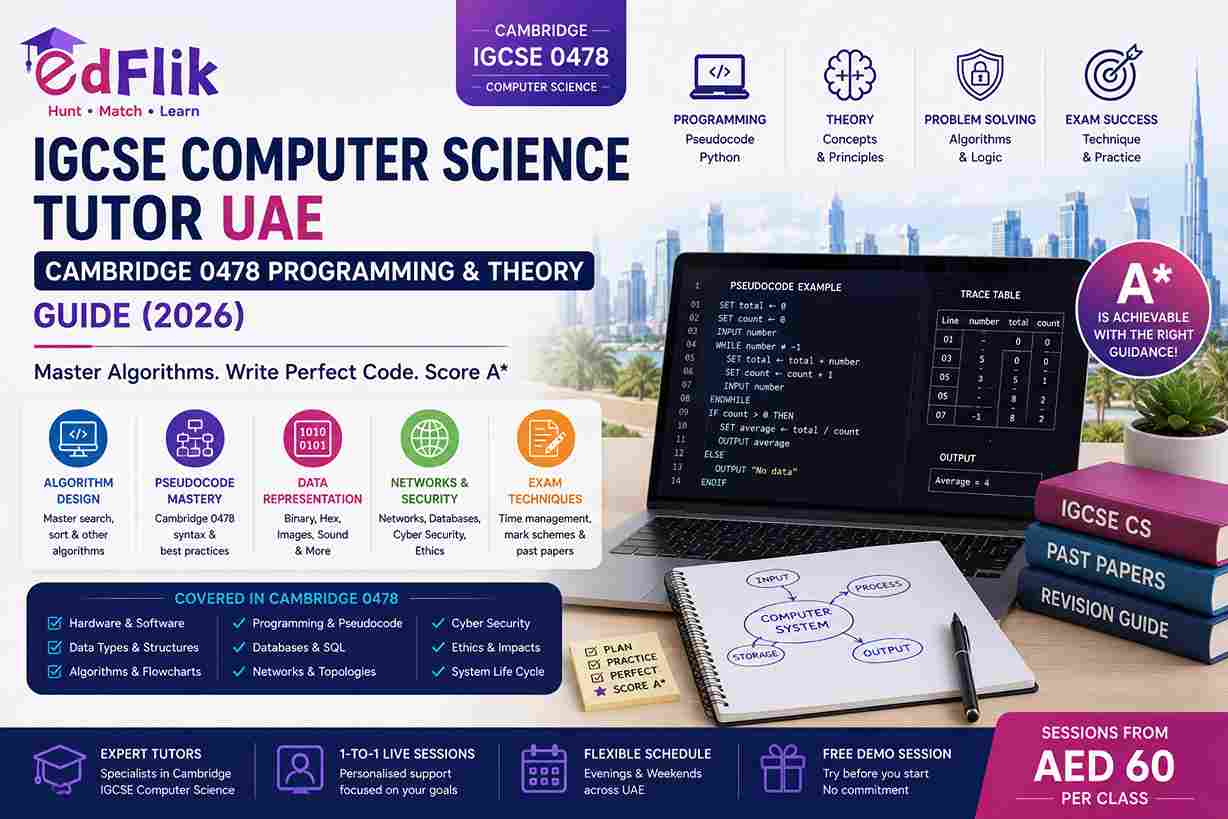
IGCSE Computer Science is one of the fastest-growing IGCSE subject choices among UAE students, driven by the country's national push toward technology education and coding literacy from primary school onwards. Cambridge 0478 is unique among IGCSE subjects in requiring two fundamentally different types of knowledge: deep theoretical understanding of how computers work, store data, and communicate; and practical algorithm design and programming skills expressed through Cambridge-specific pseudocode. Students who are strong at one but weak at the other consistently struggle in Paper 1 or Paper 2 respectively.
Cambridge 0478 — The Two-Paper Challenge
|
Paper |
Content |
Key Skills
Required |
Most
Challenging Elements |
|
Paper 1 — Theory (75 marks) |
Data representation; hardware and software; networks; databases;
security; ethics |
Recall and explain; convert between number systems; describe
processes |
Binary arithmetic under time pressure; trace tables; algorithm
descriptions |
|
Paper 2 — Algorithm and Programming (75 marks) |
Pseudocode writing; algorithm design; trace tables;
problem-solving |
Write Cambridge-format pseudocode; trace execution; design
algorithms |
Writing complete algorithms from scratch; nested loops;
procedures and functions |
Cambridge Pseudocode — The Most Important Preparation Focus
Cambridge 0478 uses its own pseudocode format that is different from any real programming language. UAE students who program in Python or JavaScript must still learn Cambridge pseudocode specifically for Paper 2. Key Cambridge pseudocode syntax elements:
|
Operation |
Cambridge
Pseudocode Syntax |
Python
Equivalent |
|
Assignment |
<- (e.g., Count <- 0) |
= (e.g., Count = 0) |
|
Output |
OUTPUT value |
print(value) |
|
Input |
INPUT variable |
variable = input() |
|
For loop |
FOR i <- 1 TO 10 |
for i in range(1, 11): |
|
While loop |
WHILE condition DO ... ENDWHILE |
while condition: |
|
If statement |
IF condition THEN ... ENDIF |
if condition: |
|
Procedure |
PROCEDURE Name(parameters) |
def Name(parameters): |
|
Arrays |
Array[1:10] |
list (Python uses 0-indexed) |
Students who write Python syntax in Paper 2 will not receive marks even if the logic is correct — Cambridge marks only Cambridge pseudocode format on Paper 2 written answers. Practising pseudocode from September of Year 10 using Cambridge specimen papers is essential.
Data Representation — The Theory Component Most UAE Students Struggle With
Paper 1 theory questions on data representation are consistently the most mark-intensive section for UAE students. Key skills:
• Binary to denary conversion: place values (128, 64, 32, 16, 8, 4, 2, 1) — must be instant recall under time pressure.
• Denary to binary conversion: repeated halving method or subtract from place values.
• Hexadecimal: convert between binary and hex using 4-bit groups; understand why hex is used (shorter representation of binary).
• Binary addition: including overflow — when the result exceeds 8 bits.
• Two's complement for negative numbers: flip bits and add 1 — required for representing signed integers.
• Character encoding: ASCII (7-bit, 128 characters) vs Unicode (16-bit or more, global character sets); how images use pixels and colour depth; how sound is sampled (sample rate and bit depth).
Frequently Asked Questions — IGCSE Computer Science Tutor UAE
Q: What does an IGCSE Computer Science tutor help with in UAE?
A: Two distinct skill sets: technical (Cambridge pseudocode writing, Python for practicals, algorithm design, trace tables) and theoretical (binary data representation, hardware components, networking, databases, cybersecurity). Both are required for Cambridge 0478 and require different preparation approaches.
Q: What programming language does IGCSE Computer Science use?
A: Cambridge pseudocode — the Cambridge-specific written format used in Papers 1 and 2. It differs from Python, JavaScript, and all other languages. Students who know Python but have not learned Cambridge pseudocode syntax specifically will make errors in written exam papers. EdFlik tutors teach Cambridge pseudocode format from the first session.
Q: What are the hardest IGCSE Computer Science topics for UAE students?
A: Algorithm design (writing pseudocode from scratch); trace tables (tracing variable values through each loop iteration); binary arithmetic under time pressure; and data representation (how integers, characters, images, and sound are stored in binary). These four areas account for the majority of marks lost on Cambridge 0478 papers.
Q: How is Cambridge IGCSE Computer Science 0478 assessed?
A: Two written papers: Paper 1 (1 hr 30 min, 75 marks) — theory; Paper 2 (1 hr 45 min, 75 marks) — algorithm and programming. No computer access in exams — all programming is written in pseudocode. Optional coursework at some schools.
Q: Does EdFlik provide IGCSE Computer Science tutoring in UAE?
A: Yes. Cambridge 0478 specialists covering both theory and algorithm/programming components. Sessions teach Cambridge pseudocode format specifically, not just general Python. From AED 60 per class. Free demo at www.edflik.com.
How EdFlik Supports IGCSE Computer Science Students Across UAE
EdFlik IGCSE Computer Science tutors are matched to Cambridge 0478 and teach Cambridge pseudocode, trace tables, and data representation alongside programming logic. Sessions from AED 60. Free demo. Book at www.edflik.com.