
IGCSE Economics Tutor UAE — How to Score A* in Cambridge 0455 (2026 Guide)
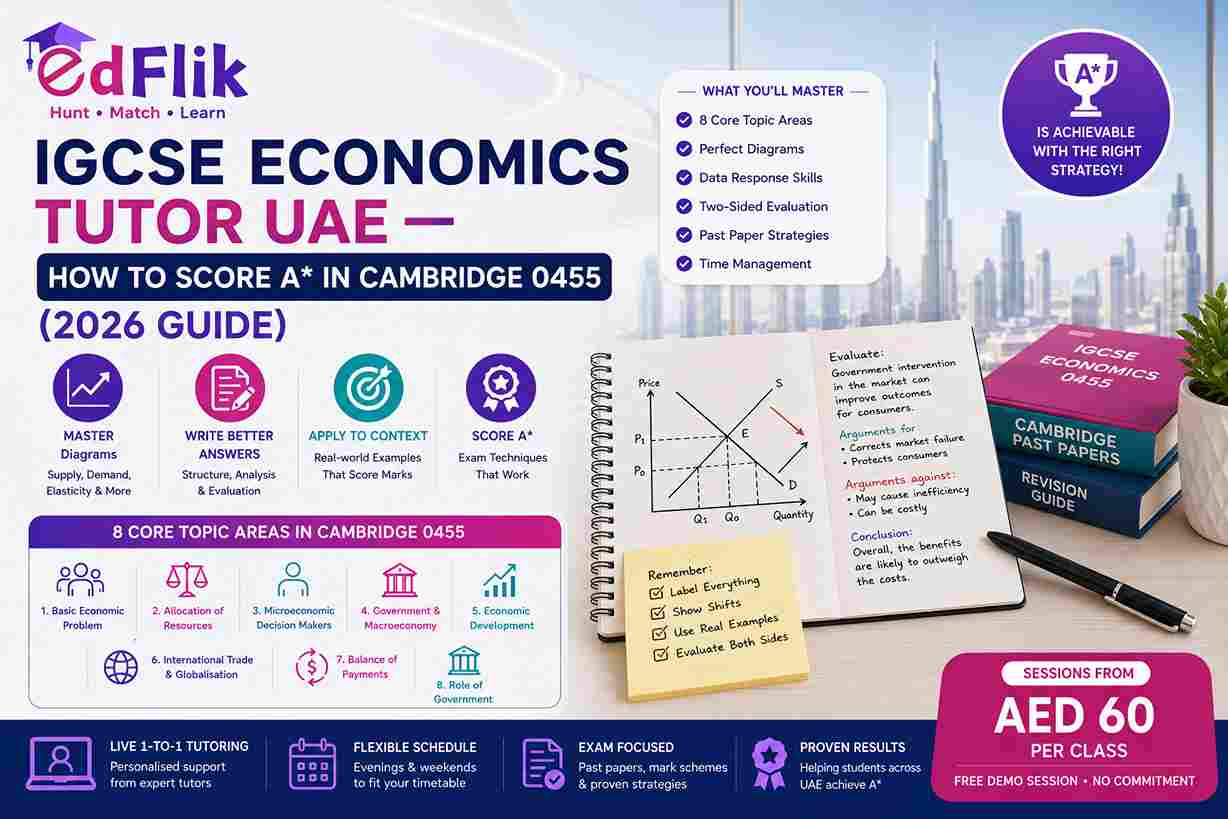
IGCSE Economics is one of the most commonly sat subjects in UAE British-curriculum schools — and one of the most consistently underperformed. Students who genuinely understand the economic concepts frequently lose marks not because their economics is wrong, but because their diagram labelling is incomplete, their evaluation is one-sided, or their data-response answers do not reference the specific context in the question. These are technique failures, not knowledge failures — and they are exactly what targeted tutoring fixes fastest.
This guide covers the Cambridge 0455 assessment structure in detail, the most common exam errors UAE students make, what an A* response looks like, and how EdFlik matches Economics specialists to UAE students.
Competitor Landscape — Why This Page Matters for UAE Parents
Most IGCSE tutoring platforms in UAE have dedicated pages for Maths, Physics, Chemistry, and Biology — the four subjects that generate the highest tutoring demand by volume. IGCSE Economics is consistently the fifth or sixth most requested IGCSE subject but has very little UAE-specific tutoring guidance available online. This guide fills that gap with specific Cambridge 0455 examination technique, UAE-contextual examples, and practical preparation strategy.
Cambridge IGCSE Economics 0455 — Assessment Structure
|
Component |
Duration |
Marks |
What It Tests |
|
Paper 1 Section A |
Included in 90 mins |
45 |
Data response: 4 structured questions using graphs, statistics,
article extracts |
|
Paper 1 Section B |
Included in 90 mins |
45 |
Essay questions: choose 2 from 4 (evaluate, assess, discuss
format) |
|
Paper 2 Section A |
Included in 90 mins |
45 |
Same format as Paper 1 — different questions |
|
Paper 2 Section B |
Included in 90 mins |
45 |
Same format as Paper 1 Section B — different titles |
|
Internal Assessment |
None |
0 |
No coursework — 100% examination |
The 5 Technique Pillars for IGCSE Economics A* in UAE
Pillar 1 — Diagram Accuracy and Completeness
Every IGCSE Economics diagram must have: axes clearly labelled (Price on vertical axis, Quantity on horizontal axis for standard supply and demand); curves correctly drawn and labelled (S for supply, D for demand); equilibrium clearly marked (P with subscript and Q with subscript); and shift arrows drawn where a change is required, with the new curve labelled. Missing any one of these typically costs 1 mark per diagram, and diagrams appear in both data-response and essay questions. UAE students sitting Paper 1 and Paper 2 together may need to draw 6 to 10 diagrams under time pressure. Daily diagram practice from September of Year 10 is the most effective preparation.
High-frequency diagrams to master from memory: basic supply and demand with equilibrium; supply and demand shift (both curves, separately and together); price elasticity of demand (PED) — elastic vs inelastic curves; price floor and price ceiling with shortage/surplus annotated; production possibility curve (PPC) with points on and inside the frontier; aggregate demand and aggregate supply (AD-AS model); Lorenz Curve; trade diagram with comparative advantage.
Pillar 2 — Two-Sided Evaluation in Essay Questions
Cambridge 0455 Section B questions use command terms like Evaluate, Assess, Discuss, and Consider. These command terms require the student to present an argument, present a genuine counterargument (not a token 'however'), and reach a justified conclusion that takes a position. Students who write one-sided arguments — presenting only the case for or against without genuine counterargument — cannot score in the top markband regardless of how well-written the argument is.
Structure for a maximum-mark IGCSE Economics essay response: (1) Define the key economic terms in the question (2 to 3 marks). (2) Present the main argument with relevant diagram and theory application. (3) Present a genuine counterargument with its own diagram or theory basis. (4) Apply to context — reference the real-world scenario or country mentioned in the question. (5) Evaluate with a justified conclusion that takes a position and explains why.
Pillar 3 — Application to Context
Cambridge 0455 specifically rewards students who apply economic theory to the real-world context given in the question — not those who simply write generic economic theory. If a question asks about inflation in a developing country, the highest marks go to responses that use the specific data given in the question (the inflation rate, the country named, the time period referenced) rather than writing general textbook answers about inflation.
Pillar 4 — Data Response Interpretation Precision
Section A data response questions test specific interpretation skills: reading values from graphs accurately; calculating percentage changes from data tables; interpreting index numbers (an index value of 115 means a 15% increase from the base year, not 115%); and distinguishing correlation from causation in economic data. These skills are not tested in classroom assessments at most UAE schools and require specific past paper practice.
Pillar 5 — Time Management Across Both Papers
Each paper gives 90 minutes for 90 marks — effectively one mark per minute. Section A data response questions must be completed in approximately 40 minutes, leaving 50 minutes for two Section B essay questions (25 minutes each). UAE students frequently overrun Section A by spending too long on individual data response questions, leaving insufficient time for the higher-mark essay section. Timed practice from at least January of Year 10 is essential.
High-Frequency Topics in Cambridge IGCSE Economics UAE Exams
|
Topic |
Exam
Frequency |
Key Technique
Required |
|
Supply and demand — shifts and equilibrium |
Every paper |
Diagram with full labels; identify which curve shifts and why |
|
Price elasticity of demand (PED) |
Every paper |
Formula (PED = % change in Qd / % change in P); interpretation;
elastic vs inelastic curves |
|
Inflation — causes and consequences |
Very high |
Define; identify demand-pull vs cost-push; effects on different
stakeholders |
|
Unemployment — causes and policies |
Very high |
Types (cyclical, structural, frictional, seasonal); policy
response with evaluation |
|
International trade — benefits and protectionism |
High |
Comparative advantage; arguments for/against tariffs and quotas |
|
Economic development — indicators |
High |
GDP vs GNI vs HDI; limitations of GDP as a measure |
|
Government policy — fiscal and monetary |
High |
Define each; how they work; evaluation (time lags, crowding out,
interest rate trade-offs) |
|
Market failure and government intervention |
Medium |
Externalities; public goods; subsidies and taxes with diagrams |
Frequently Asked Questions — IGCSE Economics Tutor UAE
Q: What does an IGCSE Economics tutor help with in UAE?
A: Diagram accuracy and labelling (the single biggest mark-loser), structured essay writing with genuine two-sided evaluation, data-response interpretation (percentage changes, index numbers, graph reading), application of theory to the specific context in each question, and timed past paper practice with Cambridge mark-scheme correction. These are technique skills that most UAE classroom teaching does not explicitly develop.
Q: What are the main topics in IGCSE Economics Cambridge 0455?
A: Eight main topic areas: Basic Economic Problem; Allocation of Resources (supply, demand, elasticity — most heavily tested); Microeconomic Decision Makers; Government and the Macroeconomy (inflation, unemployment, fiscal and monetary policy); Economic Development; International Trade and Globalisation; Balance of Payments; and Role of Government. Supply and demand, elasticity, inflation, and international trade appear in virtually every Cambridge 0455 paper.
Q: How do you score A* in IGCSE Economics in UAE?
A: Five requirements: (1) Perfect diagram accuracy with fully labelled axes, curves, and equilibria. (2) Two-sided evaluation in all essay questions with a justified conclusion. (3) Application to context — reference the specific scenario in every question. (4) Data response precision — accurate percentage change calculations and index number interpretation. (5) Timed past paper practice covering at least 6 full papers. EdFlik tutors build all five of these skills in every session.
Q: What is the biggest exam mistake UAE students make in IGCSE Economics?
A: Unlabelled or incompletely labelled diagrams — earning zero marks for diagrams that are otherwise correct. The second most common error is one-sided evaluation in essay questions. Cambridge 0455 specifically requires discussion of multiple perspectives. Students who present only the case for or against cannot score in the top markband.
Q: How is IGCSE Economics 0455 assessed?
A: Two written papers, each 90 minutes and 90 marks. Each paper has Section A (data response — 4 structured questions using graphs and article extracts) and Section B (essay questions — choose 2 from 4). No coursework. 100% examination. Both papers are externally marked by Cambridge CAIE.
Q: Does EdFlik provide IGCSE Economics tutoring in UAE?
A: Yes. Live 1:1 IGCSE Economics tutoring for Cambridge 0455 across all UAE emirates. Sessions focus on diagram technique, structured essays, data-response interpretation, and past paper practice. From AED 60 per class. Free demo at www.edflik.com.
How EdFlik Supports IGCSE Economics Students Across UAE
EdFlik IGCSE Economics tutors are matched to Cambridge 0455 specifically. Every session includes diagram practice, structured essay technique, and timed past paper questions with Cambridge mark-scheme correction. Sessions from AED 60 per class. Free demo. Book at www.edflik.com.