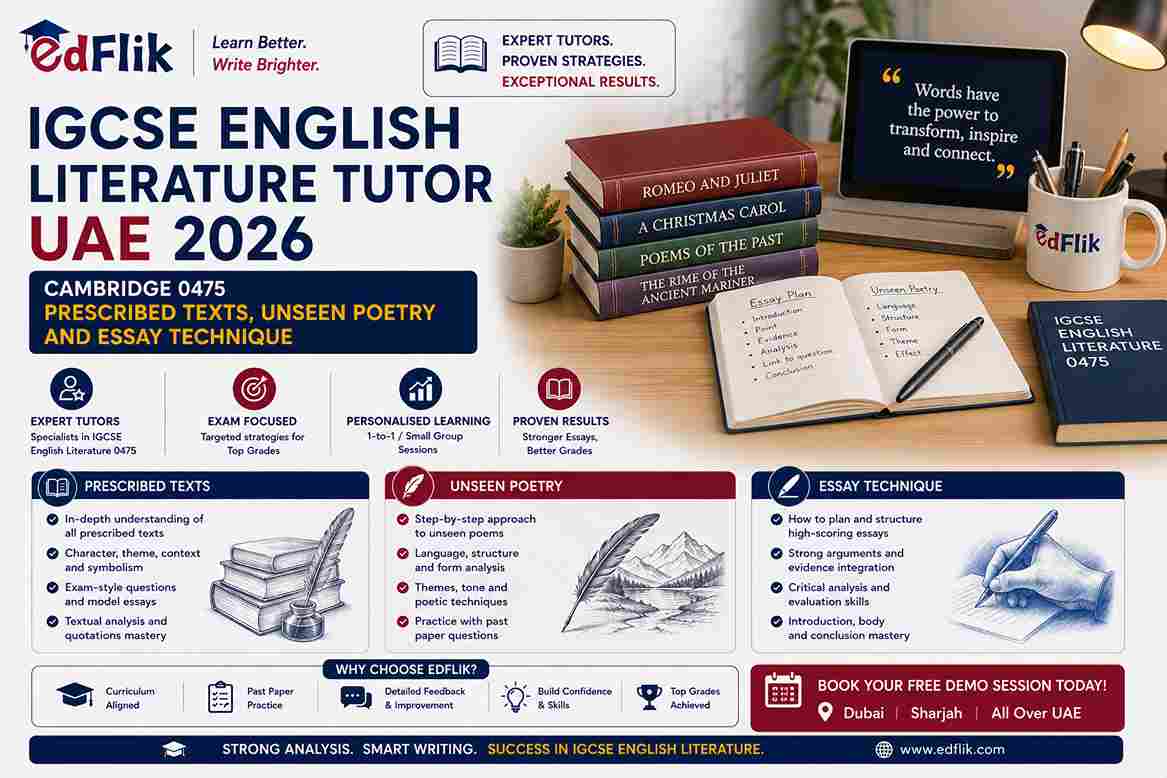
IGCSE English Literature Tutor UAE 2026 — Cambridge 0475 Prescribed Texts and Essay Guide
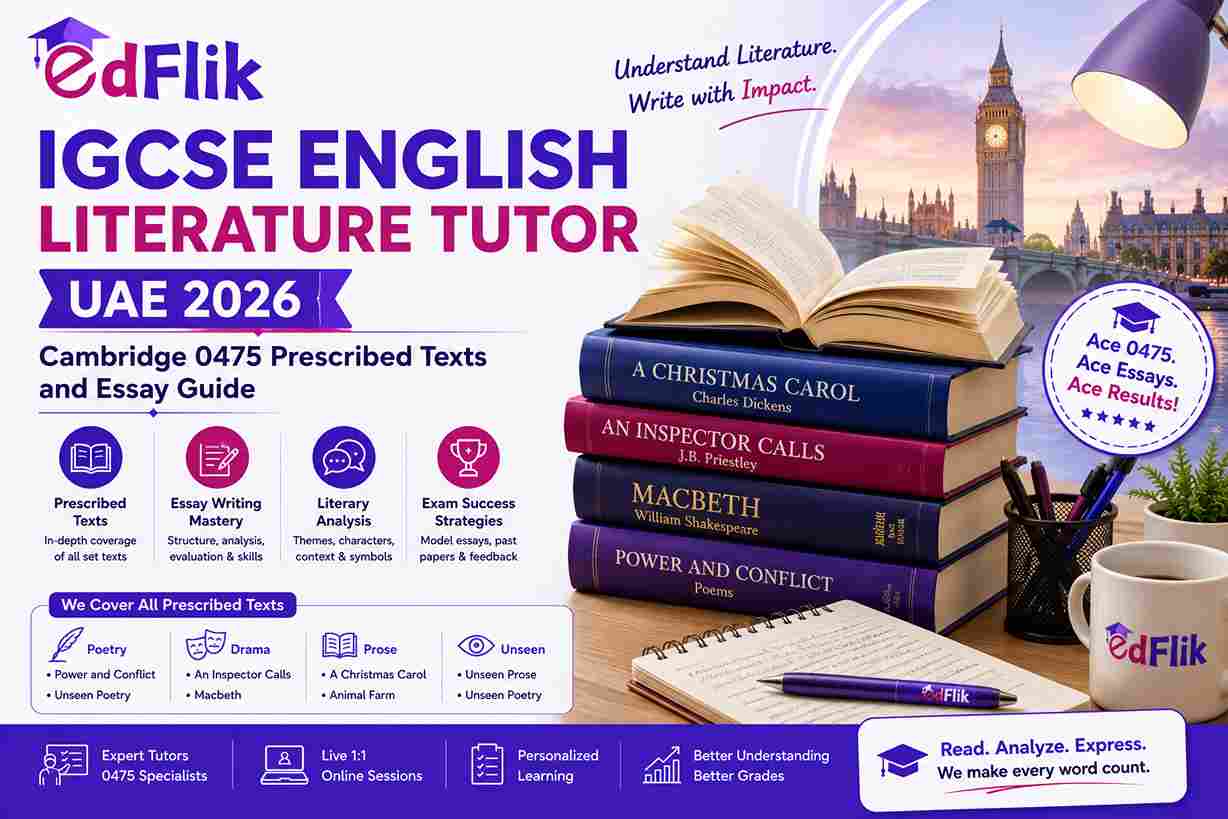
IGCSE English Literature (Cambridge 0475) is taken alongside IGCSE English Language (0500) by students at most UAE British curriculum schools who have opted for both English qualifications. Many UAE students who are confident in IGCSE English Language (comprehension, directed writing) find English Literature significantly harder — because Literature requires a fundamentally different skill: analysing how writers create effects, not just understanding what texts say. This guide covers what IGCSE English Literature actually assesses, the essay structure that earns the highest marks, and the text-specific preparation that UAE students need.
IGCSE English Literature — Assessment Structure
|
Paper |
Content |
Duration |
Marks |
Skills
Assessed |
|
Paper 1 — Set
texts |
Prose and
Drama — questions on texts studied in class |
1h 30min |
50 marks |
Literary essay
writing; close textual analysis; thematic and character discussion; use of
quotation as evidence |
|
Paper 2 —
Poetry |
Studied poetry
(set anthology or text) plus unseen poetry question |
1h 15min |
50 marks |
Analysis of
studied poems; independent analysis of an unseen poem; poetic devices and
their effects |
|
Alternative to
Coursework (Paper 3) |
Some schools
use this instead of school-submitted coursework |
~45 min
(written) |
25 marks |
Literary
analysis under timed conditions; an alternative to the coursework portfolio
offered by some schools |
The Most Important Skill: Analytical Writing vs Descriptive Writing
The clearest grade differentiator in IGCSE English Literature is whether the student writes analytically (discusses how and why) or descriptively (describes what). This distinction produces the single largest mark gap between Grade C and Grade A responses:
|
Grade Level |
How the Essay
Responds to "How does Steinbeck present loneliness in Of Mice and
Men?" |
What the
Examiner Marks It As |
|
Grade C-D
response |
Lennie and
George are lonely because they travel together without a real home. Crooks is
lonely because he is black and lives separately in the barn. Curley's wife is
lonely because Curley does not spend time with her. |
Description of
plot — no analysis of language, structure, or writer's craft; no quotation;
no discussion of how Steinbeck creates the effect of loneliness |
|
Grade A-A*
response |
Steinbeck
presents loneliness as both universal and isolating through the recurring
motif of spatial separation. Crooks's insistence that "a guy needs
somebody" (Chapter 4) is rendered structurally ironic by his physical
isolation from the bunkhouse — his words are spoken in a space literally
excluded from the workers' community. Steinbeck uses the conditional
construction "if I say something, why it's just a nigger sayin' it"
to dramatise how marginalisation silences speech itself, not merely company. |
Analysis of
language at word level; identification of structural technique (spatial
separation); analysis of specific quotation; discussion of the writer's
deliberate craft — how Steinbeck creates loneliness through specific choices |
Unseen Poetry — The Skill That Cannot Be Memorised
The unseen poetry question in IGCSE English Literature Paper 2 is the most authentic test of literary analysis ability — because it cannot be prepared through content memorisation. Effective unseen poetry approach:
• Read the title carefully — the title often signals theme, speaker, or subject. What does the title imply before you read the poem?
• Read the poem twice — first read for overall meaning and feeling; second read for specific language choices, structural decisions, and poetic devices
• Identify the speaker and situation — who is speaking? to whom? in what situation? from what perspective?
• Annotate for poetic devices — metaphor, simile, personification, alliteration, assonance, enjambment, caesura, rhyme scheme, stanza structure
• Select 3-4 most interesting features to analyse in depth — a Grade A response analyses fewer features more deeply rather than listing every feature briefly
Shakespeare Preparation for UAE Students
Shakespeare is the text type where UAE students most often need specific preparation support — particularly students whose home language is not English. Three-stage approach:
• Stage 1 — Understand the story: Use a modern prose adaptation or full play summary to understand plot, character relationships, and key themes before engaging with the original Early Modern English
• Stage 2 — Work with the original: Read key scenes in the original with a glossary. Key scenes from Macbeth: Act 1 Scene 7 (Macbeth's soliloquy before Duncan's murder); Act 2 Scene 1 (dagger soliloquy); Act 3 Scene 1 (Banquo's murder planned); Act 5 Scene 1 (Lady Macbeth's sleepwalking). Know 3-5 precise quotations per major character and theme.
• Stage 3 — Analyse the playwright's craft: Know the theatrical conventions Shakespeare uses — soliloquy (character speaks alone, audience hears thoughts), dramatic irony (audience knows what characters do not), aside, blank verse (iambic pentameter suggesting elevated speech), prose (lower-class characters or disturbed minds)
|
EdFlik IGCSE
English Literature tutors are text-specific — tutors know the specific texts
your school studies (Of Mice and Men, Macbeth, An Inspector Calls, etc.) and
work through PEE essay technique and unseen poetry analysis. From AED 55 per
session. Free diagnostic. Book at www.edflik.com or WhatsApp +91 88788 96600. |
Frequently Asked Questions
Q: How is IGCSE English Literature different from IGCSE English Language?
English Language: unseen non-literary texts, comprehension, directed writing, narrative writing. English Literature: prescribed literary texts (prose, drama, poetry) studied in advance plus unseen poetry. Different skills: Language assesses writing ability; Literature assesses literary analysis of how writers create effects.
Q: What texts are studied for IGCSE English Literature in UAE schools?
Depends on school selection from the Cambridge set text list. Common UAE choices: Of Mice and Men, Lord of the Flies, The Kite Runner (prose); Macbeth, Romeo and Juliet, An Inspector Calls (drama); Cambridge IGCSE Poetry Anthology (poetry). Tutors must know your school's specific texts.
Q: What does a high-grade IGCSE English Literature essay look like?
Opens with analytical thesis (not plot summary); uses PEE structure with specific quotations; analyses language at word level (effects of specific choices, imagery, tone); discusses writer's craft (how the writer creates effects deliberately). Grade A essays discuss HOW; Grade C essays describe WHAT.
Q: What is the unseen poetry question in IGCSE English Literature?
Analysis of a poem seen for the first time in the exam — tests independent literary analysis skills. SMILE/SCASI framework: Structure, Meaning, Imagery, Language, Effect. Rewards analytical thinking over pre-memorised content.
Q: How should UAE students approach Shakespeare in IGCSE English Literature?
Three stages: (1) Modern prose summary for plot and character understanding; (2) Original with glossary for key scenes — know 3-5 precise quotations per major theme; (3) Analyse playwright's craft — soliloquy, dramatic irony, blank verse, prose as deliberate theatrical choices.