
IGCSE Exam Preparation UAE — The Complete Study Plan (2026)
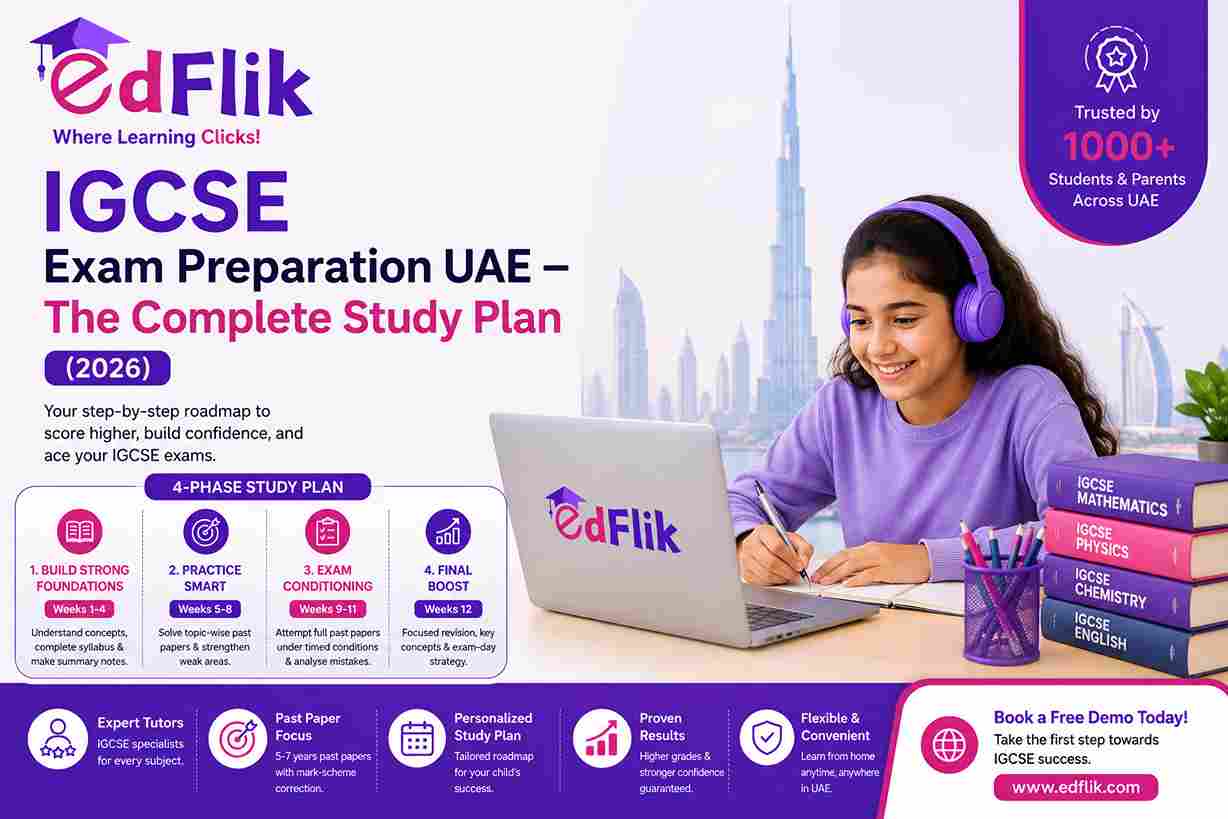
IGCSE examinations represent one of the most high-stakes academic milestones for students in UAE's British-curriculum schools. Whether sitting Cambridge CAIE or Pearson Edexcel, students in Year 10 face a series of papers across 7-11 subjects that will determine their A-Level options, IB eligibility (for students transferring at Grade 11), and in many cases their parents' confidence in the educational investment they have made. Yet the majority of UAE IGCSE students start serious preparation far too late, rely too heavily on textbooks rather than past papers, and never learn the specific mark-scheme language that separates A* from A from B.
This complete study plan addresses all three of these issues with a specific, timed approach built for UAE students.
Direct Answer — What Is the Best IGCSE Exam Preparation Strategy?
Use past papers as your primary study tool from at least 9 months before your examination. Not textbooks, not course notes, not YouTube videos — past papers, marked against the official mark scheme, reviewed error by error. A student who completes 6 full IGCSE past papers per subject with thorough mark-scheme review will outperform a student who spends the same hours reading through revision guides. This is the single most consistent finding from IGCSE teachers and examiners.
Note on Cambridge IGCSE June 2026 UAE Exams
Cambridge cancelled all June 2026 IGCSE sit-down examinations in the UAE, replacing them with a portfolio of evidence route in coordination with the UAE Ministry of Education. UAE students who were due to sit IGCSE papers in June 2026 submitted portfolios of coursework and school-assessed work instead. Grades awarded through this route are fully valid and internationally recognised. For students preparing for IGCSE in 2027 onwards, the traditional examination format is expected to resume — and this study plan is designed for that examination pathway.
The 12-Week IGCSE Revision Master Plan
|
Phase |
Weeks |
Focus |
Key Actions |
|
Phase 1: Knowledge Audit |
Weeks 1-3 |
Identify gaps |
Do a diagnostic past paper per subject under exam conditions.
Mark it. List every topic where marks were lost. These are your priority
revision targets. |
|
Phase 2: Gap Filling |
Weeks 4-6 |
Close knowledge gaps |
For each gap topic, use the IGCSE revision guide and class notes
to re-learn the concept. Then do past paper questions on that topic
specifically — not full papers. |
|
Phase 3: Past Paper Practice |
Weeks 7-10 |
Exam technique |
Complete 1-2 full timed past papers per subject per week. Mark
immediately after. Record every error type. Identify patterns in the mistakes
you repeat. |
|
Phase 4: Final Sprint |
Weeks 11-12 |
Refinement only |
Revise only remaining weak topics. Simulate full exam conditions
for your most challenging subjects. Stop learning new content 2 weeks before
exams. |
IGCSE Subject Preparation — Specific Strategies
IGCSE Mathematics Extended
The most efficient approach: download the Cambridge Maths Extended syllabus checklist, go through every topic, and rate yourself 1-3 (weak/acceptable/strong). Begin past paper practice on weak topics immediately. Key mark-scheme insight: method marks are awarded for correct steps written clearly. Never show only a final answer on a multi-step question. Specific high-yield topics that appear on nearly every Cambridge Maths past paper: Quadratic equations and functions, Circle theorems, Trigonometry (sine rule, cosine rule), Statistics (mean, standard deviation, cumulative frequency), and Vectors.
IGCSE Physics
Physics mark schemes reward precise scientific language. 'It gets hotter' earns 0 marks; 'the temperature of the substance increases because thermal energy is transferred from the heat source to the particles, increasing their mean kinetic energy' earns full marks. Every session, practise explaining physical processes in this cause-effect chain format. Past paper Section B (extended response questions) is where most marks are lost and where targeted practice produces fastest improvement.
IGCSE Chemistry
Chemistry rewards recall precision. Ionic equations must include state symbols. Test results must use correct observation language ('a white precipitate forms' not 'it goes white'). Organic chemistry reaction types (addition, substitution, condensation, fermentation) must be identified correctly before conditions can be described. Use a topic checklist: when you can answer 5 past paper questions from a specific topic without errors, move on. Repeat for every topic in the syllabus.
IGCSE English Language
English Language is the subject most resistant to last-minute preparation. Reading comprehension skills and writing quality are built over months, not weeks. However, specific examination techniques can be taught quickly: for comprehension questions, always quote the exact word or phrase that proves your point; for descriptive writing, use a 'zoom in' technique (start with a wide scene, focus on a detail, describe sensory experience); for summary questions, never include information outside the passage and always paraphrase, never copy.
Frequently Asked Questions — IGCSE Exam Preparation UAE
Q: What is the best way to prepare for IGCSE exams in UAE?
A: Use past papers from the last 5-7 years as your primary study tool — not textbooks alone. Start with a diagnostic past paper to identify weak topics. Fill knowledge gaps with targeted revision. Then complete full timed past papers weekly with mark-scheme correction. Understanding the specific language that earns marks on Cambridge and Edexcel mark schemes is as important as subject knowledge.
Q: How many past papers should I do for IGCSE in UAE?
A: Aim for at least 5-7 full past papers per subject under timed conditions. More important than volume is quality of review — a student who does 3 papers with thorough mark-scheme analysis will outperform one who rushes through 8 without review.
Q: When should UAE IGCSE students start exam preparation?
A: September of Year 10 — 9 months before May/June exams. This allows time for knowledge consolidation (September-December), targeted topic revision (January-March), and full past paper practice (March-May). Starting in January leaves insufficient time for genuine technique refinement.
Q: Can I improve by a full grade in IGCSE with tutoring?
A: Yes. For students with exam technique gaps (understand content but underperform in exams), improvement of one grade boundary within 8-12 weeks of twice-weekly tutoring is realistic. For significant content gaps, improvement takes longer but is achievable with structured support starting early in Year 10.
Q: How does EdFlik support IGCSE exam preparation?
A: EdFlik IGCSE tutors use past papers as the primary teaching tool with mark-scheme correction after every question. Sessions focus on exam technique — the language, method presentation, and structural choices that earn marks in Cambridge and Edexcel assessments. From AED 60 per class. Free trial at.
How EdFlik Supports IGCSE Exam Preparation Across UAE
EdFlik IGCSE tutors are matched by board (Cambridge vs Edexcel), subject, and tier. Sessions use past papers from the most recent 5-7 years as the primary teaching tool. Every session includes timed practice, mark-scheme review, and specific technique correction.
Sessions from AED 60. Free demo. Book at www.edflik.com.