
IGCSE Maths 0580 Exam Trends 2026 UAE — What Cambridge Is Testing This Year
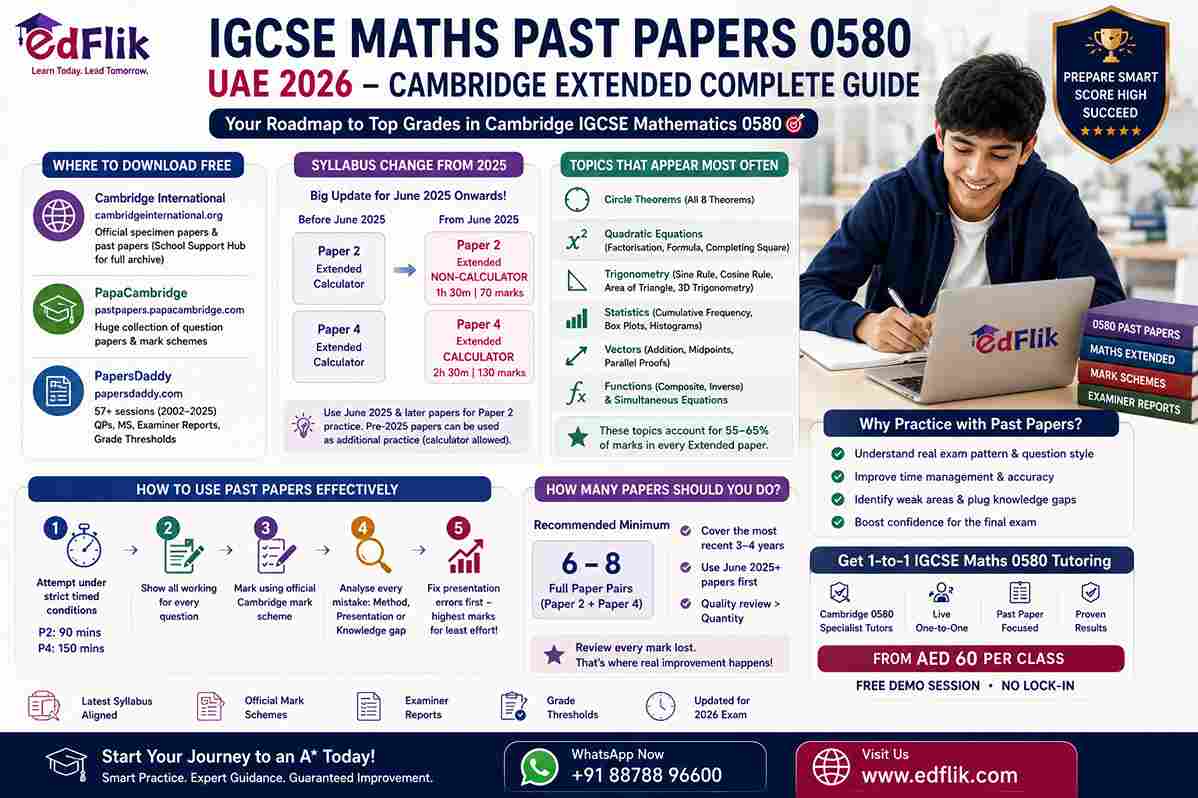
Every year from September onwards, UAE Year 11 IGCSE Maths students and their parents search for what Cambridge is prioritising in the current examination year. This guide draws on analysis of Cambridge 0580 Extended past papers from 2019 to 2025, Cambridge Principal Examiner Reports, and EdFlik's accumulated data from UAE student sessions to provide the most precise possible picture of what the 2026 and 2027 Cambridge 0580 Extended papers test most consistently.
The Biggest Change: Paper 2 is Now Non-Calculator from June 2025
The structural change to Cambridge 0580 from June 2025 onwards is the most important fact for any UAE student revising for the 2026 or 2027 series. Paper 2 (Extended tier) is now a non-calculator paper. This is not a minor adjustment — it fundamentally changes what skills Paper 2 tests:
|
Paper 2
Format |
Pre-June 2025
(OLD) |
June 2025
Onwards (CURRENT) |
|
Calculator |
Yes — calculators permitted throughout |
NO — no calculator permitted at any point |
|
Duration |
1 hour 30 minutes |
1 hour 30 minutes (unchanged) |
|
Marks |
70 marks |
70 marks (unchanged) |
|
Skills tested |
Applied calculation and algebra with calculator support |
Exact arithmetic, algebraic manipulation, geometric reasoning
without calculator |
|
Past papers usable as practice? |
Yes, but use without a calculator to simulate current format |
Yes — the June 2025 papers are the first true non-calculator
Paper 2 examples |
|
Paper 4 (calculator) |
Unchanged — calculator paper |
Unchanged — calculator paper, 2 hr 30 min, 130 marks |
Topic Frequency Analysis — Cambridge 0580 Extended 2019 to 2025
The following analysis is based on Cambridge IGCSE Mathematics 0580 Extended past papers from the June and October/November series, 2019 to 2025:
|
Topic |
Appears in |
Paper |
Mark Weight
Per Occurrence |
EdFlik
Priority |
|
Circle theorems (all 8) |
100% of series |
Paper 4 |
5 to 15 marks |
1 — memorise all 8 by name; state theorem when answering |
|
Cumulative frequency + box plots |
100% of series |
Paper 4 |
6 to 10 marks |
1 — practise reading quartiles from cumulative frequency curves |
|
Quadratic equations |
100% of series |
Both papers |
4 to 8 marks |
1 — know all 3 methods; choose method based on whether
factorisation is clean |
|
Histograms (frequency density) |
100% of series |
Paper 4 |
4 to 8 marks |
1 — y-axis MUST be frequency density (= frequency ÷ class width),
never frequency |
|
Trigonometry — sine and cosine rule |
100% of series |
Paper 4 |
5 to 10 marks |
1 — draw labelled diagram before applying any formula |
|
Vectors |
100% of series |
Paper 4 |
5 to 10 marks |
1 — sign direction carefully; parallel = scalar multiple |
|
Functions — composite and inverse |
95% of series |
Both papers |
4 to 8 marks |
2 — fg(x) means f(g(x)); f⁻¹(x) means find x in terms of y then
swap |
|
Simultaneous equations (linear + non-linear) |
90% of series |
Both papers |
4 to 6 marks |
2 — substitute one equation into the other; solve the resulting
quadratic |
|
Transformations (translation, reflection, rotation, enlargement) |
85% of series |
Paper 4 |
4 to 8 marks |
2 — describe transformations fully: type + vector/mirror
line/angle+direction+centre/scale factor+centre |
|
Probability (tree diagrams, combined) |
80% of series |
Paper 4 |
4 to 8 marks |
2 — multiply along branches; add between branches; probabilities
sum to 1 |
|
Indices and surds |
80% of series |
Paper 2 (non-calc) |
3 to 6 marks |
2 — key for non-calculator Paper 2; leave answers in exact surd
form |
|
Algebraic manipulation and fractions |
80% of series |
Paper 2 (non-calc) |
4 to 8 marks |
2 — common denominator for addition; factorised numerator and
denominator before simplifying |
Paper 2 Non-Calculator — Topics and Skills to Prioritise
With Paper 2 now non-calculator, UAE students must build genuine fluency in exact arithmetic and algebraic manipulation without calculator support. The skills Cambridge specifically tests in non-calculator Paper 2:
• Exact form answers: leaving answers in the form a + b√c, a/b (exact fraction), or kπ. Decimal approximations earn no marks when exact form is required.
• Trigonometric exact values from memory: sin 30° = 0.5; cos 30° = √3/2; sin 45° = cos 45° = √2/2; tan 45° = 1; sin 60° = √3/2; cos 60° = 0.5; tan 60° = √3. These must be recalled instantly without a calculator.
• Algebraic fraction manipulation: adding, subtracting, multiplying, dividing algebraic fractions; simplifying by factorising numerator and denominator.
• Index laws without calculator: multiplying powers (add exponents); dividing powers (subtract exponents); power to a power (multiply exponents); fractional indices as roots.
• Standard form arithmetic: multiplying and dividing numbers in standard form without a calculator — (3 × 10⁴) × (2 × 10³) = 6 × 10⁷.
• Circle theorem reasoning: stating the theorem name and the angle relationship in one clear step — 'angles in the same segment are equal, therefore angle ABC = angle ADC = 47°'.
Paper 4 — What to Prioritise in the Calculator Paper
Paper 4 remains the calculator paper. The highest-priority topics for 2026:
|
Priority |
Topic |
Why It's High
Priority in 2026 |
|
Highest |
Circle theorems |
Present every series; 5 to 15 marks; UAE students most commonly
lose marks by not stating the theorem name |
|
Highest |
Cumulative frequency and box plots |
Full data handling question every series; 6 to 10 marks; quartile
reading from cumulative frequency curve is the key skill |
|
Highest |
Histograms with frequency density |
Every series; y-axis must be frequency density — most common
single diagram error among UAE students |
|
High |
Sine and cosine rule |
Every series; always draw and label the triangle before selecting
which rule applies |
|
High |
Vectors — parallel proof |
Most series; stating 'parallel because vector AB = k times vector
CD' is required for full marks on proof questions |
|
High |
Functions — composite and inverse |
Most series; common to combine with other topics (transformation,
graph of function) |
|
High |
3D trigonometry and Pythagoras |
Most series; requires identifying a right-angle triangle in 3D;
draw 2D cross-section before applying formula |
Frequently Asked Questions — IGCSE Maths 0580 Exam Trends 2026 UAE
Q: What changed in Cambridge IGCSE Maths 0580 for 2026?
A: Paper 2 (Extended) became a non-calculator paper from the June 2025 sitting onwards. This is the current format for 2026 and 2027. Pre-2025 Paper 2 papers allowed calculators — they remain useful for topic practice but must be completed without a calculator to simulate the current format. Paper 4 remains unchanged as a calculator paper.
Q: Which topics appear in every Cambridge 0580 Extended paper?
A: 100% frequency: circle theorems (all 8), cumulative frequency and box plots, quadratic equations (all 3 methods), histograms with frequency density (NOT frequency), sine and cosine rule, vectors. These topics account for approximately 55 to 65 percent of marks across every Extended series and must be mastered before any other topic.
Q: What should UAE students focus on for Paper 2 non-calculator in 2026?
A: Exact form answers (surds, fractions, multiples of π); trigonometric exact values from memory (sin 30, cos 45, tan 60, etc.); algebraic fraction manipulation; index laws; standard form arithmetic without calculator; circle theorem reasoning with stated theorem names.
Q: Which 0580 topics are most commonly answered incorrectly by UAE students?
A: Histograms — frequency on y-axis instead of frequency density (earns zero). Circle theorems — correct angle found but theorem name not stated (loses reasoning mark). Vectors — sign errors in reversed direction; failing to recognise parallel relationship. Algebraic fractions — not finding common denominator before adding.
How EdFlik Supports IGCSE Maths 0580 Students for 2026 and 2027
EdFlik uses only current-format Cambridge 0580 past papers including the non-calculator Paper 2. Every session targets the highest-frequency topics identified above. Method mark compliance is the first technique built. Sessions from AED 60. Free demo. Book at www.edflik.com.