
IGCSE Maths Extended Tutor UAE — Cambridge 0580 Complete Grade Improvement Guide
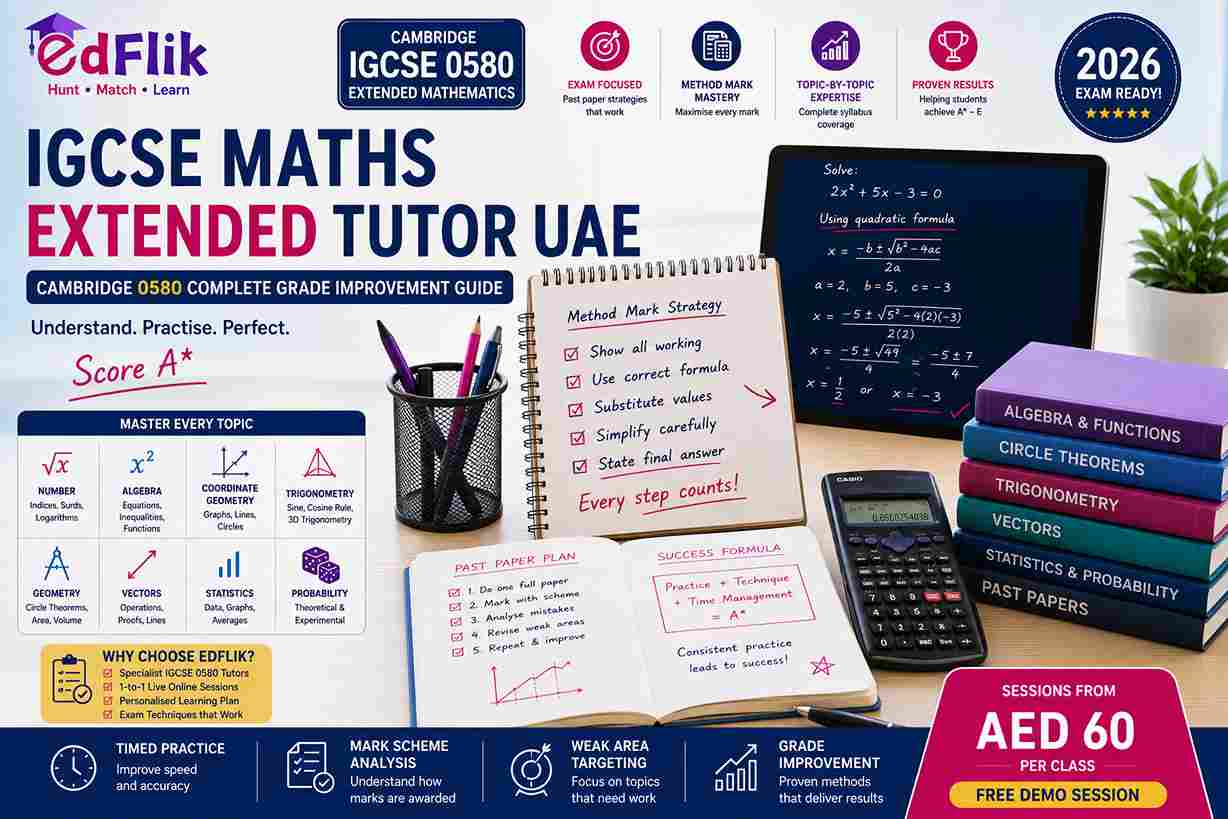
Cambridge IGCSE Extended Mathematics 0580 is the most frequently tutored subject in UAE British-curriculum schools — and the subject where the gap between understanding and examination performance is most consistently caused by a single, fixable technique error: not showing method steps in written answers. This comprehensive guide covers the 0580 syllabus structure, the method mark system that determines grades, the most frequently examined topics, and what separates A* performance from B or C performance at Dubai, Abu Dhabi, and Sharjah schools.
Cambridge 0580 Extended — Paper Structure and Grade Boundaries
|
Component |
Paper 2 |
Paper 4 |
|
Duration |
1 hour 30 minutes |
2 hours 30 minutes |
|
Total marks |
70 marks |
130 marks |
|
Question style |
Shorter questions; 1 to 6 marks each |
Longer structured questions; multi-part; up to 12 marks |
|
Calculator |
Scientific calculator throughout |
Scientific calculator throughout |
|
Typical A* threshold |
~58 to 62/70 (varies by series) |
~105 to 115/130 (varies by series) |
|
Coursework |
None — 100% examination |
None |
The Method Mark System — Why Showing Working Is Not Optional
Cambridge 0580 Extended uses three mark types in calculation questions:
• M marks (Method marks): awarded for using the correct mathematical process — visible in your written working. If no working is shown, no M mark is possible even if the answer is correct.
• A marks (Accuracy marks): awarded for the correct final answer. These can sometimes be awarded even if a method mark was lost, but typically depend on correct method being shown.
• B marks (Independent marks): awarded for specific intermediate values or facts, regardless of method. These are always visible in the mark scheme and can be earned independently.
The practical consequence: a 5-mark question on simultaneous equations typically has 1B + 2M + 2A marks. A student who solves correctly but shows no working earns at most 1B + 0M + 1A = 2 marks out of 5. The same student who shows correct working earns 1B + 2M + 2A = 5 marks. Every UAE IGCSE Maths tutor who does not address method mark presentation from the very first session is missing the most impactful technique improvement available.
The Eight Circle Theorems — Non-Negotiable Knowledge
Circle theorems appear in every Cambridge 0580 Extended Paper 4 and in many Paper 2 sittings. Students who cannot recall all eight theorems reliably lose 8 to 15 marks across both papers — marks that are entirely recoverable with specific memorisation and application practice.
|
Theorem |
Statement |
Mark Scheme
Language |
|
Tangent-radius |
Tangent to a circle is perpendicular to the radius at the point
of tangency |
Angle = 90 degrees; tangent perpendicular to radius |
|
Tangent lengths |
Two tangents from external point are equal in length |
Tangent lengths equal from same external point |
|
Angle at centre |
Angle at centre is twice the angle at circumference (same arc) |
Angle AOB = 2 x angle ACB |
|
Angles same arc |
Angles subtended by same arc at circumference are equal |
Angles in same segment are equal |
|
Angle in semicircle |
Angle subtended by diameter at circumference = 90 degrees |
Angle in semicircle = 90 degrees |
|
Cyclic quadrilateral |
Opposite angles of cyclic quadrilateral sum to 180 degrees |
Opposite angles supplementary |
|
Alternate segment |
Angle between tangent and chord = angle in alternate segment |
Alternate segment theorem |
|
Chord bisector |
Perpendicular from centre to chord bisects the chord |
Perpendicular bisector from centre |
High-Yield Topics by Paper — Where to Focus Revision
Paper 2 — Short Questions (Highest Frequency Topics)
• Algebra: expand and simplify expressions; factorise (common factor, quadratic trinomials, difference of two squares); solve quadratic equations using three methods (factorisation, completing the square, quadratic formula).
• Functions: f(x) notation; composite functions f(g(x)); inverse functions f^-1(x); domain and range.
• Graphs: gradient and y-intercept interpretation; equation of a straight line; graph transformations (y = f(x + a), y = f(x) + a, y = af(x), y = f(ax)).
• Statistics: mean, median, mode, range from frequency tables and grouped data; probability from frequency tables; simple probability trees.
Paper 4 — Extended Questions (Highest Mark Allocation)
• Trigonometry: right-angled triangle (SOH CAH TOA); sine rule; cosine rule; area of triangle (0.5absinC); 3D trigonometry problems (the most demanding application — requires identifying the correct 2D triangle within a 3D shape).
• Vectors: vector addition and subtraction; scalar multiplication; expressing paths in vector notation; midpoint vectors; proving vectors are parallel.
• Statistics: cumulative frequency tables and curves; reading quartiles from cumulative frequency; interquartile range; box-and-whisker plots; histograms (frequency density = frequency divided by class width on y-axis — not frequency).
• Sequences and series: nth term of arithmetic and geometric sequences; sum of arithmetic series; identifying term patterns.
Frequently Asked Questions — IGCSE Maths Extended 0580 Tutor UAE
Q: What is Cambridge IGCSE Extended Maths 0580 and how does it differ from Core?
A: 0580 Extended covers the full syllabus including algebraic manipulation, functions, circle theorems, trigonometry, vectors, and statistics. It allows grades A* to E. Core covers a subset of the syllabus and allows grades C to G. Most UAE students in British-curriculum schools targeting A-Level or IB sit Extended. Extended examination: Paper 2 (70 marks, 90 minutes) + Paper 4 (130 marks, 150 minutes). No coursework.
Q: How are method marks awarded in Cambridge 0580?
A: Three mark types: M marks (method marks — for correct method shown in working; zero if no working shown); A marks (accuracy marks — for correct final answer); B marks (independent marks for specific intermediate values). A student who shows no working earns only A and B marks — typically losing 2 to 3 marks per multi-step question. Showing all working is the highest single impact technique improvement for IGCSE Maths.
Q: What are the most commonly examined topics in IGCSE Maths 0580?
A: Appearing in virtually every paper: quadratic equations, circle theorems (all eight), trigonometry (sine rule, cosine rule, 3D), transformations, cumulative frequency and box plots, histograms (frequency density), vectors, functions (composite and inverse), simultaneous equations.
Q: Why do UAE students miss out on A* in IGCSE Maths?
A: Two primary causes: (1) not showing method steps — losing M marks even when answers are correct; (2) underperformance on circle theorems — losing 8 to 15 marks per paper on a predictable, memorisable topic. Both are immediately fixable with targeted tutoring.
Q: Does EdFlik provide IGCSE Maths 0580 Extended tutoring in UAE?
A: Yes. Cambridge CAIE 0580 Extended specialists. Sessions focus on method mark compliance, circle theorems, trigonometry, vectors, and timed Paper 2 and Paper 4 practice. From AED 60 per class. Free demo at www.edflik.com.
Q: How many papers does IGCSE Maths 0580 Extended have?
A: Two papers: Paper 2 (70 marks, 90 minutes — shorter questions) and Paper 4 (130 marks, 150 minutes — longer structured questions). Both allow scientific calculators throughout. No coursework. 100% examination.
How EdFlik Supports IGCSE Maths Extended Students Across UAE
EdFlik IGCSE Maths tutors are matched to Cambridge CAIE 0580 Extended specifically. Method mark presentation is a core focus from the first session. Sessions from AED 60. Free demo. Book at www.edflik.com.