IGCSE Physics & Biology Past Papers UAE 2026 — Cambridge 0625 & 0610 Guide
IGCSE Physics and Biology are the second and third most requested IGCSE tuition subjects in UAE schools after Mathematics. Both are assessed through a combination of multiple choice, structured calculation and description questions, and an alternative to practical paper — and both require specific examination techniques that are meaningfully different from the underlying subject knowledge. This guide provides UAE students with the resources and techniques needed to convert subject knowledge into examination marks.
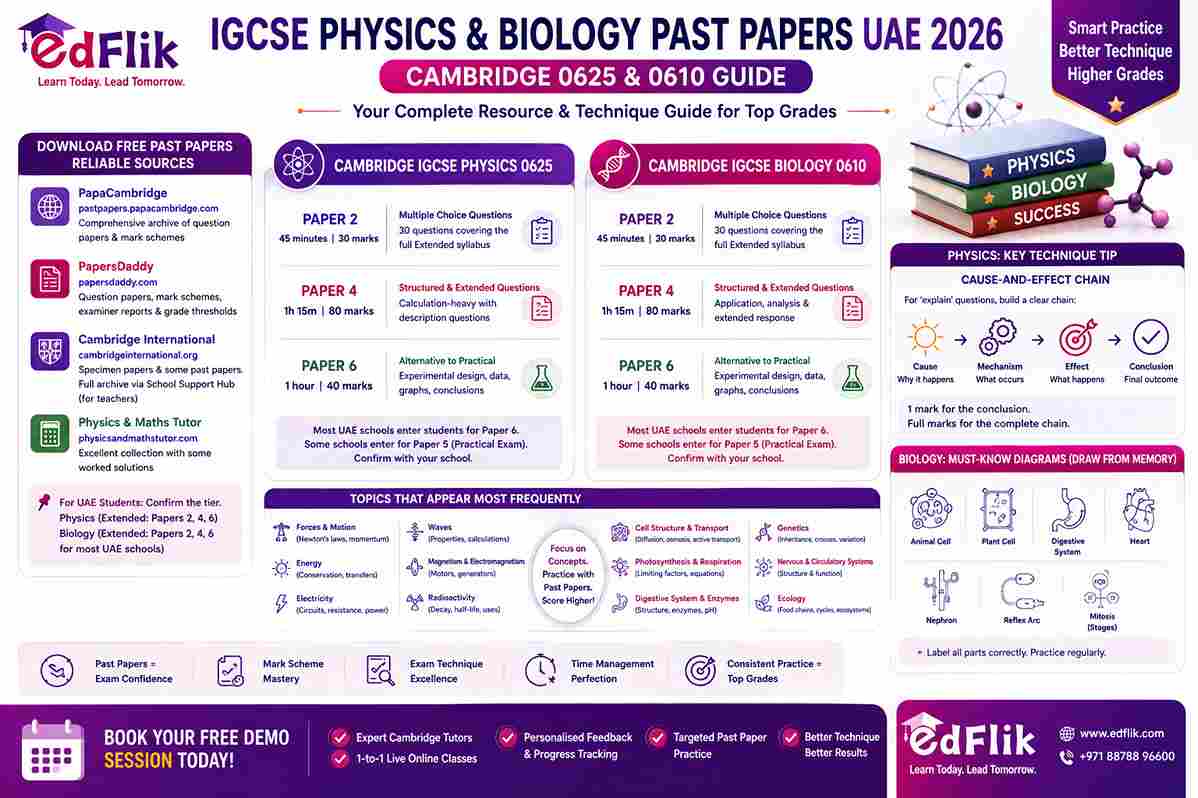
Paper Structure — Physics 0625 and Biology 0610
|
Paper |
Physics 0625 |
Biology 0610 |
Notes for UAE
Students |
|
Paper 2 — MCQ |
30 min, 30 marks |
45 min, 30 marks |
All MCQ — extended tier |
|
Paper 4 — Structured |
1 hr 15 min, 80 marks |
1 hr 15 min, 80 marks |
Mix of short and long structured questions; extended responses
for high-mark questions |
|
Paper 6 — Alt to Practical |
1 hr, 40 marks |
1 hr, 40 marks |
Most UAE schools; experimental design, data, graphs, conclusions |
|
Paper 5 — Practical |
1 hr 15 min, 40 marks |
1 hr 15 min, 40 marks |
Only schools running lab practicals — confirm with your school |
Where to Download 0625 and 0610 Past Papers Free
|
Source |
URL |
Strength |
|
PapaCambridge |
pastpapers.papacambridge.com |
Comprehensive free archive — all papers, all years, mark schemes |
|
PapersDaddy |
papersdaddy.com |
Grade thresholds and examiner reports included |
|
Cambridge International |
cambridgeinternational.org |
Official specimen papers and syllabus — some free past papers |
|
Physics and Maths Tutor |
physicsandmathstutor.com |
Strong for Physics and Biology — topic-sorted past paper
questions and some worked solutions |
|
SaveMyExams |
savemyexams.com |
Papers reorganised by topic — useful for targeting specific weak
areas |
IGCSE Physics 0625 — Examination Technique
The Cause-and-Effect Chain Principle
The single technique that separates A and A* Physics responses from B and C responses in Cambridge IGCSE is the cause-and-effect chain. When Cambridge Paper 4 asks a student to 'explain' a physical phenomenon, the mark scheme awards a mark for each step of the chain — not for the conclusion alone. Students who jump to the conclusion without showing the causal steps lose the majority of available marks.
Example: 'Explain why a gas exerts greater pressure when its temperature is increased (at constant volume).' Cause-and-effect chain answer: 'Increasing temperature increases the average kinetic energy of the gas particles (1 mark). The particles move faster (1 mark), so they collide with the container walls more frequently (1 mark) and with greater force per collision (1 mark). Therefore the pressure increases (1 mark).' A student who writes only 'the particles hit the walls harder' earns 1 mark out of 5. A student who writes the full chain earns 5.
Calculation Questions — What UAE Students Must Always Show
In Cambridge 0625 Paper 4, all calculation questions award method marks for correct working shown. UAE students must show: the formula used; the substitution of values with units; any rearrangement steps; and the final answer with the correct unit. Writing only the final answer earns only the accuracy mark — losing all method marks. A student who uses the wrong formula but shows clear working will earn marks if the subsequent steps are mathematically correct — a student who writes no working earns nothing even for a correct answer.
Unit errors are also mark-losers: if the question specifies speed in m/s and a student gives the answer in km/h without conversion, the accuracy mark is lost even if the numerical value is correct. Always check that the units of the answer match what the question requires.
High-Frequency Physics Topics
|
Topic |
Appears In |
Key Technique |
|
Electricity — circuits |
Every Paper 4 |
V = IR; P = IV; series and parallel rules; draw circuits using
standard symbols |
|
Waves — reflection, refraction, diffraction |
Every Paper 4 |
Wave equation: v = fλ; ray diagrams with correct angles;
wavefront diagrams |
|
Forces and motion |
Every Paper 4 |
F = ma; distance-time and velocity-time graph interpretation;
momentum = mv |
|
Thermal physics |
Every Paper 4 |
Kinetic theory explanation; specific heat capacity; latent heat |
|
Electromagnetism |
Every Paper 4 |
Motor effect; generator effect; transformer equation; Fleming's
rules |
|
Radioactivity |
Every Paper 4 |
Half-life calculations; properties of α, β, γ radiation; nuclear
equations |
IGCSE Biology 0610 — Examination Technique
The 7 Diagrams UAE Biology Students Must Draw from Memory
Cambridge IGCSE Biology 0610 Paper 4 requires students to draw, label, and annotate biological diagrams. Diagrams that appear most consistently across past papers:
1. Animal cell: cell membrane, nucleus (with nuclear membrane), cytoplasm, mitochondria, ribosomes. Must be clearly bounded by a cell membrane (not a cell wall). Rough endoplasmic reticulum for Extended.
2. Plant cell: cell wall (outside cell membrane), chloroplast, large central vacuole, nucleus, cytoplasm, cell membrane, mitochondria. All labelled with lines — not arrows pointing in general directions.
3. The digestive system: mouth, oesophagus, stomach, liver, gall bladder, pancreas (and pancreatic duct), small intestine, large intestine (colon), rectum, anus. Relative positions must be anatomically approximately correct.
4. The heart: four chambers (right and left atria, right and left ventricles), the four valves (tricuspid, bicuspid/mitral, pulmonary semilunar, aortic semilunar), aorta, pulmonary artery, pulmonary vein, vena cava, coronary arteries on the outer surface.
5. The nephron: glomerulus, Bowman's capsule, proximal convoluted tubule, loop of Henle, distal convoluted tubule, collecting duct. Blood vessels entering and leaving the glomerulus.
6. The reflex arc: receptor, sensory neurone, relay neurone (in spinal cord), motor neurone, effector. Arrows showing direction of impulse. Synapses between neurones.
7. Meiosis vs mitosis key distinction: meiosis produces 4 genetically different haploid cells; mitosis produces 2 genetically identical diploid cells. Cambridge often asks students to distinguish these — have the comparison memorised.
Mark-Scheme Language for Biology Description Questions
Cambridge IGCSE Biology 0610 mark schemes use specific biological terminology. Approximate language loses marks. Key correct phrases:
• For osmosis: 'water moves from a region of higher water potential to a region of lower water potential by osmosis through a partially permeable membrane' — never 'water moves from dilute to concentrated' without the membrane and water potential language.
• For active transport: 'substances move against the concentration gradient using energy from ATP (respiration)' — the ATP/energy source is required for the mark.
• For enzyme denaturation: 'the high temperature causes the enzyme's active site to change shape (denature) so the substrate can no longer fit' — 'breaks the enzyme' earns no marks.
• For photosynthesis limiting factors: 'at this point, light intensity is the limiting factor — increasing CO₂ or temperature would not increase the rate' — must identify the factor AND explain why it is limiting.
Grade Boundaries — Physics 0625 and Biology 0610
Cambridge sets grade boundaries after each examination series based on paper difficulty. These are approximate historical ranges for Extended tier (out of 200 total marks across Papers 2, 4, and 6 combined):
|
Grade |
Physics 0625
(approx) |
Biology 0610
(approx) |
Note |
|
A* |
~170 to 190 |
~165 to 185 |
Calculation accuracy + description chains + all 7 Biology
diagrams |
|
A |
~145 to 169 |
~140 to 164 |
Strong method compliance; minor description errors acceptable |
|
B |
~115 to 144 |
~110 to 139 |
Good coverage of core topics; some diagram and description
weaknesses |
|
C |
~85 to 114 |
~80 to 109 |
Foundation in basic concepts and calculation methods |
|
E (minimum) |
~55 to 84 |
~50 to 79 |
Basic recall and calculation competence |
Always check official Cambridge grade threshold tables at cambridgeinternational.org after each series — actual boundaries vary by paper difficulty.
Frequently Asked Questions — IGCSE Physics & Biology Past Papers UAE
Q: Where can I download Cambridge IGCSE Physics 0625 and Biology 0610 past papers free?
A: PapaCambridge (pastpapers.papacambridge.com), PapersDaddy (papersdaddy.com), Cambridge International (official site — specimen papers), and Physics and Maths Tutor (physicsandmathstutor.com). For UAE students: most schools enter Extended tier — Papers 2, 4, and 6 for both subjects.
Q: What is the most important technique for IGCSE Physics description questions?
A: The cause-and-effect chain. Every 'explain' question requires a step-by-step causal sequence — each step earns a separate mark. Jumping to the conclusion without showing the mechanism earns only 1 mark regardless of how many marks the question is worth.
Q: What diagrams must UAE IGCSE Biology students draw from memory?
A: Seven key diagrams: animal cell, plant cell, digestive system, heart (four chambers, four valves, major blood vessels), nephron, reflex arc, and mitosis/meiosis comparison. Each must be accurately labelled with anatomical or biological precision — approximate labels lose marks.
Q: What topics appear most often in IGCSE Biology 0610 past papers?
A: Cell structure and transport (osmosis, diffusion, active transport); photosynthesis and respiration (limiting factors, equations); digestion (enzymes and pH optima); circulatory system; nervous system (reflex arc); genetics (monohybrid crosses, codominance, sex-linkage); ecology (food chains, energy flow, nutrient cycles). Genetics and ecology almost always appear as high-mark Paper 4 extended response questions.
How EdFlik Supports IGCSE Physics and Biology Students Across UAE
EdFlik IGCSE Physics 0625 and Biology 0610 tutors are matched to Cambridge CAIE specifically. Every session uses official past papers with mark-scheme correction. Cause-and-effect chain technique for Physics and correct mark-scheme biological language for Biology are core session components. Sessions from AED 60 per class. Free demo. Book at www.edflik.com.