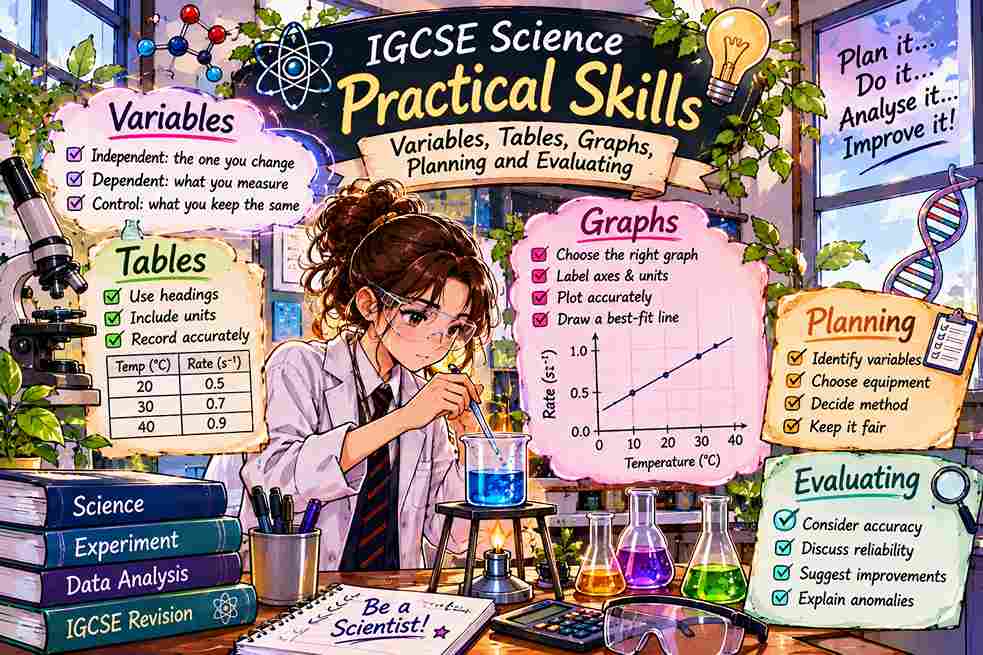
IGCSE Science Practical Skills: Variables, Tables, Graphs, Planning and Evaluating
Last updated: November 2026 | By EdFlik Education Team
Practical skills are examined on every IGCSE science course. On Cambridge, they have their own paper (Paper 5, a practical test, or Paper 6, an alternative to practical). On Edexcel, there is no separate practical paper, but practical skills are tested in the written papers. The skills are the same: plan, measure, record, analyse and evaluate. This guide covers each one.
Variables
Type |
Meaning |
Example: effect of temperature on enzyme activity |
Independent variable |
What you change |
Temperature of the water bath |
Dependent variable |
What you measure |
Time for the starch to disappear |
Control variables |
What you keep the same |
Volume and concentration of enzyme and substrate, pH |
Always state how you will change the independent variable (for example, five temperatures from 20 °C to 60 °C) and how you will measure the dependent variable (for example, with a stopwatch).
Words examiners use
Word |
Meaning |
Accurate |
Close to the true value |
Precise |
Repeat readings close together |
Reliable (repeatable) |
Similar results when the experiment is repeated |
Valid |
The experiment tests only what it is supposed to test (variables controlled) |
Anomaly |
A result that does not fit the pattern |
Resolution |
The smallest change a measuring instrument can show |
Planning an investigation: a checklist
- State the question or hypothesis.
- Name the independent, dependent and control variables.
- List the apparatus with sizes (for example, a 100 cm³ measuring cylinder).
- Write a numbered method that someone else could follow.
- State the range and number of values and the number of repeats.
- Explain how you will process the results (a mean, a graph).
- Identify the main hazard and how you will reduce the risk.
Recording results
- Draw a table before you start, with headings that include units, such as "Time / s".
- Record all raw data to the same number of decimal places.
- Show repeats and a mean column. Ignore an anomaly when calculating the mean, and say you did so.
Worked example: the mean with an anomaly
Three repeats of a time measurement are 24 s, 26 s and 41 s. The 41 s result is an anomaly, so the mean of the other two is (24 + 26) ÷ 2 =25 s. State "41 s was ignored as an anomaly".
Drawing graphs
- Independent variable on the x-axis, dependent variable on the y-axis.
- Choose a scale that uses more than half the grid in each direction, with equal intervals.
- Label both axes with quantity and unit.
- Plot points accurately (a cross or a dot with a small circle) and draw a line of best fit: a smooth curve or a straight line, not dot-to-dot.
- Describe the pattern with a number: "as temperature increases from 20 °C to 40 °C the rate doubles", not just "it increases".
Evaluating an experiment
Weakness |
Improvement |
Only one result at each temperature |
Repeat at least three times and calculate a mean |
Temperature not kept constant |
Use a thermostatically controlled water bath |
Reaction time when using a stopwatch |
Use a data logger, or a larger time interval |
Too few values |
Use more values over a wider range |
Measuring cylinder reads to 1 cm³ |
Use a smaller measuring instrument, such as a pipette or a gas syringe |
A full-mark evaluation names the problem, explains why it affects the results and suggests a specific improvement.
Practice questions
Question |
Answer |
1. A student investigates how the length of a pendulum affects the time for 10 swings. Name the independent and dependent variables. |
Independent: length of the pendulum; dependent: time for 10 swings |
2. Name two control variables for that investigation. |
Mass of the bob and the angle of release |
3. Results: 12.1 s, 12.3 s, 15.9 s. Find the mean ignoring the anomaly. |
12.2 s |
4. Why is timing 10 swings better than timing one? |
It reduces the percentage error from reaction time |
Frequently asked questions
Q: What is the difference between accurate and precise?
Accurate means close to the true value; precise means repeat readings are close to each other.
Q: How do I identify control variables?
List everything that could change the result other than the independent variable, then say how you will keep each the same.
Q: Does Edexcel have a practical exam?
Edexcel Biology, Chemistry and Physics have no separate practical paper, but practical skills are examined in the written papers. Cambridge has Paper 5 or Paper 6.
Q: How many repeats should I do?
At least three, so you can spot an anomaly and calculate a mean.
Try a free trial class with EdFlik. Live 1:1 IGCSE tutoring for Cambridge and Edexcel students in the UAE, matched to your child's board, subject and year group. Book at edflik.com or message us on WhatsApp. |
Related reading
- IGCSE Command Words Explained
- IGCSE Chemistry Rates of Reaction
- IGCSE Science Papers: Cambridge vs Edexcel
Sources
- Cambridge International IGCSE Biology, Chemistry and Physics syllabuses 2026–2028 (practical assessment)
- Pearson Edexcel International GCSE Biology, Chemistry and Physics specifications