
IGCSE Study Plan UAE 2026 — 3-Month, 6-Month and 12-Month Revision Timetables
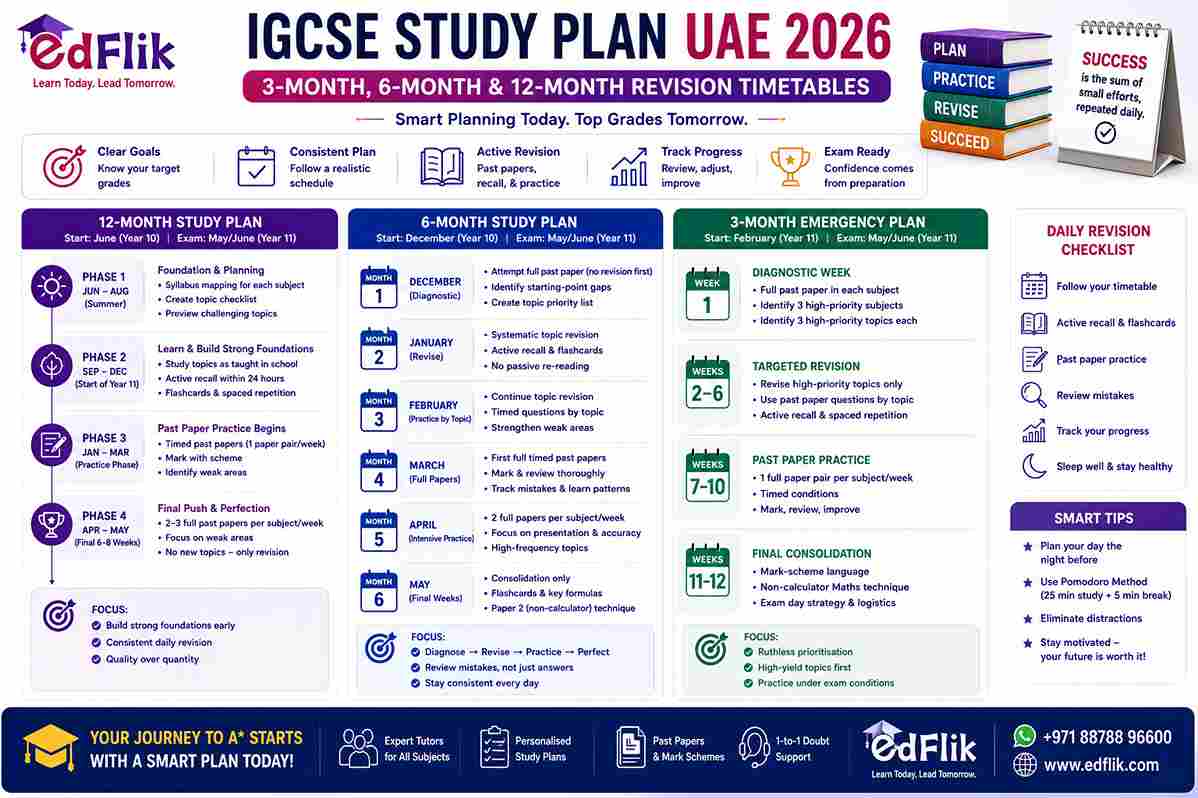
The most common IGCSE revision mistake UAE students make is not spending too little time studying — it is spending time in the wrong way. Revision without structure produces anxiety and the feeling of productivity without the reality of examination improvement. This guide gives UAE students three complete study plan frameworks (12-month, 6-month, and 3-month emergency) calibrated to the UAE school calendar, the Cambridge IGCSE May/June examination series, and the specific subject techniques that produce grade improvement.
Before Starting Any IGCSE Study Plan — Do This First
Before building a study plan, every UAE IGCSE student must do four things:
1. Download the official Cambridge or Edexcel syllabus for each subject you sit. Circle every topic. This is your complete revision checklist — not your textbook's table of contents, not your school's scheme of work, but the official Cambridge document that tells you exactly what is and is not examinable. For Cambridge, go to cambridgeinternational.org and search your subject code.
2. Complete one full past paper per subject under timed conditions before starting revision. This is your diagnostic — it tells you exactly where you are, not where you think you are. Mark it against the official mark scheme and note your score and your specific error types per topic.
3. Rank your subjects by gap: the difference between your diagnostic score and your target grade. The subjects with the largest gap get the most revision time.
4. Identify your highest-priority topic within each subject — the topic that loses you the most marks most reliably. This is where revision starts, not where you feel most comfortable.
The 12-Month IGCSE Study Plan — Starting in June of Year 10
|
Phase |
Months |
Daily/Weekly
Focus |
Goal by End
of Phase |
|
Phase 1 — Syllabus mapping |
June to August (summer) |
30 min/day: read Cambridge syllabus, create topic checklists,
preview hardest topics |
Know what is examinable in each subject; have a complete topic
list per subject |
|
Phase 2 — Active learning |
September to December |
45 min/subject/day: active recall within 24 hours of each school
lesson; build flashcard decks |
Every topic taught in school reviewed and tested within 24 hours;
flashcard decks growing |
|
Phase 3 — Past paper practice |
January to March |
Full past paper pair (P2 + P4) per subject per week; thorough
mark-scheme review |
2 to 3 completed past paper pairs per subject; specific error
types identified and logged |
|
Phase 4 — Consolidation |
April to May |
Full past papers 2 to 3 times/week/subject; high-frequency
flashcard review daily |
6 to 8 completed past paper pairs per subject; mark-scheme
language automatic |
The 6-Month IGCSE Study Plan — Starting in December
Starting in December of Year 10 gives UAE students 5 to 6 months before May/June examinations. This is the most common starting point for families who decide on tutoring support mid-year. The key is speed of diagnostic and subject prioritisation:
|
Month |
Focus |
Daily
Commitment |
Weekly Target |
|
December (Month 1) |
Diagnostic + subject prioritisation |
45 min: 1 diagnostic paper per week per subject |
Complete diagnostics for all subjects; rank by gap size; create
topic priority lists |
|
January (Month 2) |
Intensive topic revision — highest-priority subjects |
1 hr/subject: active recall methods — flashcards, blank-page,
practice questions |
Cover all high-priority topics for Priority 1 and 2 subjects |
|
February (Month 3) |
Continue topic revision + introduce timed questions |
1 hr/subject: topic revision + 30 min timed past paper questions
by topic |
First timed topic-specific practice; identify remaining gaps |
|
March (Month 4) |
First full past papers (Ramadan adjustment — see below) |
Full paper pair 2x/week rotating subjects |
1 to 2 complete papers per subject; first mark-scheme review
cycle |
|
April (Month 5) |
Intensive past paper practice |
Full paper pair 3x/week; prioritise subjects with most
improvement needed |
3 to 4 complete papers per subject; presentation errors corrected |
|
May (Month 6 — final) |
Consolidation and technique |
1 full paper pair per subject; 30 min daily flashcard
high-frequency topics |
No new topics; confidence through repetition of known material |
Ramadan Planning — The UAE-Specific Revision Factor
Ramadan falls in March or April in the 2026 and 2027 UAE school years — directly overlapping with the most intensive phase of IGCSE past paper practice. Most study plan templates from global tutoring providers ignore this. EdFlik does not.
The most effective Ramadan revision approach for UAE IGCSE students:
• Shift intensive study sessions to after Iftar (post-7 PM) when energy levels and concentration are restored. The 9 PM to 11 PM window is productive for most students during Ramadan.
• Pre-Suhoor light review: if already awake for Suhoor, a 15-minute flashcard review of Chemistry observations or Biology diagrams uses the time productively without requiring full concentration.
• Reduce targets by 30 to 40 percent but maintain daily review. Skipping all revision during Ramadan and attempting to compensate in April is consistently less effective than a reduced but maintained daily practice.
• Focus Ramadan revision on spaced repetition of previously learned material — consolidate what you already know rather than introducing challenging new topics under reduced energy conditions.
The 3-Month Emergency Plan — Starting in February
Starting IGCSE revision in February for May/June examinations is genuinely challenging — but not hopeless. The critical constraint: you cannot cover everything. You must make strategic decisions about where to focus limited revision time. The emergency plan:
|
Week |
Action |
Time
Investment |
|
Week 1 |
Diagnostic papers in all subjects (timed); identify top 3
priority subjects and top 3 priority topics per subject |
Spend one full day per diagnostic session; 8 to 10 subjects takes
2 weeks |
|
Weeks 2 to 6 |
Topic-focused revision using past paper questions — not full
papers — for priority topics only; 4 hours per day across priority subjects |
4 hours active revision daily across 3 to 4 priority subjects |
|
Weeks 7 to 10 |
Full timed past papers for priority subjects; mark-scheme review;
presentation error correction |
2 full paper pairs per priority subject per week |
|
Weeks 11 to 12 |
Consolidation only: high-frequency flashcards, Paper 2
non-calculator technique for Maths, exam day logistics |
2 full paper pairs per subject; 30 min daily flashcard review |
The emergency plan requires a clear decision: which 3 or 4 subjects will you try to genuinely improve, and which subjects will you maintain at their current level. Attempting to dramatically improve all 10 subjects in 12 weeks will result in not improving any of them sufficiently. Strategic prioritisation is the emergency plan's most important element.
Subject-Specific Time Allocation — Where to Spend Revision Hours
|
Subject Type |
Recommended
Share of Revision Time |
Reason |
|
Priority 1 subjects (largest grade gap + high stakes for post-16) |
30 to 35% of total revision time |
These subjects determine whether conditional A-Level or IB offers
are met |
|
Priority 2 subjects (medium grade gap) |
25 to 30% of total revision time |
Achievable grade improvement with targeted revision |
|
Priority 3 subjects (close to target grade) |
20 to 25% of total revision time |
Maintenance — prevent slippage rather than major improvement |
|
Remaining subjects |
15 to 20% of total revision time |
Familiarity review only — high-frequency topics and past paper
technique |
Frequently Asked Questions — IGCSE Study Plan UAE
Q: How should UAE students structure a 12-month IGCSE study plan?
A: Phase 1 (June to August): syllabus mapping and preview. Phase 2 (September to December): active recall of every topic within 24 hours of school teaching. Phase 3 (January to March): timed past paper practice — one full pair per subject per week. Phase 4 (April to May): 2 to 3 full papers per subject per week; consolidation and mark-scheme language mastery.
Q: What is the best 6-month IGCSE study plan for UAE students?
A: December: diagnostic papers + subject prioritisation. January: intensive topic revision (active recall). February: topic revision + timed topic-specific questions. March: first full past papers (with Ramadan adjustment). April: intensive past paper practice (3 papers/subject/week). May: consolidation only — no new topics.
Q: What is the best 3-month emergency IGCSE study plan?
A: Week 1 to 2: diagnostic papers — identify top 3 priority subjects and top 3 topics per subject. Weeks 2 to 6: topic-focused revision using past paper questions (not full papers) for priority areas only. Weeks 7 to 10: full timed past papers for priority subjects. Weeks 11 to 12: consolidation, high-frequency flashcards, non-calculator Maths technique.
Q: How should UAE IGCSE students plan revision around Ramadan?
A: Move intensive sessions to post-Iftar (9 PM to 11 PM). Use pre-Suhoor for light flashcard review. Reduce daily targets by 30 to 40 percent but maintain the daily review habit. Focus Ramadan on spaced repetition of known material — not new challenging topics.
Q: How many subjects should UAE students prioritise in their IGCSE study plan?
A: 3 to 4 priority subjects should receive 60 percent of all revision time. Attempting to give equal time to all 10 subjects typically produces mediocre performance across all of them. Prioritise by: gap from target grade; stakes for post-16 pathway; efficiency of revision (technique-sensitive subjects like Maths and Chemistry respond fastest to targeted practice).
How EdFlik Supports IGCSE Students With Structured Revision Plans
EdFlik IGCSE tutors build a subject-specific revision plan in the first session based on the student's diagnostic results and timeline. Sessions from AED 60 per class. Free demo. Book at www.edflik.com.