
IGCSE vs IB in UAE — Which Is Right for Your Child? (2026 Complete Guide)
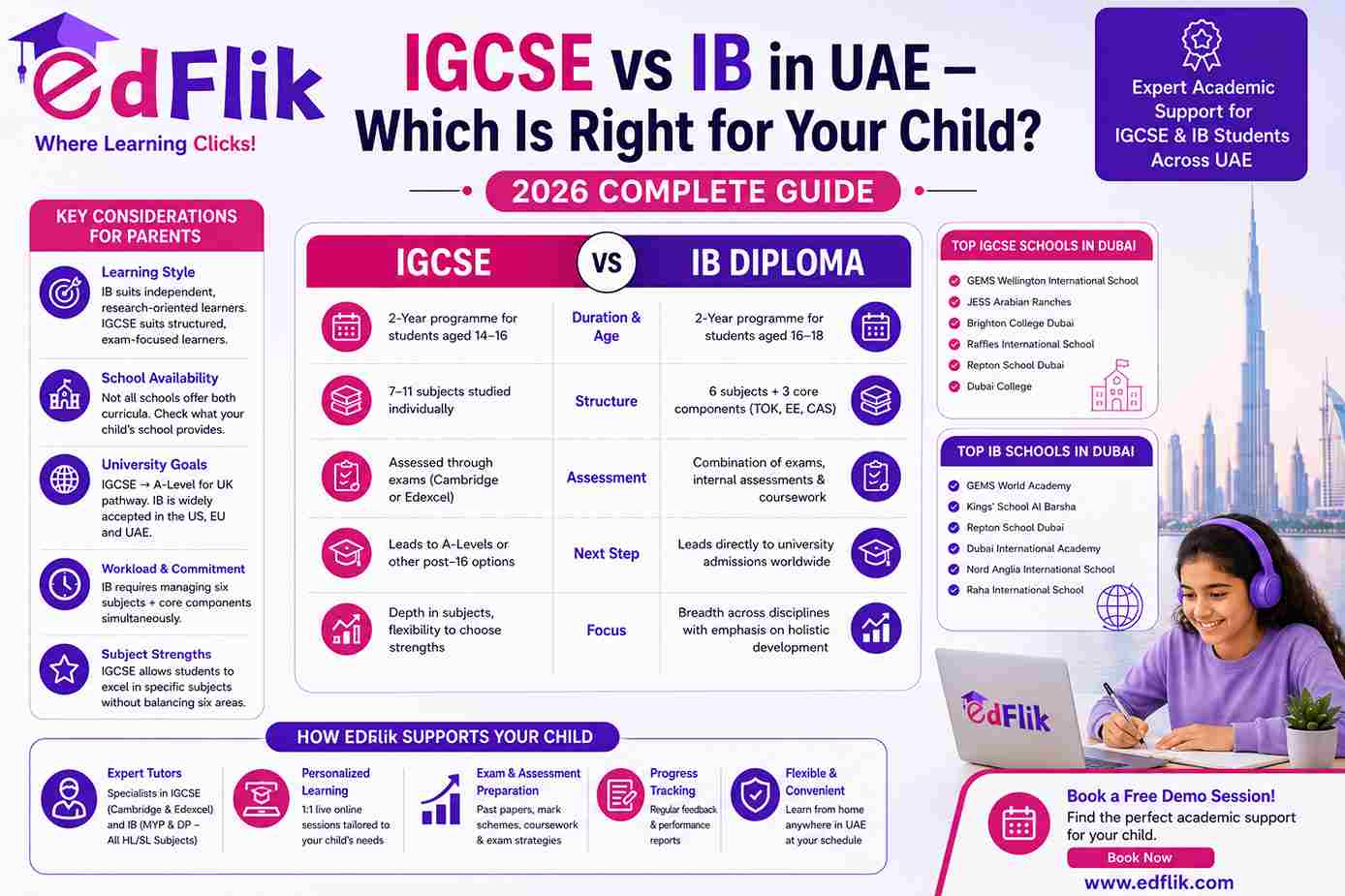
If your child is in Year 8 or Year 9 at a UAE school, the question arrives almost inevitably: IGCSE or IB Diploma? Both qualifications are internationally recognised. Both are offered across some of Dubai and Abu Dhabi's most respected schools. But they are fundamentally different in structure, assessment style, and the type of learner they suit — and choosing the wrong pathway for your child can create years of unnecessary stress.
This guide gives UAE parents a detailed, honest, and specific comparison of IGCSE and IB as they operate in the 2026 context — including assessment structures, university pathways, which learner profile thrives in each, and how EdFlik tutors support students across both programmes. There are no generic statements here. Every comparison is specific to the UAE school environment.
Direct Answer — IGCSE or IB: Which Should Your Child Choose?
The short answer: IGCSE (followed by A-Levels) suits students who are exam-focused, prefer subject-by-subject depth, and are targeting UK, Australian, or Commonwealth universities. The IB Diploma suits students who are independently motivated, academically strong across multiple disciplines, and are considering UK, US, EU, or Canadian universities. For most UAE families, the decision is shaped equally by the child's learning style and the school options available in your emirate and neighbourhood.
What Is IGCSE? A Clear Explanation for UAE Parents
The International General Certificate of Secondary Education (IGCSE) is a two-year qualification for students aged approximately 14 to 16, covering Grades 9 and 10 in the UAE. It is the most widely taught secondary qualification in Dubai, with over 600 private schools in the UAE's education ecosystem offering it in some form.
IGCSE is offered by two examining bodies in UAE schools:
• Cambridge Assessment International Education (CAIE) — the most widely used version across Dubai and Abu Dhabi, with the largest network of authorised schools.
• Pearson Edexcel — offered by a smaller number of schools, typically those with strong UK connections. Edexcel uses a 9–1 grading scale throughout.
Students typically take between 7 and 11 IGCSE subjects. Each subject has its own independent syllabus and is assessed primarily through external examinations held in May/June (Cambridge also runs a smaller November session). Grades for Cambridge IGCSE are awarded on an A* to G scale for most subjects, with some newer syllabuses using a 9–1 scale.
The most important structural feature of IGCSE is its subject independence. Each subject is its own separate qualification. A student who achieves A* in IGCSE Mathematics and a C in IGCSE English Literature has two distinct results that universities assess individually. This is very different from the IB Diploma, where everything is integrated into a single total score.
After completing IGCSE, students following the British pathway progress to A-Levels over two years (Grades 11–12), typically studying 3–4 subjects in depth. A-Level results are the primary university entry qualification for UK, Australian, and many international universities.
KHDA data: In the 2023–24 inspection cycle, 16 of Dubai's 23 Outstanding-rated schools followed a British or British/IB curriculum, confirming the IGCSE pathway's dominant position in the emirate.
What Is the IB Diploma Programme? A Clear Explanation for UAE Parents
The International Baccalaureate Diploma Programme (IBDP) is a comprehensive two-year curriculum for students aged 16 to 18 — Grades 11 and 12 in UAE schools. Unlike IGCSE, where students can excel in some subjects and underperform in others without the overall qualification being affected, the IB Diploma requires students to study six subjects simultaneously across six subject groups, plus three compulsory core components.
The six IB subject groups are: Studies in Language and Literature; Language Acquisition; Individuals and Societies; Sciences; Mathematics; and The Arts (or an additional subject from another group). Students choose each subject at either Higher Level (HL — approximately 240 teaching hours over two years) or Standard Level (SL — approximately 150 hours). Students must study a minimum of three subjects at HL.
The three core components are the Extended Essay (EE) — a 4,000-word independent research essay; Theory of Knowledge (TOK) — a philosophical course examining how knowledge is constructed and justified; and Creativity, Activity, Service (CAS) — 150 hours of extracurricular engagement combining creative, active, and service experiences.
The IB Diploma is scored out of 45 points. Each of the six subjects is marked 1–7, with up to 3 bonus points from the combined TOK and EE grade. A total score below 24 points means a student does not receive the Diploma (though they receive individual subject certificates). Most competitive university programmes in the UK and UAE require 30–32 points minimum; elite programmes often require 38+.
IGCSE vs IB: Side-by-Side Comparison Table
|
Factor |
Cambridge
IGCSE → A-Level |
IB Diploma
Programme |
|
Age range |
Grades 9–10 (IGCSE) + Grades 11–12 (A-Level) |
Grades 11–12 only |
|
No. of subjects |
7–11 subjects at IGCSE; then 3–4 at A-Level |
6 subjects simultaneously |
|
Assessment |
Primarily external exams (May/June). Some coursework elements. |
External exams + Internal Assessments (20–30%) + Extended Essay +
TOK |
|
Grading |
A* to G (CAIE) or 9–1 (Edexcel) per subject |
1–7 per subject; total score out of 45 |
|
Core components |
None beyond subject syllabuses |
TOK + Extended Essay + CAS (all compulsory) |
|
Dubai school examples |
JESS, GEMS Wellington, Raffles, Brighton College |
GEMS World Academy, Kings' School, Repton, Nord Anglia |
|
UK university recognition |
Primary pathway — all UK universities accept A-Levels |
Equally accepted; equivalent point requirements published |
|
US university fit |
Less familiar to some US admissions teams |
Strong fit — EE equivalent to college-level research |
|
Difficulty |
Rigorous per subject; less interdisciplinary |
Broadly considered more demanding overall |
|
Best for |
Structured, exam-focused learners |
Independent, intellectually broad learners |
|
Path after completion |
Progress to A-Levels for university entry |
IB total score directly qualifies for university entry |
|
EdFlik support |
IGCSE (CAIE + Edexcel) — all subjects |
IB MYP + IB Diploma (all HL/SL) — all subjects |
What Type of Learner Thrives in IGCSE?
The IGCSE pathway is best suited to students who display some or most of the following characteristics:
• They perform well in structured, clearly defined examinations with explicit marking schemes.
• They have a strong preference for specific subject areas — STEM or Humanities — and do not necessarily need to excel equally across all disciplines.
• They benefit from subject-by-subject learning without the pressure of managing six demanding courses simultaneously.
• They are targeting UK, Australian, or Commonwealth universities, where A-Levels are the primary and best-understood pathway.
• They may be academically capable but are still developing the self-management skills required for long-form independent projects like the IB Extended Essay.
• Their family may relocate — IGCSE's global standardisation makes transfer between international schools relatively straightforward.
IGCSE also works well for students who are highly motivated in specific areas. A student who wants to be an engineer and is exceptional at Mathematics, Physics, and Chemistry can build a very strong IGCSE and A-Level profile without needing to produce a literary essay or philosophical reflection at a high level.
What Type of Learner Thrives in the IB Diploma?
The IB Diploma is best suited to students who demonstrate the following:
• They are naturally curious and enjoy exploring topics from multiple angles, not just acquiring factual content.
• They are academically strong across multiple disciplines — not just STEM or just Humanities.
• They can manage several significant long-term commitments simultaneously without becoming overwhelmed: six subjects, an Extended Essay, TOK, and CAS.
• They are considering universities in the US, Canada, the Netherlands, Germany, or other European countries where the IB's breadth is specifically valued.
• They prefer a mix of coursework and examinations rather than relying entirely on final exam performance.
• They have strong intrinsic motivation — the IB rewards students who genuinely engage with ideas, not just those who memorise effectively.
It is important to be honest with families: the IB Diploma is genuinely demanding. The combination of six subjects with Internal Assessments, the Extended Essay (which requires genuine independent research of a standard comparable to early undergraduate work), and TOK creates a workload that surprises many students who underestimate it. Consistent tutoring support — particularly for IA deadlines and HL subject revision — can make a significant difference to final outcomes.
University Recognition — IGCSE/A-Level vs IB Diploma
UK Universities
IGCSE followed by A-Levels is the primary and best-understood pathway for UK university entry. All Russell Group universities — including Imperial, UCL, LSE, Edinburgh, and Oxford and Cambridge — have transparent A-Level grade requirements. The IB Diploma is equally accepted, with Russell Group universities publishing specific IB point equivalents (for example, UCL typically requires 38–40 points for its most competitive programmes; medicine commonly requires 40–42 points with 7,7,6 at HL in relevant subjects).
US Universities
The IB Diploma is viewed very favourably by US admissions committees at competitive universities. The Extended Essay demonstrates research capability equivalent to college-level work. The breadth of six subjects across different disciplines aligns with the liberal arts ethos that US universities emphasise. IGCSE with A-Levels is less familiar to some US admissions officers, though well-regarded UK curriculum students with strong A-Level results are fully competitive at US institutions. For US-targeting UAE students, the American curriculum with AP courses remains the most direct pathway.
UAE and Regional Universities
Both A-Level and IB Diploma are accepted by UAE universities including NYU Abu Dhabi, Khalifa University, American University of Sharjah, and American University in Dubai. NYU Abu Dhabi, one of the UAE's most selective institutions, regularly admits students from both pathways based on overall academic strength and extracurricular profile.
European Universities
The IB Diploma has a significant advantage for direct entry to Dutch, German, Swedish, and other Northern European universities, which often publish minimum IB point requirements and find the Diploma's structure familiar. Students with IGCSE and A-Levels can apply but may need to provide additional documentation to confirm equivalency.
Cost Comparison — IGCSE vs IB Schools in UAE
IB World Schools in UAE generally charge higher annual school fees than schools offering only IGCSE and A-Levels. This reflects the higher cost of IB World School authorisation, ongoing professional development requirements for teachers, and the resource-intensive nature of IB programmes including IA moderation. However, this generalisation varies significantly by school.
A rough comparison for Dubai: IGCSE/A-Level school fees typically range from AED 35,000 to AED 95,000 per year. IB Diploma school fees in Dubai typically range from AED 55,000 to AED 120,000 per year. Families should request and compare current fee schedules directly from each school's admissions office, as fees change annually.
Frequently Asked Questions — IGCSE vs IB UAE
Q: What is the main difference between IGCSE and IB in UAE?
A: IGCSE is a two-year, subject-specific qualification for students aged 14–16, assessed mainly through external exams. The IB Diploma is a two-year comprehensive programme for students aged 16–18, requiring six simultaneous subjects plus a 4,000-word Extended Essay, Theory of Knowledge, and 150 hours of CAS. IGCSE focuses on subject depth; IB requires interdisciplinary breadth across all six subject groups. In UAE schools, IGCSE is examined by Cambridge or Edexcel; the IB is awarded by the International Baccalaureate Organisation.
Q: Is IGCSE or IB better for university entry in UAE?
A: Both are globally recognised and accepted by UAE and international universities. IGCSE followed by A-Levels is the standard British pathway — essential for UK universities. The IB Diploma is equally accepted worldwide and is viewed particularly favourably by US and European institutions for its breadth. Neither is universally better — the right choice depends on the child's learning style, intended university country, and available school options.
Q: Which is harder — IGCSE or IB Diploma?
A: The IB Diploma is generally more demanding overall. Students must manage six subjects simultaneously — at least three at Higher Level, equivalent to first-year university study — alongside the Extended Essay, Theory of Knowledge, and CAS commitments. IGCSE requires subject-specific rigour but allows students to focus on each subject independently, which most students find more manageable.
Q: Can my child do IGCSE and then switch to IB Diploma?
A: Yes — this is a common and well-supported pathway in UAE schools. Students complete Cambridge IGCSE in Grades 9–10 and transition to the IB Diploma for Grades 11–12. This is possible either at the same school if it offers both programmes, or by transferring to an IB World School. The IGCSE provides a strong structured foundation, while the IB Diploma's breadth and university recognition are accessed at the most critical stage. Many Dubai schools including GEMS World Academy support this pathway.
Q: Which UAE schools offer IGCSE and which offer IB?
A: Cambridge IGCSE schools in Dubai include JESS Arabian Ranches, GEMS Wellington International School, Raffles International School, and Brighton College Dubai. IB Diploma schools in Dubai include GEMS World Academy Al Barsha, Kings' School Al Barsha, Repton School Dubai, Dubai International Academy, and Nord Anglia International School. In Abu Dhabi, Raha International School and Cranleigh Abu Dhabi offer IB. Always confirm current authorisation status directly with the school, as it can change.
Q: What should parents consider when choosing between IGCSE and IB in UAE?
A: Key factors to consider: (1) Your child's learning style — structured exam-focused learner vs. independent research-oriented thinker. (2) School availability in your area. (3) Target universities and country — UK typically via A-Level; US via IB or American/AP; Europe often favours IB. (4) Your child's ability to manage six demanding subjects simultaneously. (5) Availability of tutoring support for whichever pathway you choose. Speak with the school's curriculum coordinator and, if possible, with an independent education advisor before deciding.
Q: Does EdFlik support both IGCSE and IB students in UAE?
A: Yes. EdFlik provides live 1:1 online tutoring for both IGCSE (Cambridge and Edexcel) and IB (MYP and Diploma, all HL and SL subjects) across all seven UAE emirates. Tutors are matched specifically by programme, subject, and grade level — an IB Chemistry HL specialist is a different tutor from an IGCSE Chemistry specialist, and this distinction matters deeply. Sessions from AED 45 per class. Every new family receives a free demo session with no commitment or credit card required.
How EdFlik Supports IGCSE and IB Students Across UAE
EdFlik tutors for IGCSE students focus on syllabus mastery, mark-scheme language (Cambridge and Edexcel assess answers differently and this distinction matters), past paper technique, and the specific phrasing that earns full marks. For Maths, this means step-by-step method marks. For Sciences, it means command term precision — 'State', 'Explain', and 'Evaluate' require different response styles in IGCSE marking.
For IB Diploma students, EdFlik tutors focus on: IB command term application (Analyse, Evaluate, Discuss, Compare and contrast), Internal Assessment guidance within academic integrity guidelines, Extended Essay structure and argument development, TOK claim and counterclaim writing, and past paper practice at HL and SL level using IB markbands rather than IGCSE mark schemes — a critical distinction that generic tutors often miss.
Sessions from AED 45 per class. No lock-in contracts. Free trial for every new family. Book at www.edflik.com .