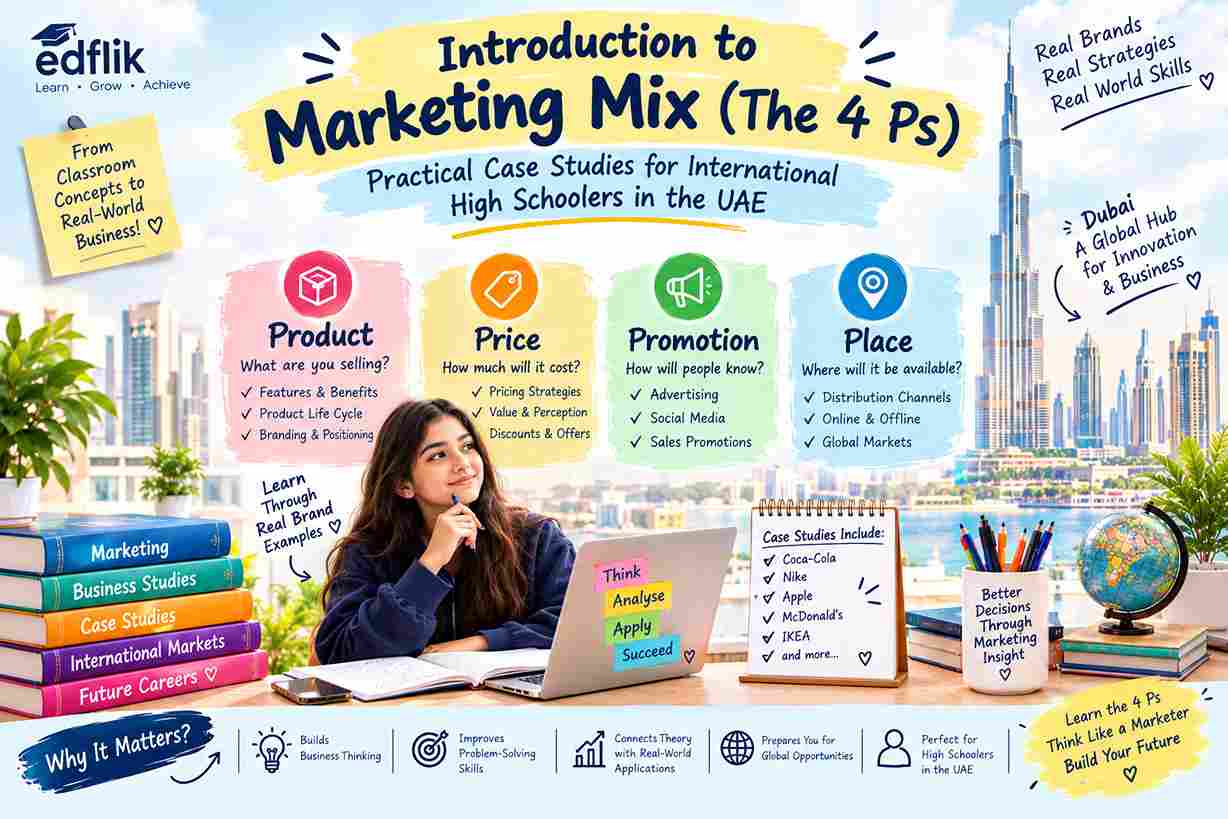
Introduction to Marketing Mix (The 4 Ps): Practical Case Studies for International High Schoolers in the UAE
Last Updated: September 2026 | By EdFlik Education Team
For students studying Cambridge IGCSE / International A-Level Business Studies, IB Career-related Programme (CP), or IB Business Management in international high schools across Dubai, Abu Dhabi, and the wider UAE, business theory comes alive when applied to the dynamic local market.
Among all foundational business concepts, the Marketing Mix—famously known as the 4 Ps (Product, Price, Place, and Promotion)—is the cornerstone of commercial strategy. Whether a business is launching a luxury beachfront hotel in Palm Jumeirah, a homegrown artisanal coffee roastery in Alserkal Avenue, or a mass-market delivery app, every corporate decision filters through the lens of the 4 Ps.
In this comprehensive guide, our expert business studies tutors break down the core components of the Marketing Mix, analyze real-world UAE case studies, and share top exam strategies to secure top grades.
Part 1: Deconstructing the 4 Ps of the Marketing Mix
The Marketing Mix is the tactical toolkit a business uses to influence consumer demand and achieve its marketing objectives. Coined by E. Jerome McCarthy and popularized by Philip Kotler, the framework balances four interrelated variables:
1. Product
The product is what the business offers to satisfy consumer needs or wants. It encompasses physical goods, services, digital experiences, brand identity, packaging, and after-sales customer service.
- Key Consideration: Product differentiation. In a saturated market like the UAE, how does your product stand out from competitors through quality, unique features, or brand prestige?
2. Price
Price is the amount a customer pays to acquire the product. It must reflect the product's perceived value, cover production costs, and align with corporate objectives (e.g., market penetration vs. price skimming).
- Key Consideration: Pricing strategies vary widely—from premium pricing used by luxury hotels in Downtown Dubai to cost-plus pricing or competitive pricing used by hypermarket chains like Carrefour.
3. Place
Place refers to distribution channels—how and where the product is made available to the target market. It includes physical retail storefronts, warehouses, logistics networks, and e-commerce platforms.
- Key Consideration: In the UAE's tech-forward, high-mobile-penetration market, omnichannel distribution (seamless integration of physical retail and fast delivery apps like Instashop or Noon) is essential.
4. Promotion
Promotion covers all the communication tools a business uses to inform, persuade, and remind target consumers about its products. This includes digital marketing, social media campaigns, influencer partnerships, public relations, and sales promotions.
- Key Consideration: Tailoring promotional messaging to local cultural nuances, bilingual Arabic-English marketing campaigns, and leveraging regional social media habits (e.g., Instagram and TikTok influencer culture in Dubai).
Part 2: Real-World UAE Case Studies
To excel in business exams, you must move beyond textbook definitions and apply the 4 Ps to real commercial environments. Let's analyze how businesses in the UAE successfully coordinate their Marketing Mix.
Case Study A: The Premium Strategy — Burj Al Arab & Luxury Hospitality
- Product: Ultra-luxury suites, Michelin-star dining, personalized butler service, and iconic architectural prestige.
- Price: Price Skimming. Charging extremely high night rates to target wealthy international tourists and elites, capitalizing on exclusive brand equity.
- Place: Exclusive physical location on its own man-made island; direct booking via luxury travel agencies and high-end digital platforms.
- Promotion: High-end global public relations, visual storytelling on luxury travel channels, and targeted digital campaigns aimed at high-net-worth individuals.
Case Study B: The Mass-Market Strategy — Al Baik Fast Food
- Product: High-quality, affordable fried chicken, garlic sauce, and fast-food staples that built a massive cult following in Saudi Arabia before expanding across the UAE.
- Price: Penetration Pricing or competitive value pricing. Keeping meals highly affordable to appeal to families, students, and multicultural working populations across Dubai and Sharjah.
- Place: High-footfall physical locations (such as drive-thrus in petrol stations and major malls like The Dubai Mall) paired with strategic delivery partnerships.
- Promotion: Word-of-mouth marketing, community-driven social media hype, and local outdoor billboard advertising celebrating regional expansion.
Part 3: Top 4 Strategies to Score Top Marks in Business Exams
- Evaluate Interdependence (The Marketing Mix is a System): Examiners reward students who recognize that the 4 Ps must align. For example, if a business raises its Price to luxury levels, its Product quality, Place (exclusive boutiques), and Promotion (glossy magazine ads) must instantly reflect that premium positioning. A mismatch will cause the marketing strategy to fail.
- Use Data and Context in Case Studies: When answering case study questions, always quote or reference specific data from the exam insert (e.g., target demographics, disposable income levels, competitor pricing) rather than giving generic answers.
- Master Business Terminology: Use precise vocabulary such as USP (Unique Selling Proposition), price elasticity of demand, distribution channels, brand loyalty, and market segmentation in your essays.
- Structure Evaluation Carefully: For high-tariff evaluation questions ("Discuss whether price is the most important element of the marketing mix..."), argue both sides. Explain why price matters for budget-conscious consumers, but counter with why product quality or brand reputation can override price in luxury or niche markets.
Struggling with Business Studies essay structures, marketing calculations, or preparing for your upcoming IGCSE or IB exams? EdFlik offers expert, 1-to-1 online tutoring customized specifically for international business curricula, helping you build analytical confidence and secure top grades.Book a Free Demo Class Today!
Frequently Asked Questions (FAQs)
Q1: What is the most important P in the Marketing Mix?
Ans: No single P works in isolation. While students often think Price or Product drives sales, a brilliant product at a great price will fail if the Place (distribution) is inaccessible or if Promotion fails to reach the target audience. Their coordination is what creates commercial success.
Q2: How do UAE businesses adapt their Marketing Mix for local consumers?
Ans: UAE businesses tailor their 4 Ps to a uniquely diverse, multicultural, and digitally connected population. This includes offering bilingual (Arabic and English) promotional campaigns, halal product certifications, localized pricing structures, and rapid e-commerce delivery networks.
Q3: What is the difference between price skimming and penetration pricing?
Ans: Price skimming involves setting a high initial price for innovative or luxury products to maximize short-term profits before lowering prices later. Penetration pricing involves setting a deliberately low introductory price to capture market share quickly in competitive mass markets.
Q4: How can EdFlik help me achieve an A or Grade 7 in Business Studies?*
Ans: EdFlik connects you with experienced, certified 1-to-1 online tutors specializing in IGCSE and IB Business curricula. Our tutors guide you through case study analysis, essay evaluation frameworks, and past paper exam practice.