KS3 Tutoring UAE 2026 — Year 7, 8 and 9 Subject Guide for British Curriculum Schools
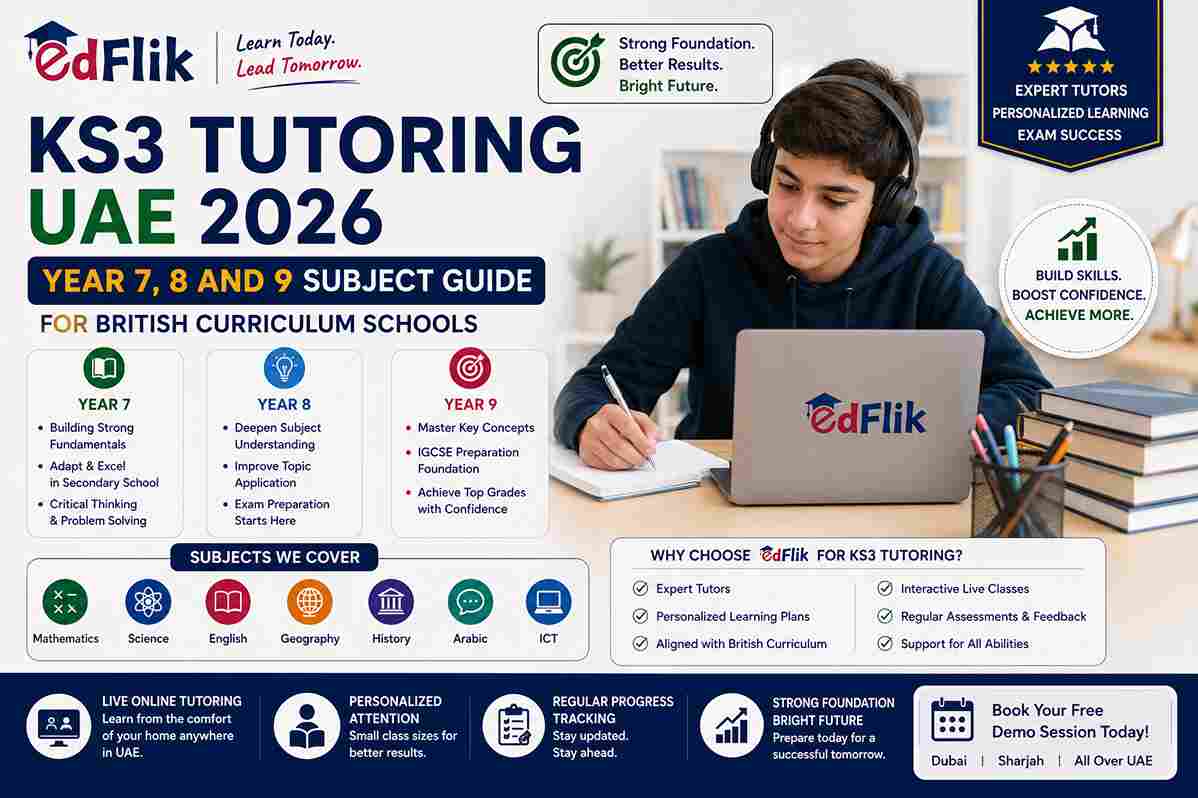
Key Stage 3 — Years 7, 8, and 9 — is the least talked-about phase of British curriculum education in UAE, and the one where the most consequential academic gaps form. By the time a parent notices their child is struggling in IGCSE Year 10, the gap typically started somewhere between Year 7 and Year 9. This guide explains what KS3 covers, what happens at each year level, and why early KS3 intervention produces far better IGCSE outcomes than Year 10 crisis preparation.
What Is KS3 and What Does It Cover?
Key Stage 3 covers Years 7, 8, and 9 — ages 11 to 14 — in all UAE British curriculum schools. It is the transition from primary (KS2) to secondary (KS4, IGCSE). This is the phase where students move from one primary class teacher to multiple secondary subject specialists, the academic content becomes significantly more abstract, and self-directed study becomes expected for the first time.
|
Subject |
Year 7 Focus |
Year 8
Extension |
Year 9 —
IGCSE Bridge |
|
Maths |
Number, basic
algebra, angles, data handling |
Algebraic
manipulation, simultaneous equations intro, trigonometry intro |
Quadratics,
proof, statistical analysis — IGCSE Foundation |
|
English |
Fiction/non-fiction
analysis, paragraph technique |
Persuasive
writing, literary analysis, language effect |
Preparing for
IGCSE text types, close reading, extended writing |
|
Sciences |
Living
organisms, forces, materials — introduction |
Chemical
reactions, waves, cells — deeper conceptual understanding |
Scientific
method, required practical concepts, IGCSE topic bridges |
|
History |
Historical
thinking, source analysis introduction |
Period study
with source evaluation |
IGCSE essay
technique, evidence-based argument |
|
Arabic |
Language
skills continuation from primary |
Grammar
deepening, formal text reading |
IGCSE Arabic B
preparation begins in most UAE schools |
Why KS3 Gaps Become IGCSE Problems
The IGCSE curriculum is designed assuming KS3 foundational skills are in place. It does not re-teach them. Specific examples of how KS3 gaps manifest in IGCSE:
Maths — The Most Common Gap
A Year 9 student who has not fully mastered simultaneous equations and factorisation will struggle from the first half-term of IGCSE Maths Extended, because quadratics and algebraic fractions — both Year 10 topics — require these as prerequisites. A tutor addressing this in Year 9 takes 6 to 8 weeks to close the gap. The same gap identified in Year 10 Term 2 with exams in May has a much shorter resolution window and far higher anxiety attached to it.
Sciences — Scientific Method
Year 8 and Year 9 science introduces the scientific method, experimental variables, and basic chemistry and physics concepts (the particle model, energy transfer, chemical reactions) that underpin all IGCSE Biology, Chemistry, and Physics. Students who coast through KS3 science without genuinely understanding these foundations find Year 10 science overwhelming from September.
English Writing — Structured Essay Skills
IGCSE English Language requires structured, timed essays with specific paragraph organisation, language effect analysis, and accurate grammar under exam conditions. These are KS3 writing skills. Students who have not developed structured essay writing by the end of Year 9 face a steep climb in Year 10 when they must produce these responses reliably under exam conditions.
KS3 Tutoring — What Good Support Looks Like at Each Year Level
|
Year Level |
Ages |
Primary
Tutoring Need |
Strategic
Goal |
|
Year 7 |
11–12 |
Building
confidence and study habits; early Maths algebra foundations |
Prevent gaps
from forming; make the transition to secondary school manageable |
|
Year 8 |
12–13 |
Algebra
deepening, simultaneous equations, scientific method; English essay structure |
Address the
first visible gaps before they compound; maintain engagement |
|
Year 9 |
13–14 |
IGCSE-readiness
in Maths, Sciences, English; bridge to Year 10 content |
Enter IGCSE
Year 10 with solid foundations — changes the entire IGCSE trajectory |
The Long-Term Value of KS3 Tutoring
Parents who engage EdFlik tutoring in Year 7 or Year 8 typically retain the same tutor through IGCSE — a 4 to 6 year tutoring relationship. The tutor knows the student's specific error patterns, learning style, and knowledge gaps. This continuity produces outcomes that a Year 10 crisis engagement simply cannot match in the available time.
|
EdFlik
provides KS3 tutoring for UAE British curriculum students in Years 7, 8, and
9 across Maths, Sciences, English, Arabic, and other subjects. From AED 50
per session. Free diagnostic trial. Book at www.edflik.com or WhatsApp +91
88788 96600. |
Frequently Asked Questions
Q: What is KS3 and what age is it for UAE British curriculum students?
Key Stage 3 covers Years 7, 8, and 9 — ages 11 to 14. It is the secondary school transition between KS2 primary and KS4 IGCSE in UAE British curriculum schools.
Q: What subjects are taught in KS3 at UAE British curriculum schools?
English, Maths, Sciences (Biology, Chemistry, Physics), History, Geography, Arabic, IT/Computer Science, Drama, Arts, PE, and sometimes a modern language — much broader than IGCSE.
Q: Why do KS3 gaps cause IGCSE problems?
IGCSE assumes KS3 foundational skills are in place — it does not re-teach them. Algebra gaps from Year 8, scientific method gaps from Year 9, and essay writing gaps from Years 7–9 all directly affect IGCSE performance from Year 10.
Q: When should my Year 7 or 8 child start tutoring?
As soon as a consistent pattern appears — repeated low marks, teacher comments about a gap, or effort not translating into results. Year 7 or 8 intervention is far more efficient than Year 10 crisis preparation.
Q: What is the most common KS3 subject where UAE students need tutoring?
Maths, reflecting the significant content jump between KS2 number/measure and KS3 algebra and geometry. Sciences and English Writing are the next most common.