
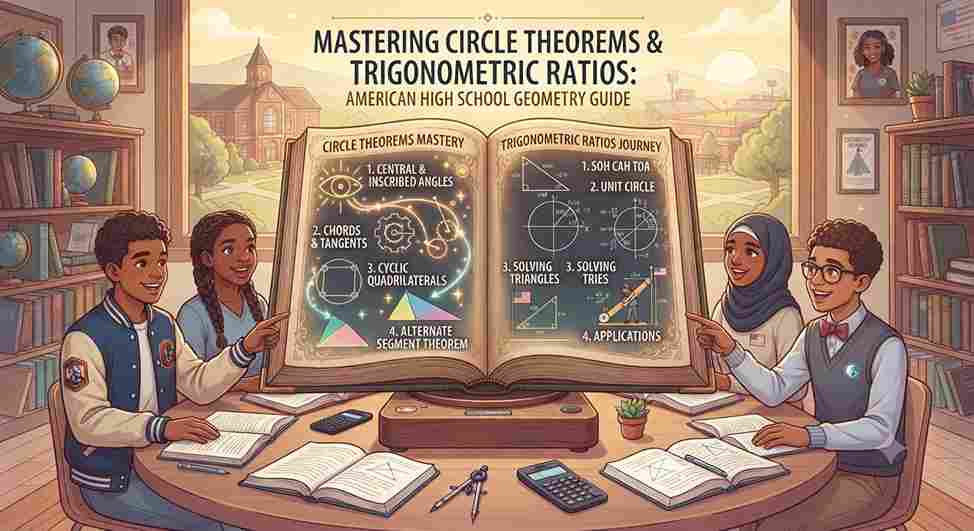
Mastering Circle Theorems and Trigonometric Ratios: American High School Geometry Guide
Last Updated: September 2026 | By EdFlik Education Team
For American high school students studying Geometry (Common Core, Honors, or AP-prep tracks), few topics carry as much weight on final exams, SAT/ACT tests, and college entrance benchmarks as Circle Theorems and Trigonometric Ratios. These foundational pillars bridge visual spatial reasoning with rigorous algebraic problem-solving.
Whether you are calculating intercepted arcs, proving cyclic quadrilateral properties, or using right-triangle trigonometry and the Laws of Sines and Cosines to solve oblique triangles, mastering these concepts requires moving beyond memorization to deep conceptual understanding.
In this comprehensive, in-depth guide, our expert math educators break down the core circle theorems, demystify right-triangle and non-right-triangle trigonometry, and share proven problem-solving strategies to help you ace your math assessments.
Part 1: Unlocking Circle Theorems
Circles are among the most elegant and rule-governed shapes in geometry. When multiple lines, secants, tangents, and chords interact with a circle, specific geometric relationships emerge. Here are the essential circle theorems you must memorize and apply:
1. Central Angles vs. Inscribed Angles
- Central Angle Theorem: The measure of a central angle is equal to the measure of its intercepted arc. If $\text{arc } AB = 70^\circ$, then the central angle subtended at the center is also $70^\circ$.
- Inscribed Angle Theorem: The measure of an inscribed angle (whose vertex lies on the circle) is half the measure of its intercepted arc. If an inscribed angle intercepts a $100^\circ$ arc, the angle measures $50^\circ$.
2. Special Inscribed Angle Properties
- Angles Subtended by the Same Arc: Inscribed angles that intercept the same arc are congruent (equal in measure).
- Thales's Theorem (Angle in a Semicircle): An inscribed angle that intercepts a semicircle (i.e., its sides pass through the endpoints of a diameter) is always a right angle ($90^\circ$).
3. Cyclic Quadrilaterals
A cyclic quadrilateral is a four-sided polygon inscribed inside a circle such that all four vertices touch the circumference.
- Opposite Angles Supplementary Theorem: The opposite angles of any cyclic quadrilateral always add up to $180^\circ$ ($\angle A + \angle C = 180^\circ$ and $\angle B + \angle D = 180^\circ$).
4. Tangents, Secants, and Chord Intersections
- Radius-Tangent Theorem: A radius drawn to the point of tangency is always perpendicular ($90^\circ$) to the tangent line.
- Intersecting Chords Theorem: If two chords intersect inside a circle, the product of the lengths of the segments of one chord equals the product of the segments of the other ($a \times b = c \times d$).
Part 2: Mastering Trigonometric Ratios
When circles intersect right triangles or when you analyze coordinate geometry, trigonometry takes center stage.
1. Right-Triangle Trigonometry (SOH-CAH-TOA)
For any right-angled triangle, the three fundamental ratios relate the side lengths to an acute interior angle $\theta$:
- $\sin(\theta) = \frac{\text{Opposite}}{\text{Hypotenuse}}$
- $\cos(\theta) = \frac{\text{Adjacent}}{\text{Hypotenuse}}$
- $\tan(\theta) = \frac{\text{Opposite}}{\text{Adjacent}}$
2. Special Right Triangles ($30^\circ\text{-}60^\circ\text{-}90^\circ$ and $45^\circ\text{-}45^\circ\text{-}90^\circ$)
Before reaching for your calculator, memorize these exact ratio rules:
- $45^\circ\text{-}45^\circ\text{-}90^\circ$ Triangle: The legs are equal ($x$), and the hypotenuse is $x\sqrt{2}$.
- $30^\circ\text{-}60^\circ\text{-}90^\circ$ Triangle: The shorter leg is $x$, the hypotenuse is $2x$, and the longer leg (opposite the $60^\circ$ angle) is $x\sqrt{3}$.
Part 3: Extending Beyond Right Triangles (Law of Sines & Law of Cosines)
Geometry problems frequently present non-right triangles (oblique triangles). To solve them, you must use advanced trigonometric laws:
1. The Law of Sines
Used when you know an angle and its opposite side (Angle-Angle-Side or Side-Angle-Side cases):
$$\frac{a}{\sin(A)} = \frac{b}{\sin(B)} = \frac{c}{\sin(C)}$$
2. The Law of Cosines
Used when you have Side-Side-Side (SSS) or Side-Angle-Side (SAS) data:
$$c^2 = a^2 + b^2 - 2ab \cos(C)$$
Part 4: Top 4 Strategies to Ace Geometry Exams
- Always Draw and Label Diagrams: If a word problem describes a circle with intersecting secants or a triangular plot of land, sketch it immediately. Visualizing the geometric relationships prevents careless algebraic errors.
- Look for Auxiliary Lines: Many complex circle proofs require drawing a radius from the center to a point of tangency or chord midpoint to create hidden right triangles.
- Check Your Calculator Mode: Ensure your calculator is set to Degrees (not Radians) unless specifically prompted by advanced pre-calculus questions.
- Justify Every Step in Proofs: When answering geometry proof prompts, clearly state the geometric theorem (e.g., "Inscribed angles intercepting the same arc are congruent") as your mathematical justification.
Struggling with high school geometry proofs, circle theorems, or trigonometry word problems? EdFlik offers expert, 1-to-1 online tutoring customized specifically for American high school curriculum standards (Common Core, Honors, and AP), helping you master difficult math topics and secure top grades.Book a Free Demo Class Today!
Frequently Asked Questions (FAQs)
Q1: How do I know whether to use the Law of Sines or the Law of Cosines?
Ans: Use the Law of Sines when you have a "matching pair" of a known side and its opposite angle. Use the Law of Cosines when you are given all three sides (SSS) or two sides with an included angle (SAS).
Q2: What is the difference between a secant line and a tangent line in circle geometry?
Ans: A secant intersects a circle at exactly two points, passing through its interior. A tangent touches the circle at exactly one single point on its outer circumference.
Q3: Are circle theorems heavily tested on the SAT and ACT?
Ans: Yes! Standardized tests routinely feature circle equation formulas $(x-h)^2 + (y-k)^2 = r^2$, central/inscribed angle relationships, and right-triangle trigonometry ratios.
Q4: How does EdFlik support high school math students?
Ans: EdFlik connects students globally with vetted, experienced 1-to-1 online tutors specializing in American High School Math, Geometry, Algebra II, and SAT/ACT test preparation. Our sessions focus on conceptual clarity, rigorous problem-solving, and building exam confidence.