Mastering Difficult Words in Context on the Digital SAT: High-Frequency Root Words List
Last Updated: October 2026 | By EdFlik Education Team
For high school students preparing to tackle the Digital SAT Reading and Writing (RW) section—whether testing at international test centers across Dubai, Abu Dhabi, or worldwide—vocabulary questions are among the most direct ways to secure fast points.
Gone are the days of the old paper SAT’s obscure, archaic vocabulary flashcards where students had to memorize definitions for bizarre words they would never encounter again in real life. The Digital SAT "Words in Context" questions are much more sophisticated. They test your ability to determine how a precise, high-utility academic word functions within the specific logic of a sentence.
However, when facing advanced options like equivocal, ameliorate, recalcitrant, or pusillanimous, many students freeze. Relying solely on context clues is risky when multiple answer choices look deceptively similar. The ultimate secret to mastering Words in Context is combining contextual reasoning with a powerful mental database of high-frequency Greek and Latin root words.
In this comprehensive, exam-focused masterclass guide, our expert SAT reading strategists break down how vocabulary is tested on the Digital SAT, introduce a high-frequency root words master list, and provide a tactical execution framework to help you eliminate distractors and secure a top score.
Part 1: Anatomy of Digital SAT "Words in Context" Questions
On the Digital SAT RW section, vocabulary questions appear early in Module 1 and Module 2, typically accounting for roughly 15% to 20% of all reading questions.
The Question Format:
You will be given a short 2-to-4 sentence passage containing a blank. Four sophisticated vocabulary words are provided as options. Your job is to select the word that best fits the precise logical, emotional, or structural tone of the passage.
The Two Golden Rules of Digital SAT Vocabulary:
- Context is King: The correct answer is never just a "good vocabulary word"—it is the word that is logically demanded by the surrounding clues in the sentence (often signaled by contrast words like however, conversely, although or support words like furthermore, consequently, thus).
- Negative and Positive Valence: Before looking at the definition of a word, determine its valence (is the blank requiring a positive, complimentary word, or a negative, critical word?). Eliminating words with the wrong valence instantly cuts your choices in half.
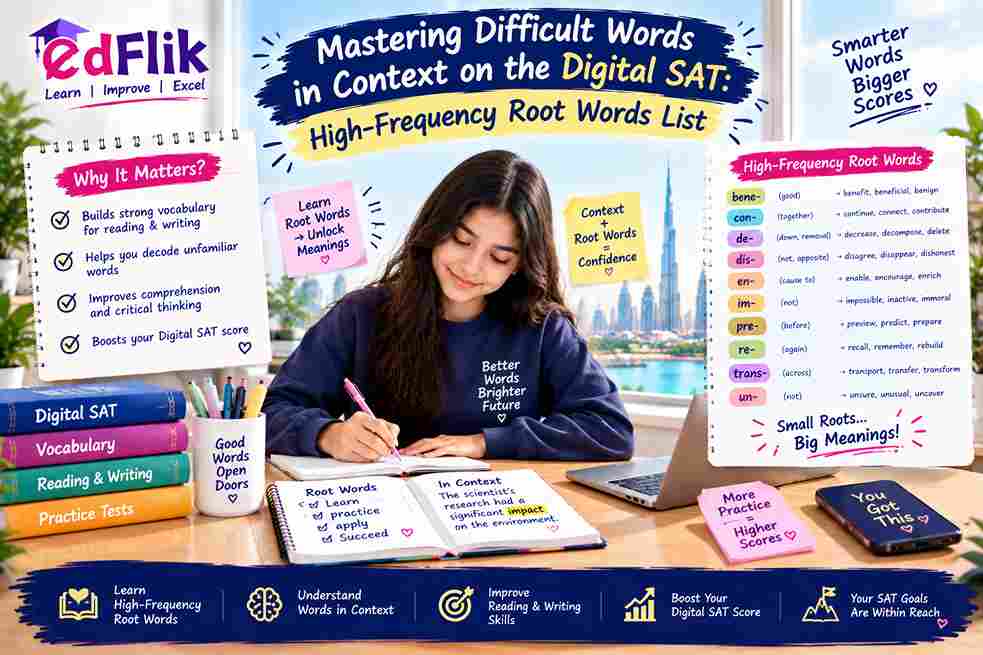
Part 2: The High-Frequency Root Words Master List
While thousands of words exist in English, the College Board repeatedly draws from a core cluster of Greek and Latin roots. Mastering these roots allows you to decode unfamiliar words on test day with surgical precision.
1. Roots of Motion, Change, and Action
- Ambul- (Walk, Move): Ambulatory (able to walk), Somnambulist (sleepwalker).
- Cess-, Ced- (Yield, Go): Recapitulate (summarize), Concede (yield/admit defeat), Incessant (unending/going without stop).
- Grad-, Gress- (Step, Go): Retrograde (moving backward), Digress (wandering off topic in speech or writing).
- Flu-, Fluc- (Flow): Effusive (expressing emotional outpouring), Confluence (a flowing together/meeting place).
2. Roots of Speech, Thought, and Mind
- Loqu-, Loc-, Dict- (Speak, Talk): Loquacious (talkative), Garrulous (excessively talkative), Malediction (a curse), Elocution (articulate speaking style).
- Cogn-, Gno- (Know): Incognito (with identity concealed), Cognitive (pertaining to mental processing), Diagnose (to know thoroughly).
- Cred- (Believe): Credulous (too trusting/gullible), Incredible (unbelievable), Credence (belief as true).
- Sci- (Knowing): Omniscient (all-knowing), Conscientious (guided by conscience/thorough).
3. Roots of Scale, Size, and Measurement
- Magn- (Large, Great): Magnanimous (generous/forgiving), Magnify (enlarge), Magisterial (authoritative).
- Micro-, Min- (Small): Diminish (make smaller), Minutiae (trivial small details), Microscopic (invisible to naked eye).
- Multi- (Many): Multifarious (diverse/having many parts), Multitude (a great number).
- Pau-, Pov- (Few, Little, Poor): Paucity (scarcity/smallness of number), Poverty (state of being poor).
4. Roots of Conflict, Emotion, and Attitude
- Bell- (War, Fight): Belligerent (hostile/aggressive), Bellicose (eager to fight), Antebellum (existing before a war, especially the Civil War).
- Pac-, Pax- (Peace): Pacify (calm down), Appease (pacify by acceding to demands).
- Bene-, Bon- (Good): Benevolent (kind), Benign (harmless), Bonafide (genuine/in good faith).
- Mal- (Bad, Evil): Malevolent (wishing harm), Malign (speak critically of), Maladroit (clumsy/inept).
- Pusill- (Small, Weak): Pusillanimous (showing a lack of courage/timid).
Part 3: Step-by-Step Execution Framework for Vocabulary Questions
When you encounter a Words in Context question on test day, use this four-step tactical protocol:
Step 1: Read the Sentence and Cover the Blank
Do not look at the four answer choices yet. Read the sentence with the blank, cover the blank with your finger or cursor, and read the surrounding context clues.
Step 2: Formulate Your Own Prediction
Based on the transition words (however, therefore, similarly), invent your own simple word or phrase to fill the blank.
- Example: If the sentence says, "Although the politician’s early speeches were fiery and persuasive, her latest address was remarkably _______, offering vague generalizations instead of concrete plans," your mental prediction for the blank is weak, vague, or unconvincing.
Step 3: Check Valence and Root Meanings
Scan the four answer choices (e.g., A) compelling, B) nebulous, C) rigorous, D) succinct).
- Eliminate words with the wrong valence immediately.
- Use your root knowledge: Nebulous comes from the root nebula (cloud/fog), meaning cloudy, vague, or unclear. It matches your prediction perfectly!
Step 4: Substitute and Verify Logic
Plug your selected choice back into the sentence and re-read it. Does the sentence flow logically? Does it make complete grammatical and thematic sense in context? If yes, lock it in and move on.
Part 4: Top 4 Traps That Cost Students Vocabulary Points
- Falling for the "Sound-Alike" Trap: Choosing a word simply because it sounds sophisticated or matches a vocabulary list you crammed the night before, even though its strict definition contradicts the sentence logic.
- Ignoring Contrast Transition Words: Misinterpreting words like despite, although, however, or paradoxically, leading you to select a synonym when the sentence actually requires an antonym.
- Relying on Partial Root Memorization: Assuming a root always means one thing without checking prefixes (e.g., confusing benign with malign because both start with related body terms).
- Over-Complicating Simple Sentences: Overthinking a straightforward context clue because you assume every SAT question must have a trick. Trust the direct context clues in the text!
Preparing for the Digital SAT and aiming for a top score of 1500+? EdFlik connects international school students globally with expert, 1-to-1 online SAT tutors, helping you master vocabulary roots, active reading strategies, and exam-day pacing.Book a Free Demo Class Today!
Frequently Asked Questions (FAQs)
Q1: How many vocabulary questions are on the Digital SAT?
Ans: "Words in Context" questions make up roughly 15% to 20% of the entire Reading and Writing section across both adaptive modules, representing a critical block of score points.
Q2: Is it better to memorize raw definitions or root words?
Ans: Learning Greek and Latin root words is infinitely more powerful than memorizing isolated definitions. Roots allow you to decode and estimate the meanings of unfamiliar words you have never seen before on exam day.
Q3: Can context clues always save me if I don't know the vocabulary words?
Ans: Context clues help narrow down the valence (positive or negative), but the Digital SAT often features nuanced answer choices where multiple words share a similar valence. Knowing core root words gives you the precision needed to pick the exact right synonym.
Q4: How does EdFlik support Digital SAT preparation?
Ans: EdFlik connects international school students worldwide with vetted, expert 1-to-1 online SAT tutors specializing in both RW and Math sections. Our personalized coaching focuses on vocabulary mastery, evidence-based reading strategies, and timed exam execution.