Mastering IGCSE Biology: Cell Division, Genetics Revision, and Science Tutoring Across Dubai and Sharjah
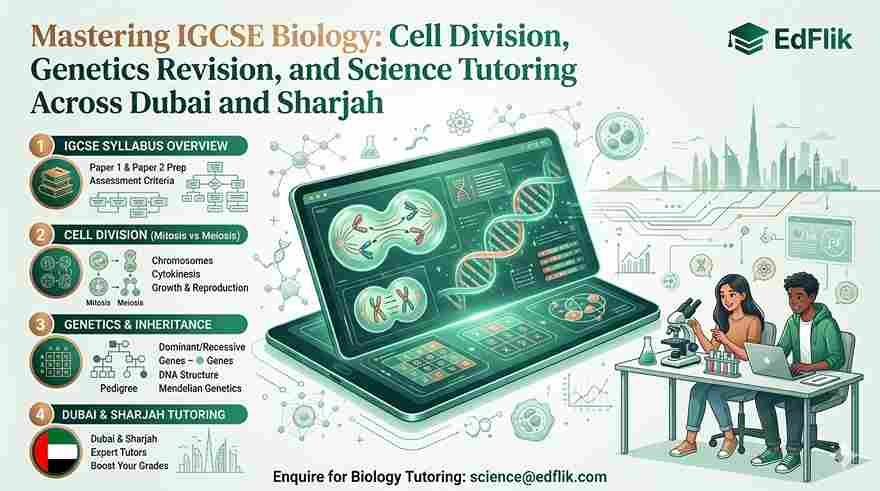
Last Updated: September 2026 | By EdFlik Education Team
For students studying Cambridge IGCSE Biology (0610 / 0970) or Pearson Edexcel IGCSE Biology in international schools across the UAE—including Dubai, Sharjah, and Abu Dhabi—mastering cellular biology and genetics is an absolute prerequisite for securing an $A^*$.
While topics like ecology and plant nutrition rely heavily on descriptive recall, Cell Division (Mitosis and Meiosis) and Inheritance (Genetics) require a deep, mechanistic understanding of how genetic information is copied, packaged, and transmitted across generations. Many students struggle in these units because they confuse key terms like chromosome, chromatid, gene, and allele, or make calculation errors when interpreting genetic cross diagrams (Punnett squares).
In this comprehensive guide, our expert IGCSE science tutors break down essential revision notes on cell division and genetics, share step-by-step problem-solving strategies, and explain how working with specialized science tutoring Sharjah and Dubai providers can give you a massive academic advantage.
Part 1: Revision Notes — Cell Division (Mitosis vs. Meiosis)
Cells divide continuously in living organisms for growth, repair, asexual reproduction, and the production of gametes. You must be able to clearly distinguish between the two types of cell division.
1. Mitosis: Growth, Repair, and Asexual Reproduction
- Definition: A type of nuclear division that gives rise to two genetically identical diploid cells (having the same number of chromosomes as the parent cell).
- Key Stages (PMAT):
- Prophase: Chromosomes condense, become visible as two sister chromatids joined by a centromere, and the nuclear envelope breaks down.
- Metaphase: Chromosomes line up along the equator (metaphase plate) of the cell, attached to spindle fibers.
- Anaphase: Sister chromatids are pulled apart to opposite poles of the cell by contracting spindle fibers.
- Telophase: Two new nuclear envelopes form around the separated sets of chromosomes, followed by cytokinesis (division of the cytoplasm).
- Significance: Essential for growth, tissue repair, cell replacement, and asexual reproduction in organisms.
2. Meiosis: Producing Gametes for Sexual Reproduction
- Definition: A reduction division in which the chromosome number is halved from diploid ($2n$) to haploid ($n$), resulting in four genetically unique haploid cells (gametes like sperm and egg cells).
- Significance: Produces genetic variation through independent assortment and crossing over during Prophase I, ensuring offspring are genetically distinct from parents.
Part 2: Genetics Revision Guide — Inheritance and Punnett Squares
Genetics is the study of heredity and the variation of inherited characteristics. Examiners test your ability to trace how alleles pass from parents to offspring using standard genetic terminology and pedigree charts.
1. Essential Genetic Terminology
- Gene: A section of DNA that codes for a specific protein (and thus a particular characteristic).
- Allele: Alternative forms of the same gene (e.g., the gene for eye color has alleles for brown or blue).
- Genotype: The genetic makeup of an organism expressed in alleles (e.g., $Bb$, $TT$, $cc$).
- Phenotype: The observable physical or biochemical characteristics of an organism resulting from its genotype and environment (e.g., brown eyes, tall height).
- Homozygous vs. Heterozygous: Having two identical alleles for a characteristic ($BB$ or $bb$) versus having two different alleles ($Bb$).
- Dominant vs. Recessive: A dominant allele is always expressed if present ($B$), whereas a recessive allele is only expressed if two copies are present ($b$).
2. Step-by-Step Punnett Square Problem
Problem: In pea plants, tall height ($T$) is dominant over dwarf height ($t$). Cross a heterozygous tall plant ($Tt$) with a homozygous dwarf plant ($tt$). Predict the phenotypic ratio of the offspring.
- Step 1: Identify parental genotypes: $Tt \times tt$.
- Step 2: Determine possible gametes produced by each parent: Parent 1 ($T$ or $t$), Parent 2 ($t$ or $t$).
- Step 3: Construct the Punnett grid and fill in the crosses:
- Top row: $T$ and $t$ | Left column: $t$ and $t$
- Grid results: Two $Tt$ (heterozygous tall) and two $tt$ (homozygous dwarf).
- Step 4: State the phenotypic ratio: 1 Tall : 1 Dwarf (or a 50% chance of each).
Part 3: The Advantage of Specialized Science Tutoring in Dubai and Sharjah
IGCSE Biology demands a rigorous blend of factual recall, data analysis, and experimental design. If a student falls behind during middle school or early Year 10, catching up independently can feel overwhelming.
Partnering with an expert provider of science tutoring Sharjah and Dubai services offers targeted advantages:
- Interactive Visual Explanations: Breaking down abstract microscopic processes like cell division and protein synthesis using clear, step-by-step digital models.
- Exam Technique Mastery: Learning how command words (describe, explain, evaluate, calculate) are graded by Cambridge and Edexcel examiners.
- Targeted Past Paper Practice: Simulating real exam conditions to eliminate careless errors in genetics crosses and data response questions.
Part 4: Top 4 Strategies to Secure an $A^*$ in IGCSE Biology
- Master Biological Definitions Verbatim: Terms like osmosis, allele, codominance, and mitosis have precise scientific definitions in mark schemes. Do not rely on loose everyday language; memorize exact definitions.
- Practice Genetic Crosses Repeatedly: Never eyeball a Punnett square. Always write out parental phenotypes, genotypes, gametes, and offspring ratios clearly in structured steps.
- Learn How to Analyze Data Tables and Graphs: IGCSE Biology Paper 2 and Paper 4 frequently feature unfamiliar experimental data. Practice extracting trends, calculating percentage changes, and explaining anomalies.
- Review Examiner Reports: Read official Cambridge and Edexcel examiner reports to identify common pitfalls—such as confusing mitosis with meiosis or mislabeling chromosome diagrams.
Struggling with cell division, genetics inheritance problems, or preparing for your IGCSE Biology exams across Dubai and Sharjah? EdFlik offers expert, 1-to-1 online tutoring customized specifically for international school students, helping you build scientific confidence and secure an $A^$.*Book a Free Demo Class Today!
Frequently Asked Questions (FAQs)
Q1: What is the main difference between mitosis and meiosis?
Ans: Mitosis produces two genetically identical diploid cells used for growth and repair. Meiosis produces four genetically unique haploid cells (gametes) used for sexual reproduction, halving the chromosome number.
Q2: What does codominance mean in IGCSE genetics?
Ans: Codominance occurs when neither allele is recessive; both alleles are equally expressed in the phenotype of a heterozygous organism (e.g., AB blood type in humans or roan cattle coats).
Q3: How many chromosomes do human body cells have compared to gametes?
Ans: Normal human body (somatic) cells are diploid and contain 46 chromosomes ($23$ pairs). Human gametes (sperm and egg cells) are haploid and contain 23 single chromosomes.
Q4: How can EdFlik help me find science tutoring in Dubai and Sharjah?
Ans: EdFlik connects students across Dubai, Sharjah, and the UAE with vetted, experienced 1-to-1 online science tutors. Our personalized sessions focus on clarifying difficult biological concepts, mastering past papers, and building exam technique.