
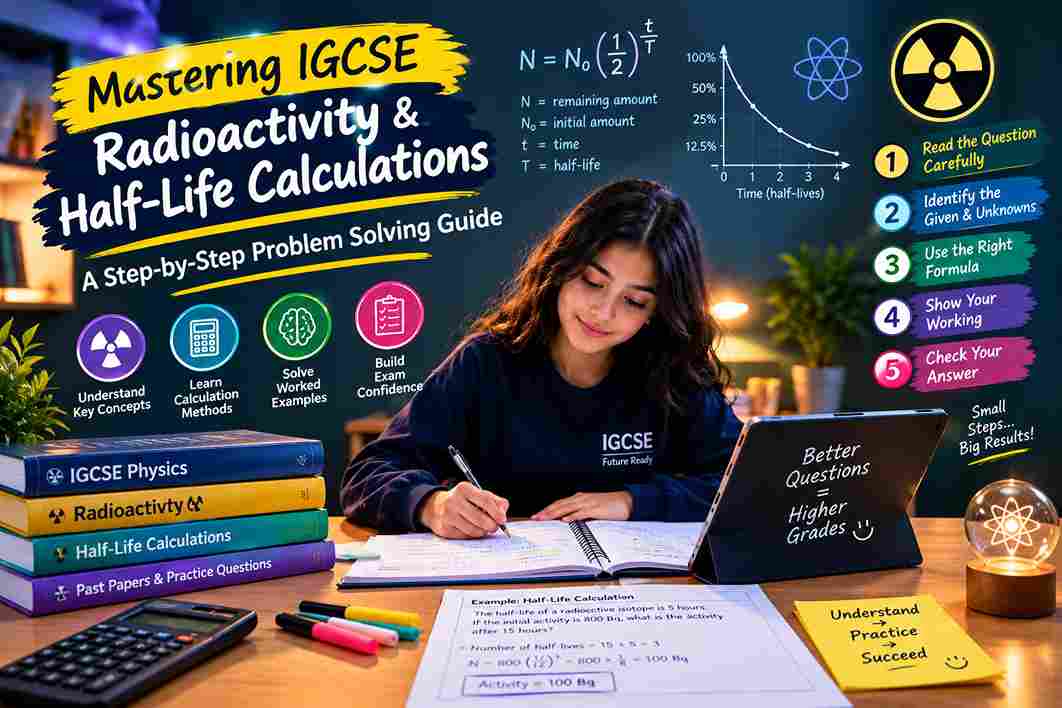
Mastering IGCSE Radioactivity and Half-Life Calculations: A Step-by-Step Problem Solving Guide
Last Updated: September 2026 | By EdFlik Education Team
For students studying Cambridge IGCSE Physics (0625), Edexcel IGCSE Physics (4PH1), or coordinated sciences, nuclear physics is a high-yield topic that regularly appears on Paper 2, Paper 4, and Paper 6 (Alternative to Practical). Within this unit, radioactivity and half-life calculations are guaranteed exam staples.
While the concept of half-life sounds straightforward on paper, students often lose marks due to careless errors: dividing by the wrong factor, forgetting to subtract background radiation, or misinterpreting decay curves.
In this comprehensive, step-by-step masterclass guide, our expert physics educators break down the core definitions, clear up common misconceptions, walk through diverse problem-solving scenarios, and provide professional exam strategies to secure your top grade.
Part 1: Core Definitions and Fundamental Concepts
Before diving into complex calculations, you must lock down the theoretical definitions examiners look for in written exam questions.
1. What is Radioactive Decay?
Radioactive decay is the spontaneous and random transformation of an unstable atomic nucleus into a more stable one by emitting ionizing radiation (alpha particles, beta particles, or gamma rays).
- Random: You cannot predict when a specific nucleus will decay or which nucleus will decay next; it is entirely governed by chance.
- Spontaneous: The decay process is completely unaffected by external physical conditions such as temperature, pressure, or chemical changes.
2. The Definitive Rule of Half-Life
The half-life ($T_{1/2}$) of a radioactive isotope is defined as:
The time taken for the number of radioactive nuclei in a sample—or its radioactive activity (count rate)—to decrease to half of its initial value.
Key Note for IGCSE: Half-life is a constant property specific to a particular isotope. Some isotopes decay in fractions of a second, while others take billions of years.
Part 2: Essential Problem-Solving Frameworks
When tackling calculation questions in IGCSE exams, you will typically encounter three primary scenarios: finding remaining activity, calculating half-life duration, and accounting for background radiation.
Scenario A: Finding Remaining Activity or Mass After a Given Time
The Problem: A radioactive source has an initial activity of $800\text{ Bq}$ and a half-life of $5\text{ days}$. What is its activity after$20\text{ days}$?
Step-by-Step Solution:
- Calculate the number of half-lives ($n$) that have passed:$$n = \frac{\text{Total Time}}{\text{Half-Life}} = \frac{20\text{ days}}{5\text{ days}} = 4\text{ half-lives}$$
- Apply successive halving ($n$ times):
- Start: $800\text{ Bq}$
- 1st half-life: $400\text{ Bq}$
- 2nd half-life: $200\text{ Bq}$
- 3rd half-life: $100\text{ Bq}$
- 4th half-life: $50\text{ Bq}$
- Final Answer: $50\text{ Bq}$ (Warning: Never divide the starting value by 4! Always halve it sequentially four times).
Scenario B: Calculating the Half-Life from Experimental Data
The Problem: A sample's count rate drops from $240\text{ counts per minute (cpm)}$ to $30\text{ cpm}$ over a period of $18\text{ hours}$. Find the half-life.
Step-by-Step Solution:
- Map out the decay chain until you reach the final value:$$240 \rightarrow 120 \rightarrow 60 \rightarrow 30$$
- Count the number of halvings: It took 3 half-lives for the value to drop from$240$ to$30$.
- Divide the total time by the number of half-lives:$$\text{Half-Life} = \frac{18\text{ hours}}{3} = 6\text{ hours}$$
- Final Answer: $6\text{ hours}$.
Scenario C: The Background Radiation Trap
The Golden Rule: Radiation detectors always pick up low-level natural radiation from rocks, cosmic rays, and building materials (background radiation). If a question includes background radiation, you must subtract it from all raw readings before doing any half-life calculations.
The Problem: A Geiger-Müller tube measures a radioactive source's initial count rate at $105\text{ counts per minute}$. The background radiation is measured at $5\text{ cpm}$. If the half-life of the source is $4\text{ hours}$, what will the corrected count rate be after $12\text{ hours}$?
Step-by-Step Solution:
- Subtract the background radiation immediately:$$\text{Initial Corrected Count Rate} = 105 - 5 = 100\text{ cpm}$$
- Calculate the number of half-lives passed:$$n = \frac{12\text{ hours}}{4\text{ hours}} = 3\text{ half-lives}$$
- Halve the corrected initial value 3 times:$$100 \rightarrow 50 \rightarrow 25 \rightarrow 12.5\text{ cpm}$$
- Final Answer: $12.5\text{ cpm}$. (Failing to subtract background radiation first is the #1 reason students lose all method marks on this question type).
Part 3: Interpreting Decay Curves on Graphs
Paper 4 and Paper 6 frequently feature exponential decay curves (plotting Activity or Mass against Time). Here is how to extract half-life accurately:
- Locate Initial Peak ($A_0$): Find the starting activity on the vertical $y$-axis when time $t = 0$.
- Halve the Value: Divide this initial value by 2 ($0.5 \times A_0$).
- Interpolate on the Curve: Find that halved value on the$y$-axis, draw a straight horizontal line across until it intersects the decay curve, then drop a vertical line straight down to the horizontal$x$-axis.
- Confirm Consistency: Repeat the process starting from the new value down to a quarter ($0.25 \times A_0$). The time interval should be identical, proving the constant nature of half-life.
Part 4: Top 4 Exam Tips to Avoid Silly Mistakes
- Check Your Units: Ensure time units match throughout the problem. If a half-life is given in hours but total time is given in days, convert days to hours ($1\text{ day} = 24\text{ hours}$) before starting calculations.
- Know Your Detectors: Be familiar with how Geiger-Müller counters and cloud chambers record radioactive emissions.
- Recognize Decay Equations: In nuclear equations, ensure that both nucleon numbers (top) and proton numbers (bottom) balance perfectly on both sides of the arrow during alpha and beta decay.
- Never Say Activity Reaches Zero: Radioactive decay is asymptotic. The activity halves repeatedly, getting infinitely close to zero, but theoretically never hits absolute zero on a standard exponential curve.
Struggling with IGCSE Physics calculations, radioactivity equations, or preparing for upcoming international school mock exams? EdFlik offers expert, 1-to-1 online tutoring customized specifically for Cambridge and Edexcel IGCSE students worldwide, helping you master challenging science topics and secure top $A^$ grades.*Book a Free Demo Class Today!
Frequently Asked Questions (FAQs)
Q1: Does the mass of a radioactive sample decrease at the same rate as its half-life?
Ans: While radioactive decay reduces the number of active parent nuclei, the total physical mass of the sample changes very little because daughter products often remain behind. Always base half-life calculations on activity (counts per minute or Becquerels) or the number of undecayed nuclei, not gross physical mass.
Q2: Is background radiation subtraction required if the question doesn't mention it?
Ans: No. If background radiation is not mentioned or its value is given as zero, proceed directly with the raw numbers provided in the prompt. However, always scan the introductory text for background count mentions.
Q3: Can half-life be altered by heating or freezing the radioactive material?
Ans: Absolutely not. Radioactive decay is a nuclear property completely independent of external environmental factors like temperature, pressure, or chemical bonding states.
Q4: How does EdFlik support IGCSE Physics students?
Ans: EdFlik connects international school students globally with vetted, experienced 1-to-1 online tutors specializing in IGCSE Physics, Chemistry, and Mathematics. Our sessions focus on mastering difficult calculation modules, reviewing past papers, and building exam confidence.