Mastering Numerical Methods and Change of Sign Rules in Edexcel IAL Pure Math 3
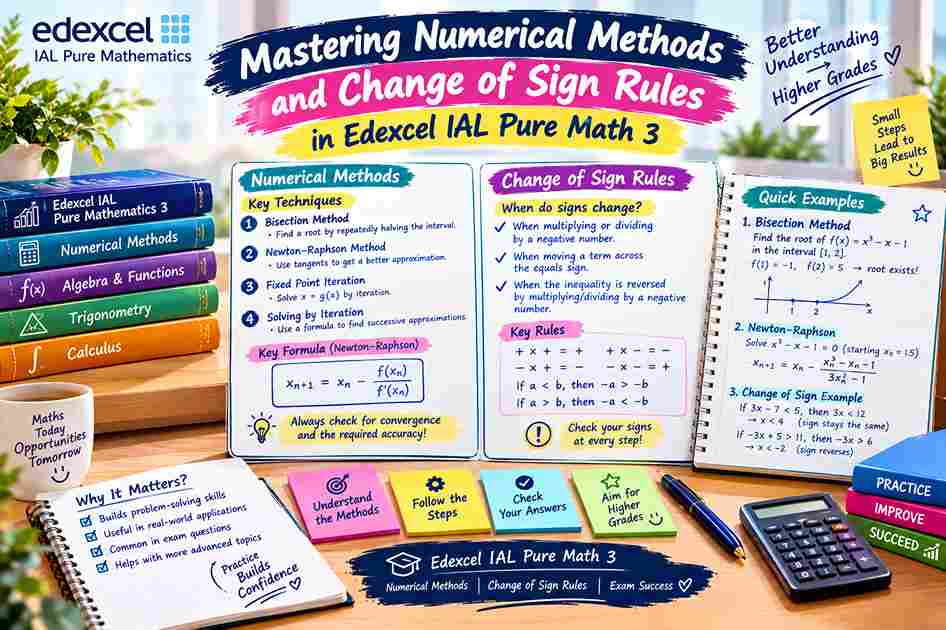
Last Updated: October 2026 | By EdFlik Education Team
For high school students completing the Pearson Edexcel International Advanced Level (IAL) Pure Mathematics 3 (P3) qualification, mastering algebraic manipulation and calculus forms the core of the syllabus. However, when equations cannot be solved analytically—such as transcendental equations combining exponential, trigonometric, and polynomial terms (e.g., $e^x - 3x = 0$ or $\sin x = x - 2$)—algebraic methods fall short.
This is where Numerical Methods (Chapter on Numerical Methods in P3) becomes essential. Routinely appearing as a high-tariff, multi-part question worth 6 to 9 marks near the end of the P3 examination paper, numerical methods test your precision, calculator fluency, and logical deduction.
In this comprehensive masterclass guide, our expert Edexcel IAL mathematics educators break down the theory behind the change of sign method, iterative formulas, the Newton-Raphson procedure, and the top examiner traps that cost students marks on Paper 3.
Part 1: Locating Roots Using the Change of Sign Method
When an equation is given in the form $f(x) = 0$, finding exact analytical solutions is often impossible. Instead, we use numerical techniques to locate roots to a required degree of accuracy.
                     THE CHANGE OF SIGN THEOREM
                                   |
        +--------------------------+--------------------------+
        |                                                     |
CONTINUOUS FUNCTION $f(x)$                              THE INTERVAL CONDITION
• The function $f(x)$ must be continuous              • If $f(a)$ and $f(b)$ have opposite signs
  across the interval $[a, b]$.                          (i.e., $f(a) \cdot f(b) < 0$),
                                                        at least one real root exists between $a$ and $b$.
1. The Underlying Mathematical Logic
If $f(x)$ is a continuous function on the closed interval $[a, b]$, and $f(a)$ and $f(b)$ have opposite signs, the graph of $y = f(x)$ must cross the $x$-axis at least once between $x = a$ and $x = b$. Therefore, a root exists in that interval.
2. Step-by-Key Exam Protocol:
- Rearrange the given equation into the standard form $f(x) = 0$.
- Substitute the given boundary values (e.g., $x = 1$ and $x = 2$) into $f(x)$.
- State the resulting values clearly: e.g., $f(1) = -1.5$ (negative) and $f(2) = 3.2$ (positive).
- Mandatory Conclusion Statement: Write: "Since there is a change of sign and $f(x)$ is continuous on the interval $[1, 2]$, there is at least one root between $x = 1$ and $x = 2$."
Part 2: Iterative Formulas ($x_{n+1} = g(x_n)$)
Once an interval containing a root has been isolated, an iterative formula allows us to approximate the root to successive decimal places.
                      REARRANGEMENT & CONVERGENCE
                                   |
      +----------------------------+----------------------------+
      |                                                         |
REARRANGEMENT OF $f(x) = 0$                              CONVERGENCE CONDITION
• Express $x$ as a function of $x$:                      • An iterative formula converges
  $x = g(x)$                                               toward the root only if:
• Construct the sequence: $x_{n+1} = g(x_n)$                $|g'(x_{\text{root}})| < 1$
Step-by-Step Worked Example:
Question: Show that the equation $x^3 + 2x - 5 = 0$ can be rearranged into the iterative formula $x_{n+1} = \sqrt[3]{5 - 2x_n}$. Starting with $x_1 = 1.3$, find $x_2, x_3,$ and $x_4$ to 4 decimal places.
Step 1: Rearrangement Proof
$$x^3 + 2x - 5 = 0 \implies x^3 = 5 - 2x \implies x = \sqrt[3]{5 - 2x}$$
Thus, the iterative formula is:
$$x_{n+1} = \sqrt[3]{5 - 2x_n}$$
Step 2: Calculate Successive Iterations
- Given $x_1 = 1.3$
- $x_2 = \sqrt[3]{5 - 2(1.3)} = \sqrt[3]{5 - 2.6} = \sqrt[3]{2.4} \approx 1.338865... \implies 1.3389$
- $x_3 = \sqrt[3]{5 - 2(1.338865)} = \sqrt[3]{2.32227} \approx 1.32454... \implies 1.3245$
- $x_4 = \sqrt[3]{5 - 2(1.32454)} = \sqrt[3]{2.35092} \approx 1.32943... \implies 1.3294$
Part 3: The Newton-Raphson Method
The Newton-Raphson method is a powerful calculus-based technique that converges toward roots much faster than simple iteration.
                      THE NEWTON-RAPHSON FORMULA
                                   |
        $$x_{n+1} = x_n - \frac{f(x_n)}{f'(x_n)}$$

• $x_n$: Current approximation of the root
• $x_{n+1}$: Refined approximation of the root
• $f'(x_n)$: First derivative of $f(x)$ evaluated at $x_n$
Step-by-Step Worked Example:
Question: Use the Newton-Raphson formula to find a second approximation ($x_2$) to the root of $f(x) = x^3 - 3x - 1 = 0$, starting with an initial estimate $x_1 = 2$.
Step 1: Find the Derivative $f'(x)$
$$f(x) = x^3 - 3x - 1$$$$f'(x) = 3x^2 - 3$$
Step 2: Evaluate $f(x_1)$ and $f'(x_1)$ for $x_1 = 2$
- $f(2) = (2)^3 - 3(2) - 1 = 8 - 6 - 1 = 1$
- $f'(2) = 3(2)^2 - 3 = 3(4) - 3 = 9$
Step 3: Apply the Formula
$$x_2 = x_1 - \frac{f(x_1)}{f'(x_1)} = 2 - \frac{1}{9} = \frac{17}{9} \approx 1.8889 \quad \text{(4 d.p.)}$$
Part 4: Top 4 Traps That Cost Students Marks in P3 Numerical Methods
- Degree vs. Radian Mode on Calculators: Evaluating trigonometric iterative formulas (e.g., $x_{n+1} = \cos(x_n) + 1$) while your scientific calculator is set to Degrees instead of Radians. All P3 trigonometry calculations must be performed in Radian mode!
- Premature Rounding of Intermediate Values: Rounding intermediate iteration values to 2 decimal places halfway through a calculation, causing compounding rounding errors in $x_3$ or $x_4$. Store full values in your calculator memory.
- Failing to State the Continuous Condition in Change of Sign Proofs: Writing "There is a sign change so a root exists" without explicitly mentioning that $f(x)$ is continuous across the interval.
- Division by Zero in Newton-Raphson: Choosing an initial estimate $x_1$ where the derivative equals zero ($f'(x_1) = 0$), resulting in a mathematical error (vertical tangent where the tangent line never intersects the $x$-axis).
Preparing for Pearson Edexcel IAL Pure Mathematics 3 (P3) exams and aiming for an $A^$ grade? EdFlik connects international school students globally with expert, 1-to-1 online IAL math tutors, helping you master numerical methods, calculus, logarithms, trigonometry, and past-paper exam strategies. *Book a Free Demo Class Today!
Frequently Asked Questions (FAQs)
Q1: How do I know how many decimal places to round my final root to?
Ans: Always check the specific instruction given in the exam question (e.g., "Give your answer to 3 decimal places" or "correct to 4 significant figures"). If no specific rounding is requested, rounding to 3 significant figures is standard practice.
Q2: Why does a change of sign sometimes fail to indicate a root?
Ans: A change of sign fails if the function is discontinuous (has an asymptote) within the interval. For example, $f(x) = \frac{1}{x}$ has negative values for $x < 0$ and positive values for $x > 0$, but it has no root at $x = 0$ because the function is undefined there.
Q3: What is the main advantage of the Newton-Raphson method over simple iteration?
Ans: The Newton-Raphson method features quadratic convergence, meaning the number of correct decimal places roughly doubles with each successive iteration, making it significantly faster than simple rearrangement iteration.
Q4: How does EdFlik support Edexcel IAL Pure Math 3 students?
Ans: EdFlik connects international school students worldwide with vetted, expert 1-to-1 online tutors specializing in Pearson Edexcel IAL Mathematics ($P_1–P_4, M_1–M_3, S_1–S_3$). Our personalized coaching focuses on clarifying complex numerical algorithms, mastering algebraic proofs, and building exam confidence under timed conditions.