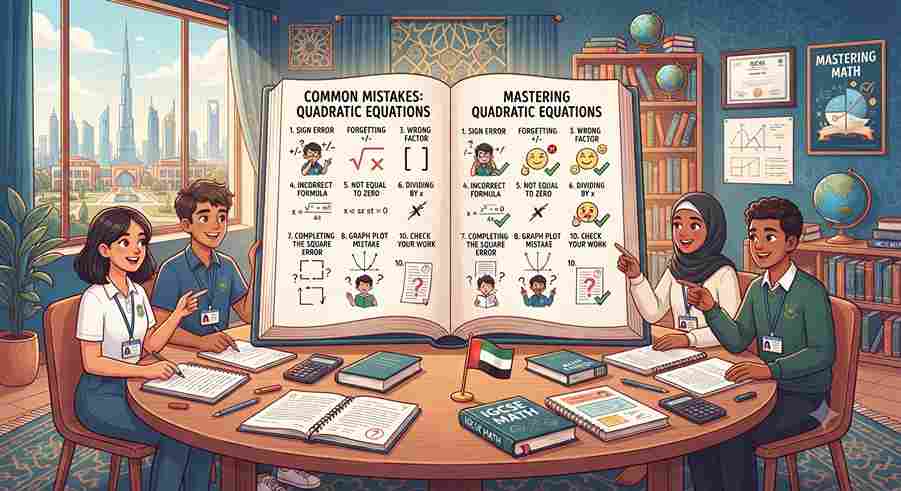
Mastering Quadratic Equations: Top 10 Common Mistakes UAE Students Make in IGCSE Math
Last Updated: September 2026 | By EdFlik Education Team
For IGCSE students across the UAE—from vibrant international schools in Dubai and Abu Dhabi to Sharjah and beyond—Mathematics is a cornerstone subject. Among all algebra topics, Quadratic Equations occupy a major chunk of both Cambridge (CAIE) and Pearson Edexcel papers.
Quadratics are high-yield questions, meaning they appear consistently in both calculator and non-calculator papers. Yet, year after year, examiner reports highlight the same frustrating pattern: capable students lose easy method and accuracy marks not because they don't understand math, but because of predictable, repetitive errors.
Whether your child is prepping for Extended or Core IGCSE Mathematics, identifying these pitfalls is the first step toward securing an $A^*$ or $9$. Below are the top 10 common mistakes UAE students make in IGCSE quadratic equations, along with expert strategies on how to avoid them.
1. Failing to Rearrange into Standard Form ($ax^2 + bx + c = 0$)
Before you attempt to factorize, use the quadratic formula, or inspect a discriminant, a quadratic equation must be in standard form.
- The Mistake: Students often try to apply formulas or factor pairs when terms are scattered across both sides of the equals sign (e.g., $3x^2 - 5 = 2x$). This leads to catastrophic sign confusion.
- The Fix: Make it a rigid, mechanical rule: Move every single term to the left-hand side so the right side equals zero ($0$) before doing any math.
2. Careless Sign Errors When Transposing Terms
In a fast-paced exam environment under time pressure, moving terms across the equals sign often triggers mental shortcuts.
- The Mistake: Shifting a term like $+4x$ across the equals sign and forgetting to flip it to $-4x$, or mishandling negative signs during expansion. For example, treating $-(2x - 6)$ as $-2x - 6$ instead of $-2x + 6$.
- The Fix: Always write an extra line of working out. When crossing the equals sign, actively circle the sign and change it explicitly on your paper.
3. Picking the Wrong Factor Pairs (The Product-Sum Trap)
Factorization by inspection is a favorite IGCSE technique, but it requires precision.
- The Mistake: When solving $x^2 + 7x + 10 = 0$, students look for two numbers that multiply to $10$ and add to $7$. Stressed students might pick $1$ and $10$ (which multiply to $10$, but add to $11$), or mix up positive and negative signs with expressions like $x^2 - 5x - 6 = 0$.
- The Fix: Always test your factor pairs mentally before writing down the brackets. Once factorized, expand your brackets back out in your head (or in the margin) to verify they reproduce the original expression.
4. Misusing the Quadratic Formula (Dropping Signs on $b$ and $c$)
When factorisation fails or decimals are required ("give your answer correct to 2 decimal places"), students turn to the quadratic formula:
$$x = \frac{-b \pm \sqrt{b^2 - 4ac}}{2a}$$
- The Mistake: In an equation like $x^2 - 4x - 5 = 0$, students plug in $b = 4$ instead of $b = -4$. Furthermore, messing up $-4ac$ when $a$ or $c$ is negative destroys the discriminant value.
- The Fix: Before substituting into the formula, write down your values clearly on the side: $a = \dots$, $b = \dots$, $c = \dots$ (including all negative signs). Always put brackets around negative substitutions, e.g., $(-4)^2$.
5. Ignoring Command Words: Formula vs. Factorization
IGCSE exam questions use strict command words that dictate how marks are awarded.
- The Mistake: If a question explicitly states "Solve $x^2 - 7x + 12 = 0$ by factorising," using the quadratic formula will result in zero method marks, even if you find the correct roots $x = 3$ and $x = 4$.
- The Fix: Underline command words in the exam question paper. If it says "by factorising," you must show the bracketed steps. Save the quadratic formula strictly for non-factorable expressions or when decimal answers are requested.
6. Premature Rounding in Decimal Calculations
When IGCSE questions ask for answers correct to 2 decimal places or 3 significant figures, precision is everything.
- The Mistake: Students calculate intermediate numbers, round them off early (e.g., writing $3.46$ instead of $3.464101\dots$), and use that rounded number in subsequent steps. This introduces compounding errors that throw off the final answer.
- The Fix: Store exact values in your calculator memory, or keep at least 4 to 5 decimal places during working out. Only round on the very final line of your answer.
7. Mishandling the Discriminant ($b^2 - 4ac$) and Root Interpretations
Questions asking about the nature of roots using the discriminant frequently appear in Paper 4 (Extended).
- The Mistake: Confusing the inequalities. Students know $b^2 - 4ac$ relates to roots, but mix up whether "two distinct real roots" means $> 0$, $\ge 0$, or $< 0$.
- The Fix: Memorize the strict rules:
- Two distinct real roots: $b^2 - 4ac > 0$
- Equal / repeated real roots: $b^2 - 4ac = 0$
- No real roots: $b^2 - 4ac < 0$
- Real roots (combining distinct and equal): $b^2 - 4ac \ge 0$
8. Forgetting the $\pm$ When Solving by Extracting Square Roots
For simpler equations lacking a linear term (e.g., $2x^2 - 18 = 0$), students solve by isolating $x^2$.
- The Mistake: Writing $x^2 = 9 \implies x = 3$, completely forgetting the negative root.
- The Fix: Train your brain to recognize that a quadratic equation of degree 2 must have two solutions (unless roots are repeated). Whenever you take a square root in an equation, immediately write $\pm$ before the number ($\pm 3$).
9. Errors in Sketching Quadratic Graphs
Paper 4 often requires sketching $y = ax^2 + bx + c$ on a set of axes.
- The Mistake: Students draw random parabolic curves without labeling key features, or draw a "U-shape" when the coefficient of $x^2$ is negative (which should be an inverted "n-shape").
- The Fix: A proper quadratic sketch requires labeling four vital anchor points:
- The $y$-intercept (where $x = 0$).
- The $x$-intercepts / roots (where $y = 0$).
- The turning point (vertex) coordinates.
- The correct orientation (positive $a$ opens up; negative $a$ opens down).
10. Skipping the Verification Step (Not Checking Answers)
Many students finish a quadratic question, move on immediately, and never look back.
- The Mistake: Leaving silent calculation errors uncorrected because they assumed their first pass was right.
- The Fix: Substitution takes less than 30 seconds. Plug your solved value of $x$ back into the original left-hand side equation. If it equals the right-hand side (usually zero), you have 100% confirmation your answer is correct before turning the page!
Looking for personalized support to help your child eliminate careless errors and master IGCSE Mathematics? EdFlik offers expert, 1-to-1 online tutoring customized for IGCSE, GCSE, and international curricula.Book a Free Demo Class Today!
Frequently Asked Questions (FAQs)
Q1: What are the three main ways to solve quadratic equations in IGCSE Math?
Ans: The three primary methods are: (1) Factorisation (splitting the middle term), (2) Using the Quadratic Formula, and (3) Completing the Square.
Q2: Which quadratic method is most common in IGCSE Paper 4?
Ans: Both factorization and the quadratic formula appear frequently. However, the quadratic formula is heavily tested when questions require answers correct to 2 decimal places, while completing the square is typically tested when asked to express $ax^2 + bx + c$ in the form $a(x + p)^2 + q$.
Q3: Why do IGCSE students lose marks on quadratic word problems?
Ans: Word problems require translating English sentences into algebraic quadratic equations. Students often struggle with setting up the initial equation correctly (e.g., relating speed, distance, and time, or area and perimeter). Once the equation is formed correctly, the solving steps follow standard rules.
Q4: How can EdFlik help my child improve their IGCSE Math grade?
Ans: EdFlik connects students with experienced, certified 1-to-1 online tutors who specialize in IGCSE board requirements. Our tutors diagnose recurring calculation habits, review past paper techniques, and build tailored study plans to boost confidence and exam scores.