
Mastering Science Internal Assessments (IAs) & Practical Lab Reports for IB and A-Level Success
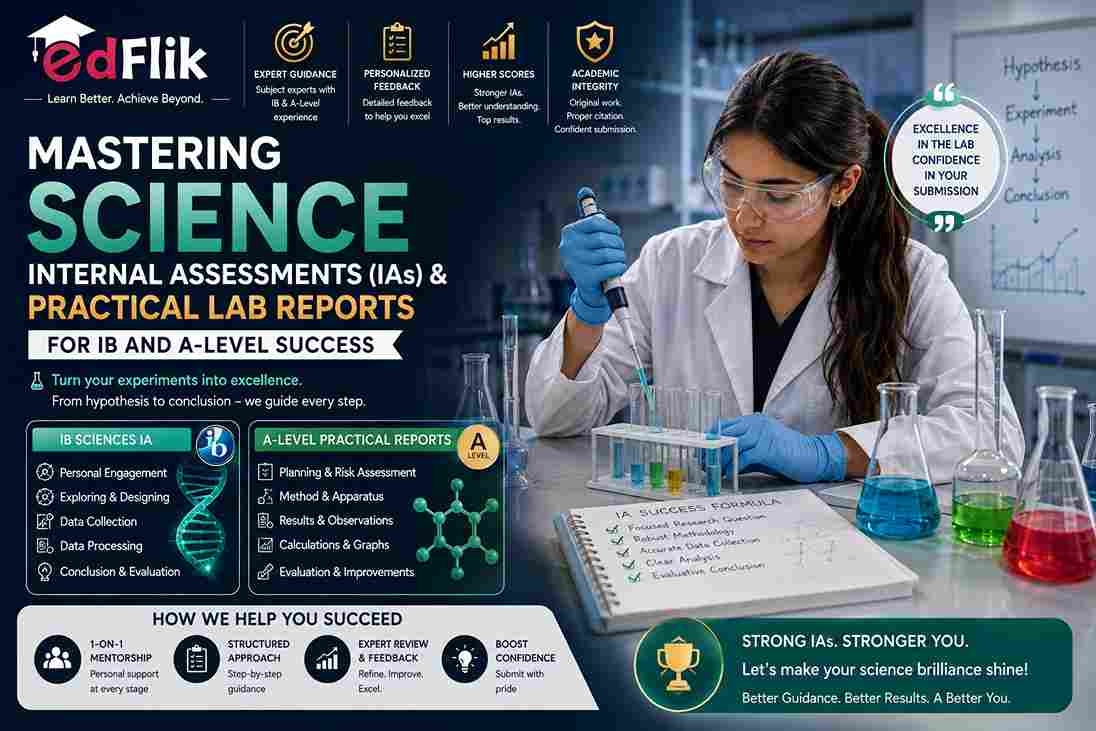
Last Updated: August 2026 | By: EdFlik Education Team
Quick Contact: Need an online science tutor in Dubai & UAE 2026 right now? WhatsApp us at +91 88788 96600 | Sessions starting from AED 65–80/hour | Book a Free Trial Class today viawww.edflik.com.
Introduction: The Deciding Factor in Science Grades
For ambitious students across Dubai, Abu Dhabi, and the wider UAE tackling International Baccalaureate (IB) Diploma Programme or Cambridge International AS & A-Level Physics, Chemistry, and Biology, final grades are rarely determined solely by end-of-year written papers. Internal Assessments (IAs) for the IB and practical examination components (such as Cambridge Paper 3 and Paper 5) account for a massive percentage of your overall subject grade.
A brilliant exam grade can easily be dragged down by a poorly structured lab report, weak error analysis, or a flawed experimental design. Conversely, an exceptional IA or practical analysis can act as a reliable anchor that secures a Grade 7 or an A* grade. This comprehensive guide breaks down the structural blueprint for mastering science practical assessments and turning lab reports into high-scoring triumphs.
Section 1: Anatomy of a Grade 7 IB Science IA & Cambridge Paper 5 Plan
Whether you are writing a 3,000-word individual investigation for IB Biology or designing a physics experiment under strict time constraints for Cambridge Paper 5, examiners look for a rigorous, methodical approach.
1. Defining the Research Design & Variables
- The Independent Variable: Clearly state the range and interval of your chosen variable (e.g., changing temperature from $20^\circ\text{C}$ to $60^\circ\text{C}$ in intervals of $10^\circ\text{C}$).
- The Dependent Variable: Explicitly define what is being measured, how it is recorded, and the instrument used.
- Controlled Variables: List every extraneous variable that could impact your results (such as ambient room temperature, voltage fluctuations, or initial reactant concentration) and explain precisely how you maintained or monitored them.
2. Crafting an Analytical Conclusion
Many students fall into the trap of writing descriptive reports rather than analytical ones.
- Descriptive: "The graph shows that the reaction rate increased as temperature increased."
- Analytical: "This suggests that increasing temperature initially raised enzyme activity by increasing the frequency of successful collisions between enzyme and substrate molecules, peaking before thermal denaturation occurred."
Section 2: Conquering Percentage Uncertainties and Error Propagation Cleanly
One of the most common reasons students lose marks in physics and chemistry practical assessments is improper handling of measurement uncertainties. Markers are ruthless when it comes to significant figures and error propagation.
The Golden Rules of Error Propagation
- Adding or Subtracting Measurements: When adding or subtracting absolute uncertainties ($\Delta A$ and $\Delta B$), you must add the absolute uncertainties together:$$\Delta (A + B) = \Delta A + \Delta B$$
- Multiplying or Dividing Quantities: When multiplying or dividing values, you must add their percentage uncertainties:$$\frac{\Delta(AB)}{AB} = \frac{\Delta A}{A} + \frac{\Delta B}{B}$$
- Powers and Exponents: If a variable is raised to a power $n$ (such as $r^2$), multiply its percentage uncertainty by that power:$$\frac{\Delta(X^n)}{X^n} = n \left(\frac{\Delta X}{X}\right)$$
Mastering these calculations prevents careless point deductions and demonstrates elite scientific competence.
Section 3: Remote Collaboration & Virtual Whiteboards for Collaborative Lab Editing
Writing a complex science IA requires rigorous data processing, graph plotting, and iterative drafting. This is where modern online tutoring transforms the workflow:
- Real-Time Data Sharing: Students and tutors can work simultaneously on shared Google Sheets or Excel workbooks to clean up raw data tables, apply proper formula syntax, and plot trendlines.
- Interactive Digital Whiteboards: When linearizing non-linear equations (such as transforming $y = ae^{bx}$ into $y = mx + c$ form using logarithms), virtual whiteboards allow tutors to visually demonstrate gradient calculations and worst-acceptable-line (WAL) constructions step-by-step.
- Line-by-Line Critique: Tutors review draft sections remotely, helping students tighten their arguments and eliminate vague terminology before school submission deadlines.
Section 4: Common Pitfalls That Trigger Marker Penalties
Avoid these frequent traps to ensure your practical work hits the highest rubric criteria:
- Unrealistic Precision: Recording instrument readings to decimal places that exceed the true resolution of the measuring device (e.g., recording a stopwatch reading to the nearest millisecond when human reaction time introduces an uncertainty of $\pm 0.2\text{ s}$).
- Omitting Qualitative Observations: Failing to record unexpected color changes, precipitate formation, or apparatus friction in chemistry and biology logs.
- Superficial Evaluation: Listing trivial errors (like "human error") instead of analyzing systematic instrument calibration flaws and proposing realistic, quantifiable improvements.
Success Stories & Testimonials
"My Chemistry IA was a complete mess, and I had no idea how to process my titration error propagation. My EdFlik online tutor sat with me for two sessions, cleaned up my data tables, and taught me how to write a rigorous evaluation. I scored a Level 7!"
— Rohan P., Dubai IB Student
"Paper 5 physics planning used to terrify me. EdFlik helped me master variable control and linear graphing techniques. It made a massive difference to my final A-Level grade."
— Fatima A., Sharjah Student
Frequently Asked Questions (FAQ)
What are the core criteria for an IB Science IA?
An IB Science IA is assessed across four key criteria: Research Design, Data Analysis, Conclusion, and Evaluation.
How much do online science practical tutors cost in Dubai?
EdFlik offers expert 1-on-1 science tutoring starting at an accessible AED 65–80/hour, providing specialized IA and lab report mentorship without inflated agency markups.
How do I handle percentage uncertainties in physics lab reports?
For addition/subtraction, add absolute uncertainties; for multiplication/division and powers, add percentage uncertainties and multiply by exponents accordingly.
Ready to Secure a Top Grade on Your Science IA or Lab Report?
Don't let complex data analysis or confusing mark schemes hold your science grades back. Experience the EdFlik difference today.
- WhatsApp Us:+91 88788 96600
- Visit Us:www.edflik.com
- Special Offer: Book your Free Trial Class now!