Mastering Specific Heat Capacity and Latent Heat: IGCSE Physics Calculation Guide
Last Updated: October 2026 | By EdFlik Education Team
For students studying Cambridge IGCSE Physics (0625/0972), Edexcel IGCSE Physics, or Oxford AQA IGCSE Physics, the thermal physics unit is a goldmine for marks—provided you master the mathematical formulas and conceptual nuances.
Within this unit, calculations involving Specific Heat Capacity (SHC) and Specific Latent Heat (SLH) frequently appear as structured calculation questions, multi-stage energy transfers, and graph analysis tasks. Examiners love to test whether you can differentiate between a scenario where a substance changes temperature versus a scenario where it undergoes a change of state.
In this comprehensive, exam-focused masterclass guide, our expert physics educators break down the core definitions, unpack step-by-step problem-solving frameworks, and expose the top exam traps that cost students marks.
Part 1: Specific Heat Capacity (SHC) — The Temperature Change Equation
1. The Definition You Must Memorize Word-for-Word
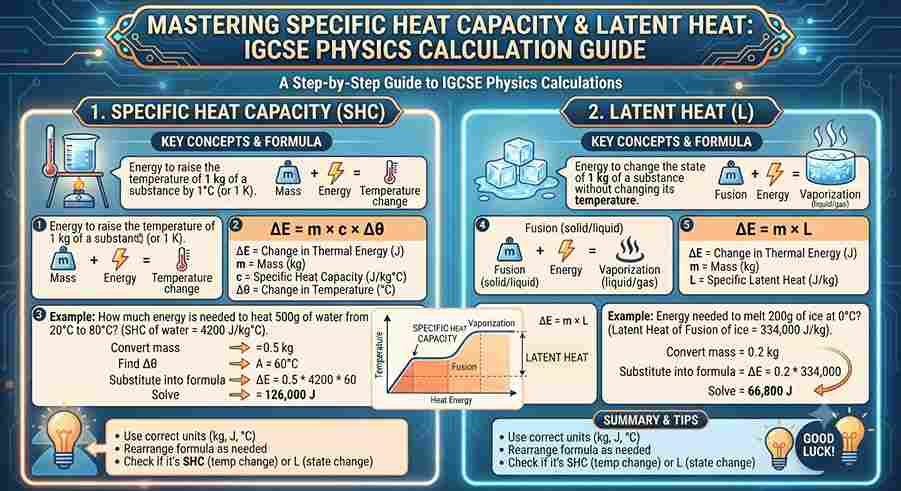
Specific Heat Capacity ($c$) is defined as the amount of thermal energy required to raise the temperature of$1\text{ kg}$ of a substance by$1^\circ\text{C}$ (or$1\text{ K}$).
- Unit: Joules per kilogram per degree Celsius ($\text{J}/(\text{kg}\cdot^\circ\text{C})$).
- Key Insight: A high specific heat capacity (like water at$4200\text{ J}/(\text{kg}\cdot^\circ\text{C})$) means a substance takes a large amount of energy to heat up and stores heat effectively. A low specific heat capacity (like copper or aluminum) heats up and cools down very rapidly.
2. The Core Formula and Variables
$$\Delta E = m \times c \times \Delta\theta$$
- $\Delta E$ = Change in thermal energy (in Joules,$\text{J}$)
- $m$ = Mass of the substance (in kilograms,$\text{kg}$)
- $c$ = Specific heat capacity (in$\text{J}/(\text{kg}\cdot^\circ\text{C})$)
- $\Delta\theta$ = Change in temperature (in$^\circ\text{C}$ or$\text{K}$)
Part 2: Step-by-Step SHC Calculation & Worked Example
Many students drop marks not because they cannot use the formula, but due to poor unit conversions or miscalculating $\Delta\theta$.
Worked Exam-Style Question:
- Question: Calculate the thermal energy supplied to heat $400\text{ g}$ of water from $20^\circ\text{C}$ to $75^\circ\text{C}$. (Specific heat capacity of water = $4200\text{ J}/(\text{kg}\cdot^\circ\text{C})$).
Step-by-Step Solution:
- Extract and Convert Variables:
- Mass ($m$) =$400\text{ g} = 0.4\text{ kg}$ (Always divide grams by 1000!)
- Temperature change ($\Delta\theta$) = Final Temp$-$ Initial Temp$= 75 - 20 = 55^\circ\text{C}$
- Specific Heat Capacity ($c$) = $4200\text{ J}/(\text{kg}\cdot^\circ\text{C})$
- State the Formula:$$\Delta E = mc\Delta\theta$$
- Substitute and Compute:$$\Delta E = 0.4 \times 4200 \times 55$$$$\Delta E = 92,400\text{ J} \quad (\text{or } 92.4\text{ kJ})$$
Part 3: Combining Electrical Energy with SHC
In many IGCSE lab-based questions, thermal energy is supplied via an electric immersion heater. You must combine the electrical power formula with the thermal energy formula:
$$\Delta E = P \times t \quad \text{and therefore} \quad P \times t = mc\Delta\theta$$
- $P$ = Power of the heater in Watts ($\text{W}$ or $\text{J/s}$)
- $t$ = Time in seconds ($\text{s}$) (Remember to multiply minutes by$60$!)
Part 4: Specific Latent Heat (SLH) — The State Change Equation
Unlike specific heat capacity, latent heat is involved when a substance changes state (melting, boiling, freezing, condensing) without any change in temperature.
1. Definitions
- Specific Latent Heat of Fusion ($L_f$): The energy required to change$1\text{ kg}$ of a substance from a solid to a liquid at constant temperature.
- Specific Latent Heat of Vaporisation ($L_v$): The energy required to change$1\text{ kg}$ of a substance from a liquid to a gas at constant temperature.
- Unit: Joules per kilogram ($\text{J/kg}$)
2. The Core Formula
$$E = m \times L$$
- $E$ = Thermal energy for state change (in Joules,$\text{J}$)
- $m$ = Mass (in kilograms,$\text{kg}$)
- $L$ = Specific latent heat ($L_f$ or$L_v$, in$\text{J/kg}$)
Why does temperature stay flat? During melting or boiling, the thermal energy added does not increase the kinetic energy of the particles (so temperature remains constant). Instead, the energy goes entirely into breaking the intermolecular bonds holding the particles together.
Part 5: Interpreting Heating and Cooling Curves
Exam questions frequently display a temperature-time graph for a substance being heated steadily from a solid to a gas:
- Sloping Sections (Temperature Rising): The substance is in a single state (solid, liquid, or gas). Use$\Delta E = mc\Delta\theta$.
- Flat/Horizontal Sections (Temperature Constant): The substance is undergoing a change of state (melting or boiling). Use$E = mL$. The longer the flat section, the more energy is required to complete the phase transition.
Part 6: Top 4 Traps That Cost Students Marks
- Forgetting Unit Conversions: Leaving mass in grams instead of converting to kilograms ($\text{kg}$), or leaving time in minutes instead of seconds ($\text{s}$).
- Confusing SHC with Latent Heat: Trying to use $\Delta E = mc\Delta\theta$ during a phase change (melting/boiling) where $\Delta\theta = 0$, which would mathematically give zero energy.
- Misidentifying Temperature Change: Using the final temperature instead of the change in temperature ($\Delta\theta$).
- Forgetting Heat Losses: Assuming 100% of electrical heater energy goes into the substance. In real experiments, thermal energy escapes to the surrounding air, requiring insulation (like polystyrene lids or lagging) to improve accuracy.
Struggling with IGCSE Physics calculations, thermal physics past papers, or exam formulas? EdFlik connects international school students globally with expert, 1-to-1 online physics tutors, helping you master problem-solving frameworks and secure top $A^$ grades.*Book a Free Demo Class Today!
Frequently Asked Questions (FAQs)
Q1: What is the difference between heat and temperature?
Ans: Temperature is a measure of how hot something is (the average kinetic energy of its particles), whereas heat is the total thermal energy transferred from a hotter body to a colder body.
Q2: Why does water have such a high specific heat capacity?
Ans: Water molecules form strong hydrogen bonds that require a large amount of thermal energy to disrupt, allowing oceans to stabilize global coastal climates by absorbing and releasing heat slowly.
Q3: Can $\Delta\theta$ be measured in Kelvin instead of Celsius?
Ans: Yes! Because a $1^\circ\text{C}$ change is equal in magnitude to a $1\text{ K}$ change, temperature differences ($\Delta\theta$ or $\Delta T$) work identically in both units.
Q4: How does EdFlik support IGCSE Physics students?
Ans: EdFlik connects international school students worldwide with vetted, expert 1-to-1 online physics tutors specializing in Cambridge, Edexcel, and Oxford AQA curricula. Our personalized tutoring targets numerical calculations, practical experiment walkthroughs, and rigorous past-paper practice.