Mastering Taylor and Maclaurin Series Expansions in Edexcel Further Mathematics
Last Updated: October 2026 | By EdFlik Education Team
For high school students completing the Pearson Edexcel International Advanced Level (IAL) or A-Level Further Mathematics qualifications (specifically within Further Pure Mathematics 1 / Further Pure Mathematics 2), Taylor and Maclaurin Series Expansions represent some of the most elegant, powerful, and high-tariff topics on the syllabus.
Routinely featuring as multi-part integration, limit-evaluation, or differential equation questions worth 7 to 10 marks on examination papers, series expansions bridge the gap between complex non-linear functions and polynomial approximations. However, examiners design these questions to test meticulous differentiation, factorial tracking, and boundary condition substitutions under strict time constraints.
In this comprehensive, exam-focused masterclass guide, our expert Edexcel Further Mathematics educators break down the foundational formulas, explore standard expansions, solve differential equations via series methods, and expose the top examiner traps that cost students marks.
Part 1: Foundations of the Maclaurin Series (Expansion About $x = 0$)
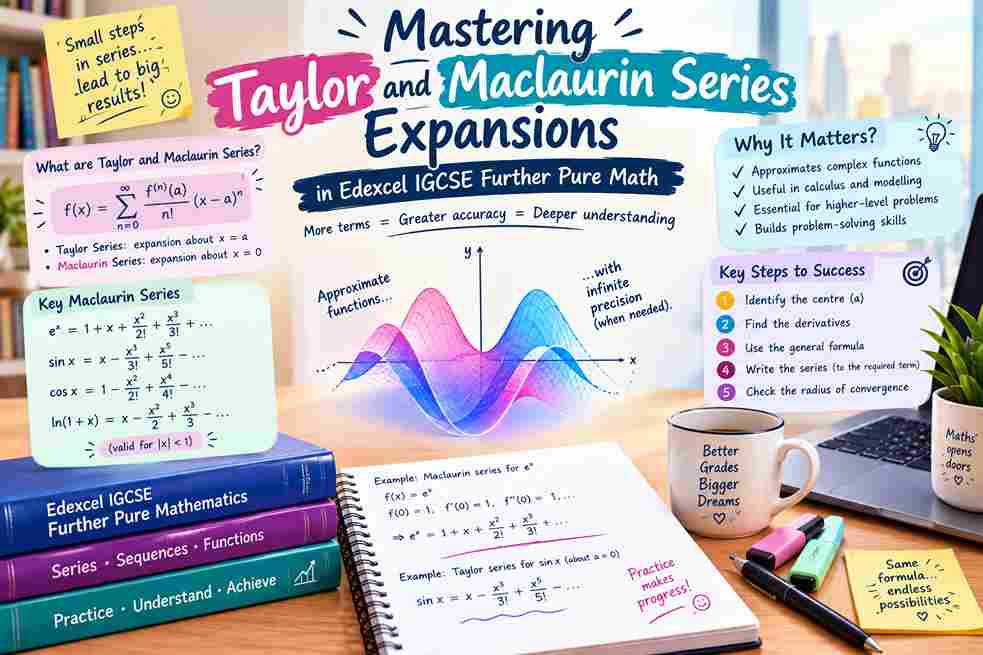
A Maclaurin Series is a special case of the Taylor series where a function is expanded in ascending powers of$x$ about the point$x = 0$. It allows infinitely differentiable functions (such as$e^x$,$\sin x$,$\ln(1+x)$) to be represented as an infinite polynomial sum.
                     THE MACLAURIN SERIES FORMULA
                                   |
        $$f(x) = f(0) + f'(0)x + \frac{f''(0)}{2!}x^2 + \frac{f'''(0)}{3!}x^3 + \dots + \frac{f^{(n)}(0)}{n!}x^n + \dots$$

• $f(0)$: Function evaluated at $x = 0$
• $f'(0), f''(0), \dots$: Successive derivatives evaluated at $x = 0$
• $n!$: Factorial denominator ($n! = n \times (n-1) \times \dots \times 1$)
1. Standard Maclaurin Expansions to Memorize
While you must know how to derive them via repeated differentiation, memorizing these standard expansions saves precious minutes on exam day:
- $e^x = 1 + x + \frac{x^2}{2!} + \frac{x^3}{3!} + \dots + \frac{x^n}{n!} + \dots$
- $\sin x = x - \frac{x^3}{3!} + \frac{x^5}{5!} - \frac{x^7}{7!} + \dots$
- $\cos x = 1 - \frac{x^2}{2!} + \frac{x^4}{4!} - \frac{x^6}{6!} + \dots$
- $\ln(1+x) = x - \frac{x^2}{2} + \frac{x^3}{3} - \frac{x^4}{4} + \dots$
Part 2: Generalizing to the Taylor Series (Expansion About $x = a$)
Not all functions are well-behaved or defined at $x = 0$ (for instance, $\ln x$ is undefined at $x = 0$). To overcome this, we generalize the Maclaurin series into the Taylor Series, expanding a function about any general point$x = a$.
                     THE TAYLOR SERIES FORMULA
                                   |
        $$f(x) = f(a) + f'(a)(x-a) + \frac{f''(a)}{2!}(x-a)^2 + \frac{f'''(a)}{3!}(x-a)^3 + \dots$$

• Expands the function in ascending powers of $(x-a)$.
• Reduces directly to the Maclaurin series when $a = 0$.
Step-by-Step Worked Taylor Expansion Example:
Question: Find the Taylor series expansion of $f(x) = \sin x$ about the point $x = \frac{\pi}{3}$, up to and including the term in $(x - \frac{\pi}{3})^3$.
Step 1: Evaluate $f(a)$ and Successive Derivatives at $x = a = \frac{\pi}{3}$
- $f(x) = \sin x \implies f\left(\frac{\pi}{3}\right) = \sin\left(\frac{\pi}{3}\right) = \frac{\sqrt{3}}{2}$
- $f'(x) = \cos x \implies f'\left(\frac{\pi}{3}\right) = \cos\left(\frac{\pi}{3}\right) = \frac{1}{2}$
- $f''(x) = -\sin x \implies f''\left(\frac{\pi}{3}\right) = -\sin\left(\frac{\pi}{3}\right) = -\frac{\sqrt{3}}{2}$
- $f'''(x) = -\cos x \implies f'''\left(\frac{\pi}{3}\right) = -\cos\left(\frac{\pi}{3}\right) = -\frac{1}{2}$
Step 2: Substitute into the Taylor Formula
$$\sin x = f\left(\frac{\pi}{3}\right) + f'\left(\frac{\pi}{3}\right)\left(x-\frac{\pi}{3}\right) + \frac{f''\left(\frac{\pi}{3}\right)}{2!}\left(x-\frac{\pi}{3}\right)^2 + \frac{f'''\left(\frac{\pi}{3}\right)}{3!}\left(x-\frac{\pi}{3}\right)^3 + \dots$$$$\sin x = \frac{\sqrt{3}}{2} + \frac{1}{2}\left(x-\frac{\pi}{3}\right) - \frac{\sqrt{3}}{4}\left(x-\frac{\pi}{3}\right)^2 - \frac{1}{12}\left(x-\frac{\pi}{3}\right)^3 + \dots$$
Part 3: Series Solutions to Differential Equations
One of the most powerful applications tested in Edexcel Further Pure Mathematics is using Taylor or Maclaurin series to find approximate series solutions to differential equations that cannot be solved analytically.
                  DIFFERENTIAL EQUATION SERIES METHOD
                                   |
  Step 1: Identify Initial Conditions ---> Given values like $y_0$ and $\left(\frac{dy}{dx}\right)_0$ at $x_0 = 0$.
  Step 2: Repeated Differentiation    ---> Differentiate implicitly to find higher derivatives ($y'', y''', \dots$).
  Step 3: Substitute into Expansion   ---> Insert derivative values into the standard Maclaurin/Taylor form.
Part 4: Top 4 Examiner Traps That Cost Students Marks
- Degree vs. Radian Mode in Trig Expansions: Evaluating trigonometric derivatives or substituting angle values while your calculator is in Degree mode. All calculus operations involving series must be performed in Radians!
- Factorial Omissions in Denominators: Forgetting to include $n!$ in the denominator of terms beyond $x^2$ (e.g., writing $\frac{x^3}{3}$ instead of $\frac{x^3}{3!}$).
- Sign Errors in Repeated Differentiation: Incorrectly differentiating alternating functions like $\sin x$ and $\cos x$, leading to cascading sign errors throughout the expansion.
- Expanding About the Wrong Point: Using the Maclaurin formula ($x=0$) when the question explicitly requests a Taylor expansion about$x = a$ (e.g.,$x = 1$ or$x = \frac{\pi}{2}$).
Preparing for Edexcel IAL or A-Level Further Mathematics exams and aiming for an $A^$ grade? EdFlik connects international school students globally with expert, 1-to-1 online Further Math tutors, helping you master Taylor series, differential equations, complex numbers, matrices, and past-paper strategies. *Book a Free Demo Class Today!
Frequently Asked Questions (FAQs)
Q1: What is the fundamental difference between a Taylor series and a Maclaurin series?
Ans: A Maclaurin series is simply a specific, restricted case of the Taylor series where the expansion is centered exactly at$x = 0$. The Taylor series is more general and can expand a function about any arbitrary point$x = a$.
Q2: When should I use standard expansions versus deriving from scratch?
Ans: When asked to find the expansion of composite functions (e.g., $e^{2x} \sin x$), substituting standard Maclaurin series using algebraic multiplication is much faster and less prone to differentiation errors than taking fourth derivatives from scratch.
Q3: What does the radius of convergence mean for a power series?
Ans: The radius of convergence defines the strict interval of $x$-values for which the infinite polynomial series accurately converges to the function value. Outside this radius, the series diverges.
Q4: How does EdFlik support Edexcel Further Mathematics students?
Ans: EdFlik connects international school students worldwide with vetted, expert 1-to-1 online tutors specializing in Pearson Edexcel IAL Further Pure Mathematics ($FP_1, FP_2$) and Core Pure. Our personalized coaching focuses on clarifying complex series expansions, solving differential equations, and building exam confidence under timed conditions.