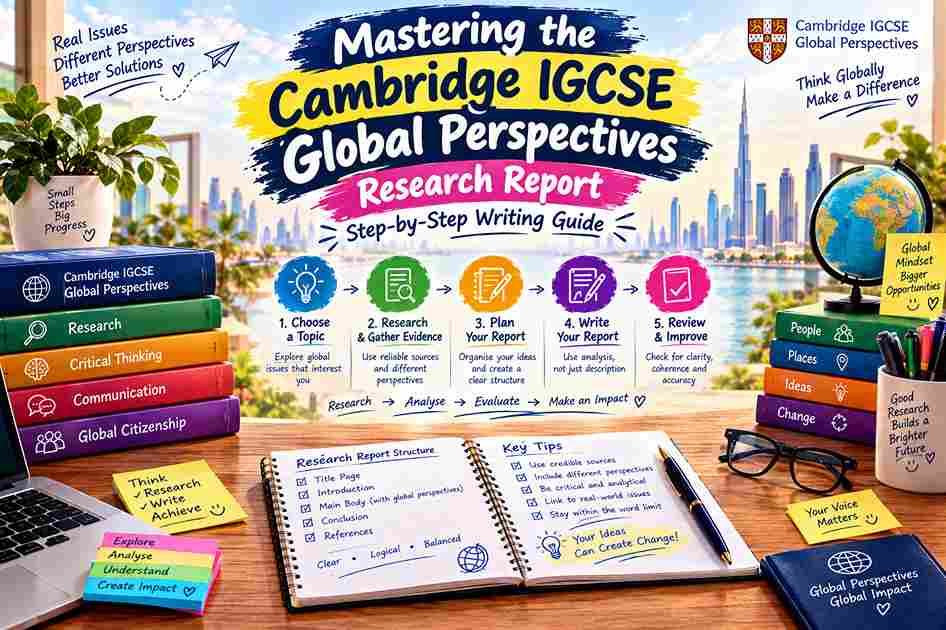
Mastering the Cambridge IGCSE Global Perspectives Research Report: Step-by-Step Writing Guide
Last Updated: September 2026 | By EdFlik Education Team
For students following the Cambridge IGCSE Global Perspectives (0457) curriculum, the Individual Research Report (often referred to as the research report or component) is one of the most intellectually rewarding yet challenging components of the course. Accounting for a significant portion of your final IGCSE grade, this 1,500 to 2,000-word essay-style report requires you to dive deep into a global issue, evaluate diverse cultural perspectives, analyze causes and consequences, test source reliability, and propose viable courses of action.
Unlike standard essay subjects where you simply repeat historical facts or scientific principles, Global Perspectives demands critical thinking, multi-perspective evaluation, and independent inquiry.
In this comprehensive guide, our expert IGCSE humanities and global perspectives tutors break down the exact structural framework, research strategies, and assessment criteria required to secure a top $A^*$ grade.
Part 1: Decoding the Core Requirements and Assessment Criteria
Before typing your title page, you must understand what Cambridge examiners are actually looking for. The Individual Report is assessed across four primary skill areas:
- Research (Locating and Selecting Information): Gathering information from a diverse range of primary and secondary sources, ensuring they are recent, authoritative, and relevant.
- Analysis (Causes, Consequences, and Perspectives): Examining root causes and short- or long-term consequences, and exploring contrasting arguments from personal, national, and global viewpoints.
- Evaluation (Judging Sources and Arguments): Critically testing the credibility of your sources (using frameworks like the CRAAP test) and evaluating the strength of different claims.
- Reflection and Communication: Demonstrating how your own perspective has evolved through research and presenting arguments clearly with complete, consistent citations.
Part 2: Step-by-Step Writing Blueprint (1,500 – 2,000 Words)
To hit every mark on the Cambridge rubric without exceeding the strict word limit (never go past 2,000 words), organize your report into clear, purposeful sections.
Step 1: Crafting Your Global Research Question
Your title must be framed as an open-ended question linked to one of the official Cambridge syllabus topics (e.g., Artificial Intelligence, Climate Change, Health and Wellbeing, or Sustainable Living).
- Weak Title: "Pollution in Cities" (Too broad, descriptive, not a question).
- Strong Title: "To what extent can urban centers transition successfully to zero-emission public transport? A comparative study of Singapore and London."
Step 2: The Introduction (approx. 200–250 words)
- The Hook: Introduce the issue using a striking global statistic, a quote from an international organization (e.g., UN, WHO, World Bank), or a recent news event.
- Contextualization: Define the scope of the problem and explain why it is a pressing global issue today.
- Thesis Statement: Outline the structure of your report and state the core dilemma you will investigate.
Step 3: Analyzing Causes and Consequences (approx. 400–500 words)
Move beyond mere description to deep analytical reasoning:
- Causes: Unpack the root causes (economic, political, social, or environmental) driving the issue. For instance, if researching food security, examine climate disruptions alongside global supply chain vulnerabilities.
- Consequences: Analyze both immediate and long-term effects on societies, economies, and ecosystems. Use quantitative data (graphs, percentages, indices) alongside qualitative case studies.
Step 4: Exploring Multiple Perspectives (Personal, National, Global) (approx. 500–600 words)
This is where top-band candidates distinguish themselves. You must examine how different groups and nations view the issue:
- National/Local Perspective: Examine how your chosen issue impacts a specific country or local community, noting government policies or cultural attitudes.
- Global Perspective: Compare how different nations or international bodies approach the problem. Highlight how economic development status (e.g., LEDCs vs. MEDCs) alters a country's priorities and capacity to respond.
- Personal Perspective: Reflect briefly on your own viewpoint and how encountering conflicting evidence challenged your initial assumptions.
Step 5: Evaluating Sources and Arguments (Built throughout or dedicated section)
Do not just state facts; evaluate where those facts came from:
- Critique at least 3 key sources using criteria like Currency, Relevance, Authority, Accuracy, and Purpose (CRAAP).
- Ask yourself: Does this author have a political or commercial bias? Is the data outdated? Does the reasoning hold up under scrutiny?
Step 6: Proposing and Evaluating Courses of Action (approx. 300–400 words)
Examiners require actionable, realistic solutions:
- Propose at least two distinct courses of action (e.g., individual behavioral change versus governmental legislation/international treaties).
- Evaluate their practicality, cost, potential effectiveness, and barriers to implementation. Conclude with a reasoned judgment on which solution offers the best path forward.
Part 3: Top 4 Strategies to Secure an $A^*$ in Global Perspectives
- Maintain a Consistent Citation Style: Use MLA, APA, or Harvard referencing consistently throughout your footnotes/in-text citations and bibliography. Uncited claims severely limit your research mark.
- Avoid Purely Descriptive Writing: If your report reads like a Wikipedia summary of facts, you will score in lower bands. Every paragraph must answer why, how, or with what consequence.
- Integrate Quantitative and Qualitative Evidence: Balance hard statistics (economic data, scientific measurements) with qualitative insights (expert testimonies, cultural narratives, NGO reports).
- Strictly Monitor Your Word Count: Aim for 1,750 to 1,950 words. Falling significantly short prevents you from fully developing your arguments, while exceeding 2,000 words results in examiners cutting off review past the limit.
Preparing for Cambridge IGCSE Global Perspectives or looking for expert online tutoring? EdFlik offers specialized, 1-to-1 mentorship customized for international school students, helping you master research structuring, source evaluation, and top-tier essay writing.Book a Free Demo Class Today!
Frequently Asked Questions (FAQs)
Q1: How many sources should I use in my IGCSE Global Perspectives Research Report?
Ans: While there is no strict official minimum, a well-researched report typically draws upon 8 to 12 diverse, high-quality sources, including academic journals, news articles, international organization reports (UN/WHO), and think-tank publications.
Q2: Can I write my research report in the first person?
Ans: Yes, using the first person ("I discovered," "My perspective shifted when...") is acceptable and encouraged when discussing personal reflection and how your views evolved, but maintain an objective, academic tone for the rest of the analytical sections.
Q3: What happens if my report exceeds 2,000 words?
Ans: Cambridge examiners strictly adhere to the 2,000-word ceiling. Any text written beyond the word limit will not be read or credited, which can abruptly cut off your conclusion or evaluation.
Q4: How can EdFlik help me prepare for IGCSE Global Perspectives?
Ans: EdFlik connects students globally with vetted, experienced 1-to-1 online tutors specializing in Cambridge IGCSE Humanities and Global Perspectives. Our personalized sessions focus on formulating research questions, structuring comparative analysis, and refining academic writing.