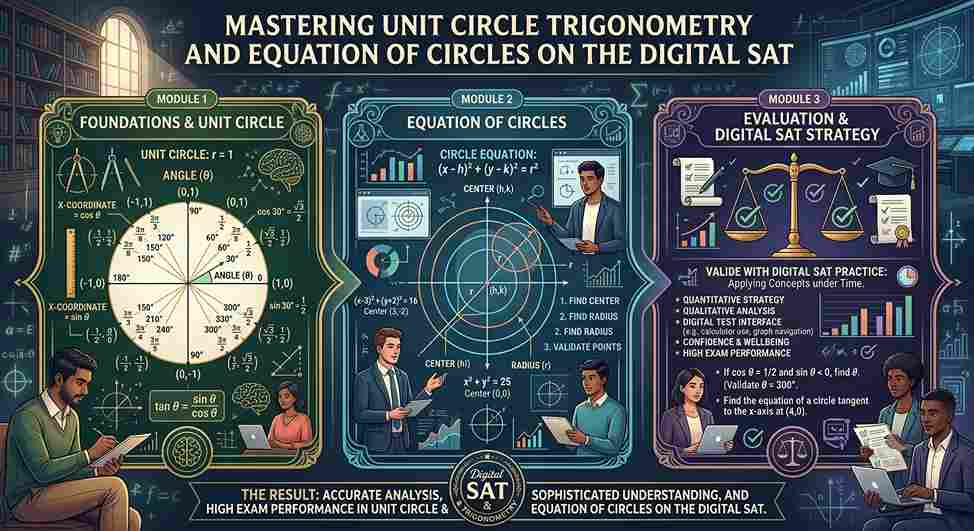
Mastering Unit Circle Trigonometry and Equation of Circles on the Digital SAT
Last Updated: October 2026 | By EdFlik Education Team
For high school students taking the Digital SAT, securing a top math score (700–800 range) requires complete mastery over the Advanced Math and Geometry/Trigonometry modules. While basic algebra and linear functions make up the foundation of the exam, the most challenging hard-module questions frequently target Circle Geometry and Trigonometry.
Specifically, two core circle concepts appear consistently:
- The Standard Equation of a Circle in the $xy$-Plane (including completing the square to find radius and center coordinates).
- Unit Circle Trigonometry (converting between degrees and radians, understanding reference angles, and navigating trigonometric ratios in all four quadrants).
With the built-in Desmos graphing calculator available across the entire Digital SAT Math section, students who understand both the underlying algebraic mechanics and strategic calculator tricks can solve these high-yield questions in seconds.
In this comprehensive masterclass guide, our expert SAT math strategists break down the core formulas, provide step-by-step problem-solving frameworks, expose common College Board traps, and share Desmos calculator strategies to help you score an 800.
Part 1: The Equation of a Circle in the $xy$-Plane
1. Standard Form Equation
In the Cartesian coordinate plane, the standard equation of a circle centered at point $(h, k)$ with radius $r$ is:
$$(x - h)^2 + (y - k)^2 = r^2$$
                           CIRCLE GEOMETRY IN THE xy-PLANE
                                         |
        +--------------------------------+--------------------------------+
        |                                                                 |
CENTER COORDINATES: (h, k)                                       RADIUS: r
• Pay close attention to signs!                                  • The right side equals r² (not r)
• Equation: (x - 3)² + (y + 4)² = 25                              • r² = 25  ⇒  r = 5
  Center = (3, -4)                                                 • Diameter = 2r = 10
College Board Trap Warning: Notice the minus signs in $(x - h)^2$ and $(y - k)^2$. If an equation is written as $(x + 5)^2 + (y - 2)^2 = 36$, the center is at $(-5, 2)$, NOT $(5, 2)$! Also, remember that $36 = r^2$, so the radius $r = \sqrt{36} = 6$.
2. General Form to Standard Form (Completing the Square)
On harder Digital SAT Module 2 questions, the equation of a circle will rarely be given in standard form. Instead, you will see the expanded general form:
$$x^2 + y^2 + Ax + By + C = 0$$
To find the center $(h, k)$ or radius $r$, you must complete the square for both $x$ and $y$.
Step-by-Step Worked Example:
Question: A circle in the $xy$-plane has the equation $x^2 + y^2 - 6x + 8y - 11 = 0$. What is the radius of the circle?
- Group $x$ and $y$ terms together and move the constant to the right side:$$(x^2 - 6x) + (y^2 + 8y) = 11$$
- Complete the square for $x$ and $y$:
- Take half of the $x$-coefficient ($-6 / 2 = -3$) and square it ($(-3)^2 = 9$).
- Take half of the $y$-coefficient ($8 / 2 = 4$) and square it ($4^2 = 16$).
- Add both values to BOTH sides of the equation:$$(x^2 - 6x + 9) + (y^2 + 8y + 16) = 11 + 9 + 16$$
- Factor into standard form:$$(x - 3)^2 + (y + 4)^2 = 36$$
- Identify center and radius:
- Center $= (3, -4)$
- $r^2 = 36 \implies \text{Radius } r = 6$.
3. Digital SAT Desmos Hack for Circles
Whenever you face a circle equation question on the Digital SAT:
- Type the exact equation given in the question into line 1 of the Desmos Graphing Calculator.
- Desmos will render the circle immediately!
- Click or hover over the top, bottom, leftmost, or rightmost points of the circle to read the coordinates. The distance from the center to any edge gives you the radius instantly without doing manual algebra.
Part 2: Unit Circle Trigonometry and Radians
The Unit Circle is a circle centered at the origin $(0,0)$ with a radius of $r = 1$. It bridges geometry and algebra by defining trigonometric functions for any angle $\theta$.
                        THE UNIT CIRCLE QUADRANTS

                                (0, 1)  90° (π/2)
                                  |
                                  |   Quadrant I (ALL positive)
             Quadrant II          |   x = cos(θ) > 0, y = sin(θ) > 0
             x = cos(θ) < 0       |
             y = sin(θ) > 0       |
   180° (π) ----------------------+---------------------- 0° / 360° (2π)
  (-1, 0)                         |                       (1, 0)
             Quadrant III         |   Quadrant IV
             x = cos(θ) < 0       |   x = cos(θ) > 0
             y = sin(θ) < 0       |   y = sin(y) < 0
                                  |
                               (0, -1) 270° (3π/2)
1. Coordinates on the Unit Circle
For any angle $\theta$ measured counterclockwise from the positive $x$-axis on the unit circle:
- The $x$-coordinate is $\cos\theta$.
- The $y$-coordinate is $\sin\theta$.
- The slope of the line segment is $\tan\theta = \frac{\sin\theta}{\cos\theta} = \frac{y}{x}$.
$$\text{Point on Unit Circle } P = (\cos\theta, \sin\theta)$$
Because $x^2 + y^2 = r^2$ and $r = 1$, we derive the fundamental Pythagorean Identity:
$$\sin^2\theta + \cos^2\theta = 1$$
2. Degree-to-Radian Conversions
The Digital SAT heavily tests radian measure. Remember that $180^\circ = \pi \text{ radians}$.
- Degrees to Radians: Multiply by $\frac{\pi}{180^\circ}$$$\text{Example: } 120^\circ \times \frac{\pi}{180^\circ} = \frac{2\pi}{3} \text{ radians}$$
- Radians to Degrees: Multiply by $\frac{180^\circ}{\pi}$$$\text{Example: } \frac{5\pi}{4} \times \frac{180^\circ}{\pi} = 225^\circ$$
3. Trigonometric Ratios and Quadrant Signs ("ASTC")
To determine whether $\sin$, $\cos$, or $\tan$ is positive or negative in a specific quadrant, memorize the "All Students Take Calculus" (ASTC) rule:
- Quadrant I ($0$ to $\frac{\pi}{2}$ / $0^\circ$ to $90^\circ$): All functions ($\sin, \cos, \tan$) are positive.
- Quadrant II ($\frac{\pi}{2}$ to $\pi$ / $90^\circ$ to $180^\circ$): Sine is positive ($\cos$ and $\tan$ are negative).
- Quadrant III ($\pi$ to $\frac{3\pi}{2}$ / $180^\circ$ to $270^\circ$): Tangent is positive ($\sin$ and $\cos$ are negative).
- Quadrant IV ($\frac{3\pi}{2}$ to $2\pi$ / $270^\circ$ to $360^\circ$): Cosine is positive ($\sin$ and $\tan$ are negative).
4. Complementary Angle Relationship
A favorite Digital SAT question type relies on cofunction identities:
$$\sin(x^\circ) = \cos(90^\circ - x^\circ) \quad \text{or in radians: } \sin(x) = \cos\left(\frac{\pi}{2} - x\right)$$
Quick Rule: If $\sin(A) = \cos(B)$, then $A + B = 90^\circ$ (or $\frac{\pi}{2}$ radians).
Part 3: Top 4 Traps That Cost Digital SAT Math Points
- Forgetting to Square the Radius in the Equation: Writing the equation as $(x - h)^2 + (y - k)^2 = r$ instead of $r^2$. If the radius is $7$, the right side of the equation MUST be $49$!
- Degree vs. Radian Mode in Desmos: Evaluating trigonometric functions in Desmos without checking the angle mode! Desmos defaults to Radians. If your angle is in degrees (e.g., $\sin(45^\circ)$), click the wrench icon in the top right of Desmos and toggle to Degrees.
- Misidentifying Arc Length and Sector Area Formulas:
- Arc Length: $s = r\theta$ (when $\theta$ is in radians) or $s = \frac{\theta}{360} \cdot 2\pi r$ (when $\theta$ is in degrees).
- Sector Area: $A = \frac{1}{2}r^2\theta$ (when $\theta$ is in radians) or $A = \frac{\theta}{360} \cdot \pi r^2$ (when $\theta$ is in degrees).
- Sign Errors in Center Coordinates: Extracting center $(h, k)$ with incorrect signs from $(x + 4)^2 + (y - 9)^2 = 100$. The center is $(-4, 9)$, not $(4, -9)$.
Preparing for the Digital SAT and aiming for a 750–800 Math score? EdFlik connects high school students globally with expert 1-to-1 online SAT prep tutors, helping you master circle geometry, advanced algebra, Desmos strategies, and high-yield digital test techniques. Book a Free Demo Class Today!
Frequently Asked Questions (FAQs)
Q1: How many circle and trigonometry questions appear on the Digital SAT Math section?
Ans: Geometry and Trigonometry account for approximately $15\%$ of the total math section (roughly 5 to 7 questions across both modules). Circle equations, arc lengths, and unit circle ratios appear consistently in Module 2.
Q2: Can I use the Desmos calculator to solve circle equations directly on the SAT?
Ans: Yes! The embedded Desmos graphing calculator handles implicit circle equations effortlessly. Plotting the equation allows you to visually identify center coordinates, radius lengths, and line-circle intersections without manual algebra.
Q3: What are the key special right triangle ratios I need for the unit circle?
Ans: You should memorize the two standard special right triangles provided on the SAT reference sheet:
- $45^\circ-45^\circ-90^\circ$ Triangle: Side ratios are $x : x : x\sqrt{2}$. ($\sin 45^\circ = \cos 45^\circ = \frac{\sqrt{2}}{2}$).
- $30^\circ-60^\circ-90^\circ$ Triangle: Side ratios are $x : x\sqrt{3} : 2x$. ($\sin 30^\circ = \cos 60^\circ = \frac{1}{2}$; $\sin 60^\circ = \cos 30^\circ = \frac{\sqrt{3}}{2}$).
Q4: How does EdFlik support Digital SAT prep students?
Ans: EdFlik connects high school students worldwide with vetted, expert 1-to-1 online Digital SAT math and verbal tutors. Our personalized coaching focuses on identifying individual skill gaps, mastering Desmos shortcuts, practicing under timed test conditions, and building confidence for test day.