Mastering Vector Geometry and 3D Line Equations in Edexcel IAL Pure Math 4
Last Updated: October 2026 | By EdFlik Education Team
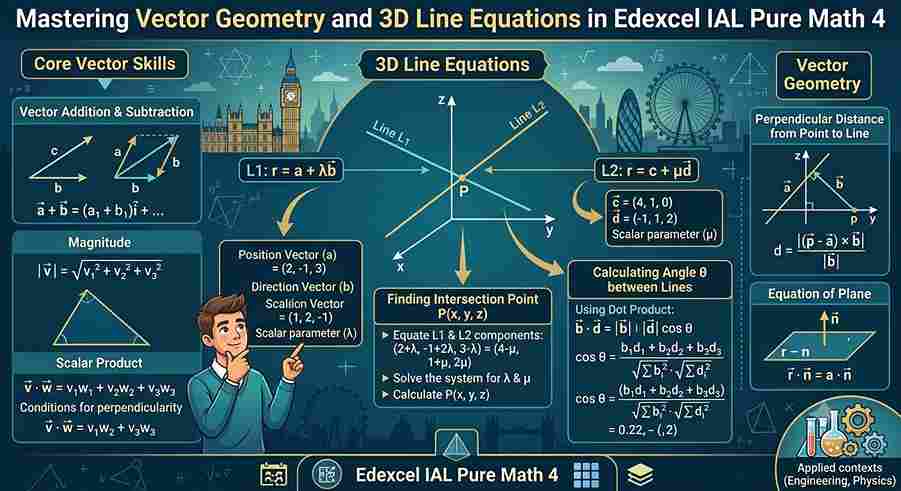
For high school students completing the Pearson Edexcel International Advanced Level (IAL) Pure Mathematics 4 (P4) qualification, Vector Geometry represents one of the most intellectually rewarding yet challenging topics on the examination paper. While GCSE and AS-Level vectors focused primarily on 2D geometry, vector addition, and simple ratios, P4 elevates the subject into three-dimensional space ($3\text{D}$).
Featured prominently near the end of the P4 exam paper, 3D vector questions routinely carry 7 to 10 high-tariff marks. They test your ability to construct vector equations of lines, determine whether two lines intersect, are parallel, or are skew, calculate angles between vectors using the scalar product, and solve complex shortest-distance problems.
In this comprehensive, exam-focused masterclass guide, our expert Edexcel IAL mathematics educators break down core 3D vector principles, provide a foolproof problem-solving framework, expose common examiner traps.
Part 1: The Vector Equation of a Line in 3D
In two-dimensional coordinate geometry, lines are defined by $y = mx + c$. In three-dimensional space, however, lines cannot be expressed simply by a slope and a y-intercept because they can tilt in any direction across the $x, y,$ and $z$ axes. Instead, we use a vector equation.
                   3D VECTOR EQUATION OF A LINE
                                 |
        $$\mathbf{r} = \mathbf{a} + \lambda \mathbf{d}$$

• $\mathbf{r}$: General position vector $(x, y, z)$ of any arbitrary point on the line.
• $\mathbf{a}$: Fixed position vector of a known point on the line.
• $\mathbf{d}$: Direction vector $(d_1, d_2, d_3)$ parallel to the line.
• $\lambda$: Scalar parameter ($\lambda \in \mathbb{R}$) that scales the direction vector.
1. Converting Between Cartesian and Vector Forms
Examiners often present equations in Cartesian form and require you to convert them, or vice versa:
$$\frac{x - x_1}{d_1} = \frac{y - y_1}{d_2} = \frac{z - z_1}{d_3} = \lambda$$
From this Cartesian form, you can immediately extract:
- Point on the line ($\mathbf{a}$): $(x_1, y_1, z_1)$
- Direction vector ($\mathbf{d}$): $(d_1, d_2, d_3)$
Part 2: Determining the Relationship Between Two 3D Lines
When given two distinct lines in 3D space, $L_1$ and $L_2$, their geometric relationship falls into one of three categories:
                  THREE RELATIONSHIPS BETWEEN 3D LINES
                                   |
        +--------------------------+--------------------------+
        |                          |                          |
1. INTERSECTING LINES              2. PARALLEL LINES          3. SKEW LINES
• Lines cross at a single          • Direction vectors are    • Lines do NOT intersect
  common point.                      multiples ($\mathbf{d}_1 = k\mathbf{d}_2$).  and are NOT parallel.
• Consistent $\lambda$ and $\mu$   • No common intersection   • Exist only in 3D space
  values across $x, y, z$.           point.                     (non-coplanar).
Protocol for Testing Line Intersections:
- Set up two separate vector equations using different parameters (e.g., parameter $\lambda$ for line 1 and parameter $\mu$ for line 2).
- Equate the $x, y,$ and $z$ components to form a system of three simultaneous equations with two unknowns ($\lambda$ and $\mu$).
- Solve for $\lambda$ and $\mu$ using any two equations (e.g., $x$ and $y$).
- The Consistency Test: Substitute your values of $\lambda$ and $\mu$ into the third equation ($z$). If the equation holds true, the lines intersect. If it fails, the lines do not intersect (meaning they are either parallel or skew).
Part 3: Step-by-Step Problem-Solving Framework (Finding the Angle Between Two Lines)
One of the most common 5-mark calculation items in P4 vector questions requires finding the acute angle $\theta$ between two intersecting or skew lines.
                    ANGLE BETWEEN TWO LINES WORKFLOW
                                   |
  Step 1: Extract Direction Vectors ---> Identify $\mathbf{d}_1$ and $\mathbf{d}_2$ from line equations
  Step 2: Apply Scalar Product Formula ---> Use $\mathbf{d}_1 \cdot \mathbf{d}_2 = |\mathbf{d}_1||\mathbf{d}_2|\cos\theta$
  Step 3: Calculate Dot Product      ---> Multiply components and sum them ($x_1x_2 + y_1y_2 + z_1z_2$)
  Step 4: Evaluate Magnitudes        ---> Find lengths $|\mathbf{d}_1|$ and $|\mathbf{d}_2|$ using Pythagoras in 3D
  Step 5: Solve for $\theta$           ---> Calculate $\cos\theta$ and take $\arccos$
Worked Calculation Example:
Question: Find the acute angle $\theta$ between the two lines given by:$L_1: \mathbf{r} = \begin{pmatrix} 1 \\ 2 \\ 3 \end{pmatrix} + \lambda \begin{pmatrix} 2 \\ 1 \\ -2 \end{pmatrix}$$L_2: \mathbf{r} = \begin{pmatrix} 4 \\ 1 \\ 0 \end{pmatrix} + \mu \begin{pmatrix} 3 \\ 4 \\ 12 \end{pmatrix}$
Step 1: Extract Direction Vectors
- Direction vector 1 ($\mathbf{d}_1$) = $\begin{pmatrix} 2 \\ 1 \\ -2 \end{pmatrix}$
- Direction vector 2 ($\mathbf{d}_2$) = $\begin{pmatrix} 3 \\ 4 \\ 12 \end{pmatrix}$
Step 2: Calculate the Scalar (Dot) Product ($\mathbf{d}_1 \cdot \mathbf{d}_2$)
$$\mathbf{d}_1 \cdot \mathbf{d}_2 = (2)(3) + (1)(4) + (-2)(12) = 6 + 4 - 24 = -14$$
Step 3: Calculate the Magnitudes
$$\vert{}\mathbf{d}_1\vert{} = \sqrt{2^2 + 1^2 + (-2)^2} = \sqrt{4 + 1 + 4} = \sqrt{9} = 3$$$$\vert{}\mathbf{d}_2\vert{} = \sqrt{3^2 + 4^2 + 12^2} = \sqrt{9 + 16 + 144} = \sqrt{169} = 13$$
Step 4: Apply the Scalar Product Formula
$$\cos\theta = \frac{\mathbf{d}_1 \cdot \mathbf{d}_2}{\vert{}\mathbf{d}_1\vert{}\vert{}\mathbf{d}_2\vert{}} = \frac{-14}{(3)(13)} = \frac{-14}{39} \approx -0.35897$$
Step 5: Solve for $\theta$
$$\theta = \arccos(-0.35897) \approx 111.0^\circ$$
Since examiners typically ask for the acute angle between lines, take $180^\circ - 111.0^\circ = 69.0^\circ$.
Part 4: Top 4 Traps That Cost Students Marks in P4 Vectors
- Using the Same Parameter Letter for Two Different Lines: Writing $\lambda$ for both line 1 and line 2 when testing for intersections. You must use two distinct parameters (such as $\lambda$ and $\mu$) to avoid artificially forcing the lines to intersect at the same scalar multiple.
- Forgetting to Report the Acute Angle: Leaving an obtuse angle (e.g., $115^\circ$) as your final answer when the question explicitly requests the acute angle between two lines. Always subtract obtuse angles from $180^\circ$.
- Arithmetic Sign Errors in Dot Products: Dropping negative signs when multiplying components in scalar products (e.g., $(-2)(12) = -24$), which completely ruins the angle calculation.
- Confusing Position Vectors and Direction Vectors: Using the fixed point position vector ($\mathbf{a}$) instead of the direction vector ($\mathbf{d}$) when calculating angles between lines. Remember: lines are angled based on their direction vectors, not where they pass through space!
Preparing for Pearson Edexcel IAL Pure Mathematics 4 (P4) exams and aiming for an $A^$ grade? EdFlik connects international school students globally with expert, 1-to-1 online IAL math tutors, helping you master 3D vector geometry, differential equations, integration techniques, and past-paper exam strategies. *Book a Free Demo Class Today!
Frequently Asked Questions (FAQs)
Q1: What is the difference between parallel lines and skew lines in 3D?
Ans: Parallel lines have direction vectors that are exact scalar multiples of each other ($\mathbf{d}_1 = k\mathbf{d}_2$) and lie in the same plane. Skew lines are neither parallel nor intersecting; they exist in different planes and never meet.
Q2: How do I prove that three points lie on a straight line (collinear)?
Ans: To prove points $A, B,$ and $C$ are collinear, find vectors $\vec{AB}$ and $\vec{BC}$. If $\vec{AB}$ is a scalar multiple of $\vec{BC}$ (i.e., $\vec{AB} = k\vec{BC}$) and they share a common point (point $B$), the three points are collinear.
Q3: Can the scalar product of two non-zero vectors be zero?
Ans: Yes! If the scalar product equals zero ($\mathbf{a} \cdot \mathbf{b} = 0$), it means $\cos\theta = 0$, indicating that the two vectors are perpendicular (orthogonal) to each other at a $90^\circ$ angle.
Q4: How does EdFlik support Edexcel IAL Pure Math 4 students?
Ans: EdFlik connects international school students worldwide with vetted, expert 1-to-1 online tutors specializing in Pearson Edexcel IAL Mathematics ($P_1–P_4$). Our personalized coaching focuses on clarifying complex 3D vector proofs, mastering calculus integration, and building exam confidence under timed conditions.
More on A-Level
- A-Levels in the UAE: A Complete Guide to Boards, Subjects, Exams and University Entry
- Mastering Radians, Sectors, and Arcs: Edexcel IAL Pure Math 1 Exam Masterclass
- Mastering Edexcel IAL Pure Mathematics 2 (P2): Logarithms, Exponentials, and Finding Expert A-Level Math Tutors in Abu Dhabi
- Conquering Coordinate Geometry and Differentiation: Edexcel IAL Pure Mathematics 1 Breakdown
- All A-Level articles