Navigating IB MYP Individuals and Societies: Geography Criteria, Sustainable Cities Projects, and Global Challenges
Last Updated: September 2026 | By EdFlik Education Team
For students and teachers navigating the International Baccalaureate (IB) Middle Years Programme (MYP)—typically spanning ages 11 to 16 (Years 7 through 11 / Grades 6 to 10)—Individuals and Societies (humanities/geography) serves as a vital framework for understanding human systems, environmental interactions, and global citizenship.
Among all geographical themes in the MYP curriculum, Sustainable Cities and Communities (closely aligning with UN Sustainable Development Goal 11) is one of the most engaging, interdisciplinary, and frequently assessed units. Whether you are completing a Criterion-based assessment task, preparing for e-portfolios, or designing a community action project, mastering the MYP assessment criteria is essential to achieving top marks (Level 7).
In this comprehensive, in-depth guide, our expert IB MYP humanities tutors break down the four assessment criteria, explore innovative sustainable cities project ideas, and share proven strategies for success.
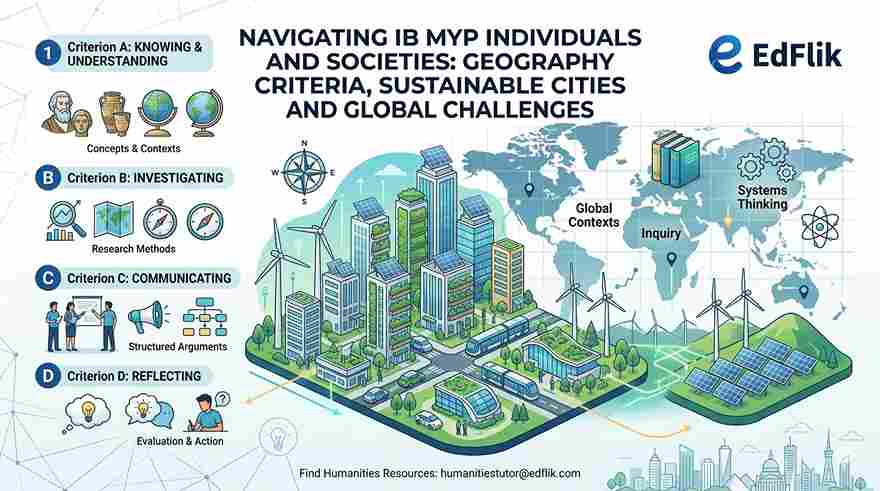
Part 1: Deconstructing the IB MYP Humanities Assessment Criteria (Criteria A to D)
Unlike traditional curricula that rely solely on terminal exams, the IB MYP assesses students holistically across four distinct criteria, each graded on a scale of 0 to 8. To score a top Grade 7 overall, students must consistently demonstrate high-level proficiency in all four areas.
1. Criterion A: Knowing and Understanding
- What it measures: Factual and conceptual knowledge, terminology, and the ability to explain complex geographical phenomena.
- How to excel: Avoid purely descriptive answers. Use precise geographical vocabulary (e.g., urban sprawl, gentrification, ecological footprint, microclimate, albedo effect) and explain why and how processes occur rather than just stating what happens.
2. Criterion B: Investigating
- What it measures: Formulating a clear research question, designing safe and effective research methods, collecting and recording data, and evaluating sources.
- How to excel: When conducting geographical inquiries (such as a field study on urban heat islands or traffic congestion), explicitly state your hypothesis, evaluate the reliability of secondary sources (using the CRAAP test: Currency, Relevance, Authority, Accuracy, Purpose), and acknowledge limitations in your data collection.
3. Criterion C: Communicating
- What it measures: Organizing information logically, structuring arguments, using appropriate referencing (MLA or APA), and communicating information effectively through maps, graphs, and written text.
- How to excel: Ensure your reports feature properly labeled geographical graphs, choropleth maps, or flow diagrams. Keep your writing structured with clear headings, topic sentences, and seamless transitions.
4. Criterion D: Thinking Critically
- What it measures: Analyzing and synthesizing information, evaluating different perspectives (social, economic, environmental, and political), and drawing reasoned conclusions.
- How to excel: This is the highest-tariff criterion. Never look at a geographical issue through a single lens. If you are discussing urban expansion, analyze the economic benefits for developers against the environmental loss of biodiversity and the social displacement of low-income communities.
Part 2: Sustainable Cities Project Ideas for MYP Students
Urban geography units in MYP Individuals and Societies often culminate in a major inquiry project or design task. Here are four high-scoring, real-world project ideas that integrate geographical concepts with Criterion B (investigating) and Criterion D (critical thinking):
1. The 15-Minute City Blueprint (Urban Planning)
- The Concept: Students redesign a neighborhood in their local city (or a fictional urban zone) so that all residents can access work, education, healthcare, and leisure within a 15-minute walk or bike ride.
- Geographical Focus: Transportation networks, land-use zoning, spatial accessibility, and carbon emission reduction.
- Deliverable: A digital master plan map paired with an environmental impact justification essay.
2. Urban Heat Island (UHI) Mitigation Audit (Fieldwork Investigation)
- The Concept: Students use digital thermometers or infrared sensors to measure surface and air temperatures across different urban microclimates (e.g., asphalt parking lots vs. parks with dense canopy cover).
- Geographical Focus: Microclimates, albedo, green infrastructure, and human well-being.
- Deliverable: A formal geographic investigation report with data tables, scatter graphs, and recommendations for urban forestation.
3. Smart Waste and Circular Economy Proposal
- The Concept: Investigate current municipal waste generation in your city and design a community-level circular economy framework that eliminates single-use plastics and optimizes organic composting.
- Geographical Focus: Resource management, demographic waste footprints, and sustainable consumption (SDG 12).
- Deliverable: A persuasive multimedia pitch deck or website targeting local municipal policymakers.
4. Climate-Resilient Architecture Showcase
- The Concept: Research how coastal or arid cities adapt to extreme weather events (e.g., rising sea levels in coastal Asian megacities or extreme heat management in the GCC region) and build a comparative case study.
- Geographical Focus: Natural hazards, human adaptation, and sustainable engineering solutions.
- Deliverable: A comparative comparative research essay analyzing the cost-benefit ratio of structural vs. non-structural mitigation strategies.
Part 3: Top 4 Strategies to Secure a Level 7 in MYP Humanities
- Use the PEEL Paragraph Structure: When writing analytical responses for Criteria A and D, structure your body paragraphs using Point, Evidence, Explanation, Link. Always anchor your arguments with specific case study data or statistical evidence.
- Integrate Spatial Thinking (Maps and GIS): Geography is inherently spatial. Whenever possible, incorporate annotated sketch maps, Google Earth screenshots, or GIS data overlays into your Criterion C presentations to show where phenomena occur and why location matters.
- Address Multiple Perspectives: Top-level essays never present a one-sided argument. Explicitly discuss how different stakeholders view an issue—for instance, how a real estate developer, an indigenous community, and an environmental activist might hold conflicting priorities regarding land development.
- Refine Your Referencing Habits: Do not leave your bibliography to the last minute. Keep a running document of every website, academic journal, and map source you consult, formatting citations consistently throughout your inquiry process.
Struggling to unpack your MYP humanities criteria, structure your geographical investigations, or develop a standout sustainable cities project? EdFlik offers expert, 1-to-1 online tutoring customized specifically for the IB Middle Years Programme, helping students build critical thinking confidence and secure Level 7s.Book a Free Demo Class Today!
Frequently Asked Questions (FAQs)
Q1: How are MYP Humanities grades calculated across the four criteria?
Ans: Each of the four criteria (A, B, C, and D) is graded out of 8, giving a total possible score out of 32. Teachers use the official IB grade boundaries conversion table to translate the final aggregate score into an overall IB grade from 1 to 7.
Q2: What is the difference between MYP Individuals and Societies and DP Geography?
Ans: MYP Individuals and Societies is an interdisciplinary framework covering history, geography, economics, and sociology designed for students aged 11–16. It builds foundational research, critical thinking, and inquiry skills that feed directly into specialized Diploma Programme (DP) courses like IB Geography HL/SL.
Q3: How can I improve my critical thinking marks in Criterion D?
Ans: To hit the top bands in Criterion D, you must move beyond describing facts. You need to weigh the advantages against the disadvantages, evaluate the short-term versus long-term impacts, and justify your conclusions using balanced, counter-argued evidence.
Q4: How can EdFlik help my child succeed in IB MYP Humanities?
Ans: EdFlik connects students with experienced, certified 1-to-1 online tutors specializing in the IB Middle Years Programme. Our personalized sessions focus on clarifying complex geographical concepts, refining essay structures, and guiding inquiry projects.