Navigating the British Curriculum: Your Ultimate Success Blueprint for Grade 9 and Year 10 (The IGCSE Launchpad)
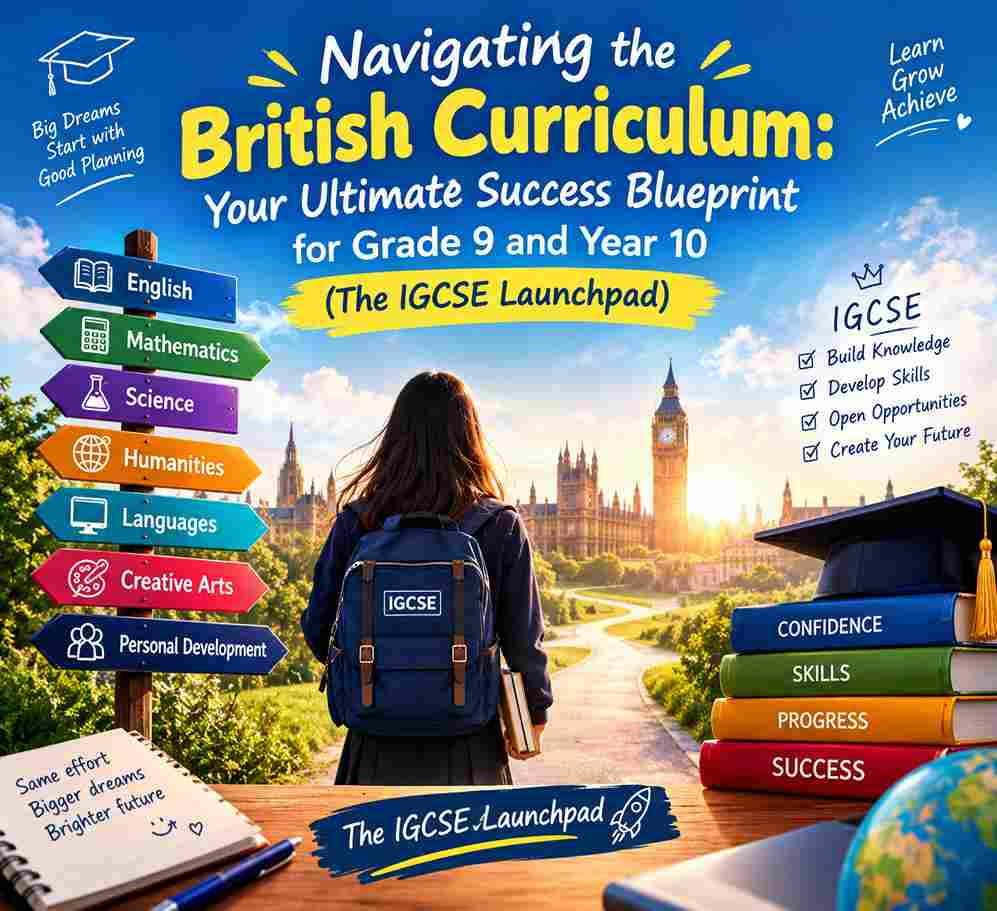
Last Updated: September 2026 | By EdFlik Education Team
For students and parents navigating the British Curriculum across international schools in the UAE and worldwide, stepping into Grade 9 and Year 10 marks the official entry into the IGCSE / GCSE examination cycle.
Moving away from Key Stage 3—where learning is exploratory and general—Year 10 represents a profound academic gear-shift. Students begin studying their chosen IGCSE subject option blocks, facing higher-tier content, rigorous mark schemes, and foundational concepts that directly feed into final terminal examinations at the end of Year 11. Treating Year 10 as a standard "cruise year" is the single biggest mistake students make; building strong study habits now is what separates $A^*$ students from the rest.
In this comprehensive guide, our expert curriculum advisors break down the structural realities of Year 10, share proven revision strategies, and explain how targeted academic support can secure top-band success.
Part 1: The Anatomy of IGCSE Year 10
The International General Certificate of Secondary Education (IGCSE) is typically structured as a two-year course. Grade 9 / Year 10 serves as the critical knowledge acquisition phase.
1. The Subject Option Architecture
Students typically transition from studying 10 to 14 general subjects down to a focused portfolio of 7 to 9 IGCSE subjects:
- Core Compulsory Subjects: Mathematics, English Language, English Literature, and Coordinated/Triple Sciences (Biology, Chemistry, Physics).
- Elective Option Blocks: Humanities (History, Geography, Economics), Modern Foreign Languages, Computer Science, Business Studies, and Creative Arts.
- The Tiering System: In subjects like Mathematics and Sciences, schools begin preparing students for either Foundation Tier (capping grades at a 5/C) or Higher Tier (unlocking grades 4 through 9 / $A^*$ to $C$). Year 10 performance heavily dictates tier placement.
Part 2: The Critical Timeline — Surviving and Thriving in Year 10
Success in Year 11 mock and final exams is entirely built upon the foundational discipline established during Year 10.
Phase 1: Semester 1 (September – January) — The Adjustment Shock
- Focus: Adapting to faster curriculum pacing, mastering complex IGCSE terminology, and adjusting to the jump in homework volume.
- The Trap: Assuming that because final exams are still 18 months away, there is plenty of time. Students who fall behind on foundational algebra, chemical balancing, or scientific terminology in Term 1 often find themselves overwhelmed by spring.
- Actionable Tip: Build a digital or physical folder structure for every subject on Day 1. Actively summarize each textbook chapter into concise revision notes immediately after it is taught in class.
Phase 2: Semester 2 (February – June) — Building Revision Momentum
- Focus: Consolidating mid-year topics, tackling end-of-year school promotional exams, and identifying individual conceptual weak spots.
- The End-of-Year Reality: End-of-year Year 10 exams are critical because schools use these grades to set official predicted tracks, finalize tiering decisions (Foundation vs. Higher), and counsel students on Sixth Form options.
- Actionable Tip: Do not wait until Year 11 to start using past papers. Introduce topic-specific past paper questions at the end of every major unit to get comfortable with exam board command words.
Part 3: Top 4 Strategies to Secure Top Grades ($A^*$ / Grades 8–9)
- Master Active Recall Over Passive Reading: Simply rereading a textbook creates an "illusion of competence." Use flashcards, blurting techniques, and summary mind-maps to force your brain to retrieve information from long-term memory.
- Deconstruct Command Words Early: IGCSE examiners grade strictly against specific instructions. Learn the exact distinction between describe, explain, calculate, evaluate, and suggest across your subjects.
- Prioritize Weak Areas Immediately: If you struggle with simultaneous equations, mole calculations, or analyzing unseen poetry, do not ignore them. Tackle difficult topics head-on while you have time on your side in Year 10.
- Keep a Consistent Weekly Routine: Consistent, moderate study (45 minutes to 1 hour daily) is infinitely more effective than stressful, last-minute weekend cramming sessions.
Part 4: Why Personalized Tutoring Matters in Year 10
With up to nine rigorous subjects demanding high-level performance, school classrooms cannot always provide the individualized attention needed to catch small conceptual misunderstandings before they snowball.
Partnering with an expert 1-to-1 tutoring provider like EdFlik offers transformational advantages during Year 10:
- Targeted Conceptual Support: Breaking down notoriously difficult IGCSE topics (such as trigonometry in Mathematics, organic chemistry, or syntax analysis in English) into manageable, clear steps.
- Early Exam Technique Training: Teaching students how to decode mark schemes and structure extended-response answers to gain maximum credit.
- Unshakeable Academic Confidence: Providing a supportive mentorship environment where students can clarify doubts freely and build absolute readiness for the final push into Year 11.
Stepping into Grade 9 and Year 10? EdFlik offers expert, 1-to-1 online tutoring customized specifically for international school students following the British curriculum, helping you build analytical mastery and secure top $A^$ grades.*Book a Free Demo Class Today!
Frequently Asked Questions (FAQs)
Q1: What is the difference between Cambridge IGCSE and Pearson Edexcel IGCSE?
Ans: Both are internationally recognized qualifications aligned with the British curriculum. While both cover rigorous academic standards, they are administered by different exam boards, featuring slightly different question formats, syllabus weightings, and grading scales (Edexcel uses a 9-1 scale for most subjects, while Cambridge offers both 9-1 and A*-G scales depending on the region).
Q2: How important are Year 10 end-of-year exams?
Ans: Extremely important. Schools use Year 10 final exams to determine Higher vs. Foundation tier entry in Mathematics and Sciences, set internal student tracking targets, and establish baseline predicted trajectories for Year 11.
Q3: Can I change my IGCSE option subjects during Year 10?
Ans: Most international schools allow minor subject adjustments or option changes during the first few weeks of Year 10. However, changing subjects too late means catching up on missed coursework and syllabus content independently.
Q4: How can EdFlik support British curriculum students in Grade 9 and Year 10?
Ans: EdFlik connects students with vetted, experienced 1-to-1 online tutors specializing in all major IGCSE and GCSE subjects (Mathematics, Sciences, English, Humanities, and Computer Science). Our personalized sessions focus on clarifying difficult topics, mastering past papers, and refining exam technique.