Olympiad Problem-Solving Techniques UAE 2026 — 5 Core Strategies
Olympiad mathematics is not about knowing more content than your peers — it is about thinking differently. The students who win Maths Olympiad competitions from Grade 5 through to AMC are not necessarily those who have memorised the most formulas. They are the ones who have internalised five fundamental problem-solving strategies that unlock problems that standard curriculum training cannot. This guide explains all five strategies with worked examples accessible to students from Grade 5 upward.
Why Olympiad Problem-Solving Requires a Different Mindset
In school Maths, a student sees a problem and selects the appropriate algorithm: this is a quadratic, I use the quadratic formula; this is a probability, I count favourable outcomes and divide by total outcomes. The algorithm is taught; the student applies it.
In Olympiad Maths, no algorithm is provided. The problem is deliberately designed so that direct calculation either fails or produces an answer that cannot be verified without additional reasoning. The student must select a strategy, attempt it, evaluate whether it is productive, and switch strategies if not — under time pressure, with no template.
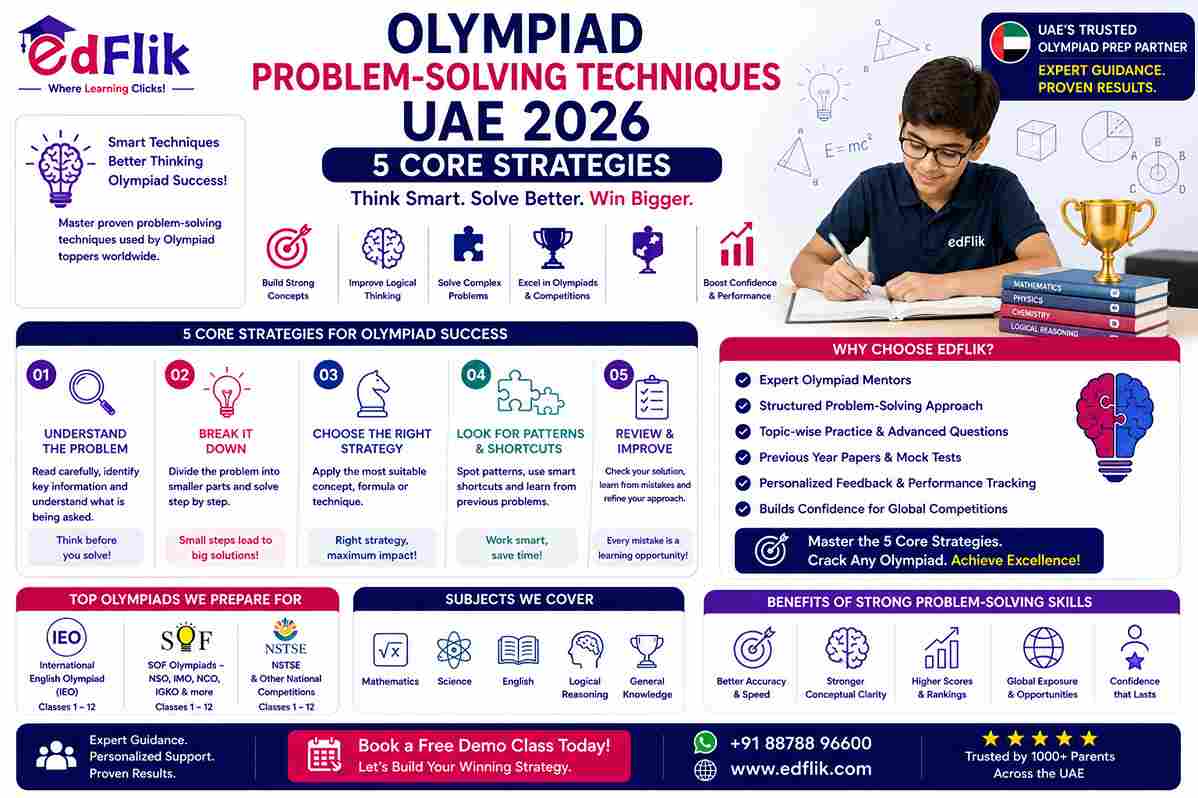
The five strategies below are the core toolkit. A student who has deeply internalised all five can approach any junior Olympiad problem with genuine tools rather than guesswork.
Strategy 1: Work Backwards
When to use it
Use working backwards when: the end state is known but the starting state is not; or when the problem asks "is it possible to reach X from Y?" and the forward path seems too complex.
How it works
Start from what the answer must look like — the conditions the final state must satisfy. Then ask: what state could have produced this? Work backwards step by step until you reach the starting state, or prove that no valid path exists.
Worked example (Grade 6 level)
Problem: A number is doubled, then 3 is subtracted, then the result is halved, giving 7. What was the original number?
Forward approach: very hard — we don't know the number to start.
Working backwards: End state = 7. Before halving: 7 × 2 = 14. Before subtracting 3: 14 + 3 = 17. Before doubling: 17 ÷ 2 = 8.5. The original number was 8.5.
Olympiad application: Working backwards is essential for tournament problems, sequence problems, and game theory problems where the winning or terminal state is known.
Strategy 2: Proof by Contradiction
When to use it
Use proof by contradiction when: the problem asks you to prove something is impossible; or when proving directly seems to require considering too many cases.
How it works
Assume the opposite of what you want to prove is true. Then show that this assumption leads to a logical contradiction — a statement that cannot be true. Since the assumption produced an impossibility, the assumption must be false, and therefore the original statement is true.
Worked example (Grade 7–8 level)
Problem: Prove that the square root of 2 is irrational.
Assume the opposite: Assume √2 = p/q where p and q are integers with no common factor (fully reduced fraction). Then 2 = p²/q², so p² = 2q². Therefore p² is even, so p is even (say p = 2k). Then (2k)² = 2q², so 4k² = 2q², so q² = 2k². Therefore q is also even. But then p and q are both even — contradicting our assumption that p/q was fully reduced. Contradiction: √2 cannot be rational.
Olympiad application: Proof by contradiction is used whenever "impossibility" must be shown, or whenever a positive proof would require handling infinitely many cases.
Strategy 3: Extreme Cases
When to use it
Use extreme cases when: the problem involves a quantity that varies; or when the general case is too complex but the extreme version (maximum, minimum, zero, or infinity) reveals the pattern.
How it works
Test the most extreme possible values of the variable quantity. What happens when it equals zero? When it equals its maximum? When two quantities are equal? The extreme case often reveals the structure of the general solution.
Worked example (Grade 5–6 level)
Problem: A rectangle has perimeter 20. What dimensions give the maximum area?
Extreme case approach: What if the rectangle is very flat — length 9, width 1? Area = 9. What if it's a square — length 5, width 5? Area = 25. The square gives the largest area. Testing extreme cases reveals that equal sides maximise area for a fixed perimeter.
Olympiad application: Extreme cases are used in optimisation problems, combinatorics, and geometric problems where equal/symmetric configurations often produce the extremum.
Strategy 4: The Pigeonhole Principle
When to use it
Use the Pigeonhole Principle when: the problem asks "is it possible that none of the groups has more than one item?" or "must at least two things share a property?"
How it works
If N items are distributed into M containers, and N > M, then at least one container must hold more than one item. The power of this principle is that it proves existence (at least one container has 2+) without telling you which container — which is often exactly what an Olympiad problem requires.
Worked example (Grade 7 level)
Problem: Prove that in any group of 13 people, at least two were born in the same month.
Pigeonhole argument: The 13 people are the items. The 12 months are the containers. 13 > 12, therefore at least one month must contain 2 or more people. QED. The proof takes two sentences.
Worked example (Grade 9 level)
Problem: A 10×10 square grid has 51 cells filled. Prove that some row contains at least 6 filled cells.
Pigeonhole argument: 51 filled cells distributed across 10 rows. If every row had at most 5 filled cells, the maximum total would be 10 × 5 = 50. But we have 51. Contradiction: at least one row has ≥ 6 filled cells.
Strategy 5: Invariants
When to use it
Use invariants when: the problem involves a sequence of operations and asks whether a particular final state is reachable; or when you need to prove something about every step of a process.
How it works
An invariant is a quantity that does not change regardless of which operations are applied. Identify this quantity, calculate its value at the start, and calculate what it would need to be at the target state. If the invariant at the start does not equal the invariant at the target, the target is unreachable.
Worked example (Grade 8 level)
Problem: A row of 10 coins, all heads up. In each move, you flip exactly 3 adjacent coins. Can you reach a state where all coins are tails up?
Invariant argument: Count the number of heads-up coins. Initially: 10 (even). Each move flips 3 coins. 3 flips changes the count of heads by ±1 or ±3 — always an odd number. So the parity of "number of heads" changes with every move. Start: 10 (even). Target: 0 (even). Even → odd → even → ... Starting from even and changing parity each time, we reach even after an even number of moves. So 0 heads (even) is theoretically reachable in terms of parity. But testing further shows the specific structure prevents it — the invariant here needs to be refined. This demonstrates how invariant analysis leads to deeper investigation.
Building These Strategies Through Structured Practice
The five strategies are not memorised — they are internalised through repeated exposure to problems that require each one, followed by review that identifies which strategy applies and why.
A structured Olympiad preparation programme at EdFlik works through these strategies in order:
• Sessions 1–4: Working backwards — 20 problems per session, increasing complexity
• Sessions 5–8: Proof by contradiction — starting with number theory, then combinatorics
• Sessions 9–12: Extreme cases — optimisation and geometric problems
• Sessions 13–16: Pigeonhole Principle — combinatorics and existence proofs
• Sessions 17–20: Invariants — game problems and sequence analysis
• Sessions 21–30: Mixed competition papers — all five strategies integrated under timed conditions
|
EdFlik
provides live 1:1 Olympiad problem-solving coaching for UAE students in
Grades 5–12. Covers all five strategies with worked examples and competition
paper practice. From AED 70 per session. Free diagnostic session. Book at
www.edflik.com or WhatsApp +91 88788 96600. |
Frequently Asked Questions
Q: What is the most important Olympiad problem-solving technique?
Working backwards is the most universally useful entry strategy — applicable to sequences, game theory, and "is it possible?" problems. Combined with proof by contradiction, it solves the majority of junior Olympiad problems that seem initially impossible.
Q: What is the Pigeonhole Principle and how is it used in Olympiads?
If N items are placed in M containers and N > M, at least one container has more than one item. Used to prove existence — "at least two people share a birthday month" — in two-sentence proofs that would otherwise require complex calculation.
Q: How do you find the invariant in an Olympiad problem?
List all possible operations. Calculate what each does to candidate quantities (sum, parity, remainder, product). Find the quantity that remains constant across all operations. If the invariant at start ≠ invariant at target, the target is unreachable.
Q: At what age should students start learning Olympiad problem-solving strategies?
Working backwards and extreme cases from Grade 5–6 (ages 10–12) in simple, concrete forms. Proof by contradiction and invariants from Grade 7–8 (ages 12–14) when algebraic maturity supports abstract reasoning.
Q: Are Olympiad problem-solving strategies useful outside competitions?
Yes. Working backwards is used in engineering and business. Proof by contradiction is fundamental to university mathematics. Extreme cases is a software testing technique. Invariants are central to physics conservation laws. These skills transfer directly to A-Level, IB HL, and university-level thinking.