Online Tutoring for ADHD and Learning Differences UAE 2026 — What Parents Need to Know
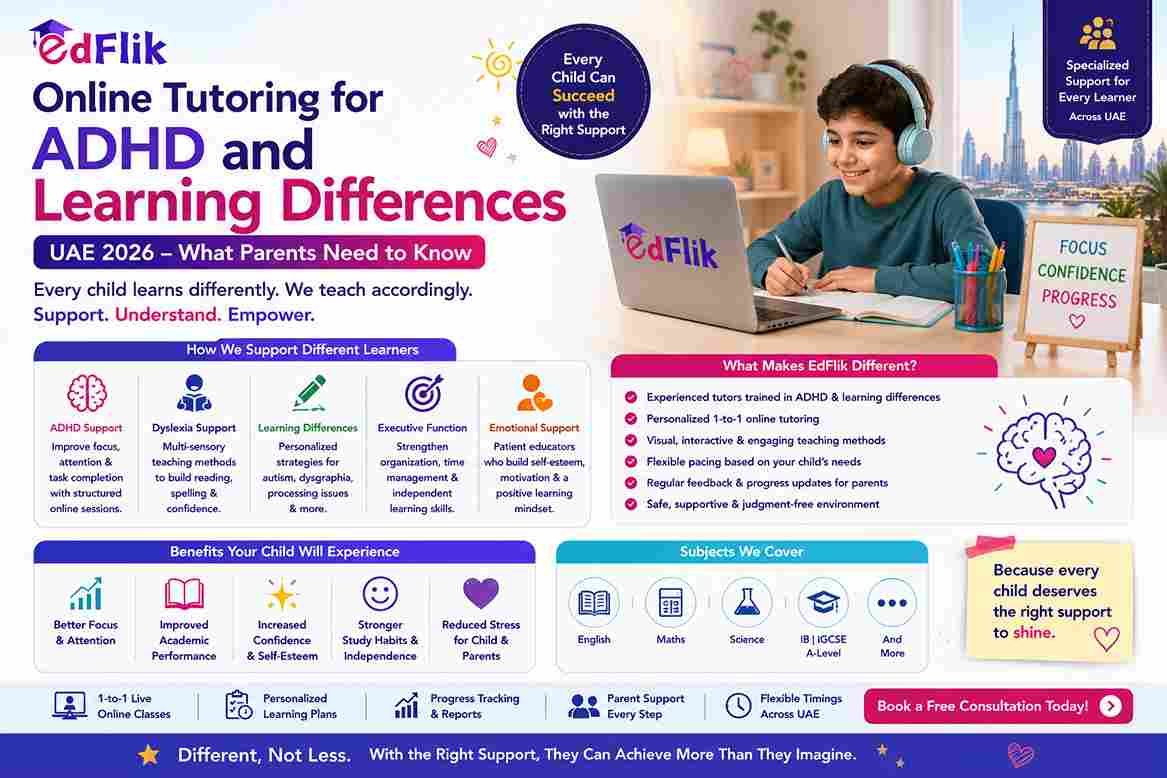
UAE private schools serve a significant number of students with ADHD, dyslexia, dyscalculia, dysgraphia, and autism spectrum conditions — and demand for tailored online tutoring support for these students is growing consistently. Standard 1:1 tutoring, delivered without adaptation, is significantly less effective for students with learning differences than tutoring that is explicitly adapted to the student's specific profile. This guide covers what UAE parents need to know about online tutoring for students with learning differences — what works, what must be communicated to the tutor, and how examination accommodations connect to tutoring preparation.
How Online Tutoring Works Differently for Students with Learning Differences
|
Learning
Difference |
Key Challenge
in Standard Tutoring |
Effective
Online Tutoring Adaptations |
|
ADHD |
Sustained
attention across a 60-minute session; executive function planning; homework
completion between sessions |
Short 10-15
minute segments with specific micro-tasks; frequent check-ins; visual timer
on screen; clear structured recap at end; immediate positive feedback during
session |
|
Dyslexia |
Reading text
on screen; processing written questions quickly; expressing understanding in
writing |
Oral
explanation of written questions; coloured screen backgrounds (cream/yellow
reduces visual stress); extended processing time within session; allow verbal
answers alongside written; focus on oral comprehension before written
response |
|
Dyscalculia |
Number
representation; place value; multi-step calculations; time on
number-intensive questions |
Use of visual
number representations; consistent use of the same calculation layout;
step-by-step breakdown of every calculation process; avoid timed calculation
drills that create anxiety |
|
Dysgraphia |
Handwriting-based
note-taking during session; written answers in session |
Dictation or
verbal responses instead of written in session; digital whiteboard for the
student (not paper); typed answers where possible; focus on content quality
rather than written presentation |
|
Autism
Spectrum Condition |
Changes in
session format; unpredicted questions; social communication elements of
tutoring relationship |
Consistent
session structure every week; preview the session plan at the start; avoid
rapid topic changes; provide questions in writing as well as orally; allow
processing time before expecting response |
Cambridge and IB Examination Access Arrangements — What UAE Families Should Know
Cambridge IGCSE, A-Level, and IB examinations provide access arrangements for students with formally identified learning differences. The most important points for UAE families:
• The school applies, not the family directly: Access arrangements are applied for by the school (specifically the SEN or learning support coordinator) to Cambridge or IB. Parents cannot apply independently.
• Evidence must be current: An Educational Psychologist's assessment report is typically required. Cambridge and IB usually require reports not more than 2-3 years old at the time of application.
• The deadline is early: Applications are typically submitted in October or November for May/June examinations. Families who receive a new diagnosis in February cannot usually access arrangements for that May sitting.
• Practise the condition: If a student has 25% extra time granted, tutoring sessions should practise under the conditions the student will use — specifically with 25% more time than standard timed practice. This prevents the student being unaccustomed to the longer time allocation.
• Reader and scribe arrangements need practice too: A student who has never dictated answers to a scribe will find the actual examination unfamiliar. Practising dictation in tutoring sessions prepares the student for this specific format.
ADHD and Online Tutoring — Session Structure That Works
ADHD-specific adaptations that EdFlik tutors implement when explicitly briefed by parents:
• Session segmentation: A 55-minute session divided into 3-4 segments of 10-15 minutes each, with a stated objective for each segment. "We are going to practise three quadratic factoring questions in the next 10 minutes" is more effective than "let's work on quadratic equations."
• Immediate and specific positive feedback: "That's right — and specifically because you checked the discriminant first" rather than "good." Specific reinforcement strengthens the target behaviour.
• No long reading tasks in session: Extended reading of textbook passages during tutoring is not an appropriate use of session time for ADHD students. The tutor summarises key concepts verbally; the student works through problems.
• Structured between-session practice with exact specifications: "Complete questions 1-5 on page 47" is significantly more likely to be completed than "practise quadratic equations before next week." Specificity reduces the executive function demand of deciding what to do.
|
EdFlik
provides 1:1 online tutoring for UAE students with ADHD, dyslexia,
dyscalculia, and other learning differences — with explicit briefing from
parents and school learning support teams to ensure tutoring adapts to each
student's profile. Sessions structured around each student's attention and
processing needs. From AED 55 per session. Free diagnostic. Book at
www.edflik.com or WhatsApp +91 88788 96600. |
Frequently Asked Questions
Q: Does online tutoring work for students with ADHD?
Yes, with adaptations — short segmented sessions, visual focus via digital whiteboard, scheduling at the student's best attention time, specific immediate positive feedback, and full briefing from parents about what strategies work.
Q: What learning differences do UAE students most commonly have?
ADHD, Dyslexia, Dyscalculia, Dysgraphia, and Autism Spectrum Condition are the most common. Many students have co-occurring conditions. UAE school Learning Support Units provide specialist support; tutoring supplements this.
Q: What exam accommodations are available for UAE students with learning differences?
Cambridge and IB access arrangements include 25% extra time, reader allowance, scribe allowance, prompt, separate room, and rest breaks. Applications submitted by school with EdPsych report evidence — deadline is typically October-November for May exams.
Q: How should a parent brief an online tutor about their child's learning differences?
Provide: specific condition(s) and diagnosis date; school learning support strategies that help most; attention triggers and span; granted exam accommodations; student's own self-reported learning preferences.
Q: Is extra time the most important exam accommodation for students with dyslexia?
Not always. Extra time helps most when processing speed is the primary difficulty. More impactful are tutoring interventions: consistent practice with exam format, automatic vocabulary recognition, and reliable reading comprehension strategies that compensate for slower decoding.