Preparing for IGCSE Options: How Year 9 Students in the UAE Should Choose Their Subjects
Last Updated: October 2026 | By EdFlik Education Team
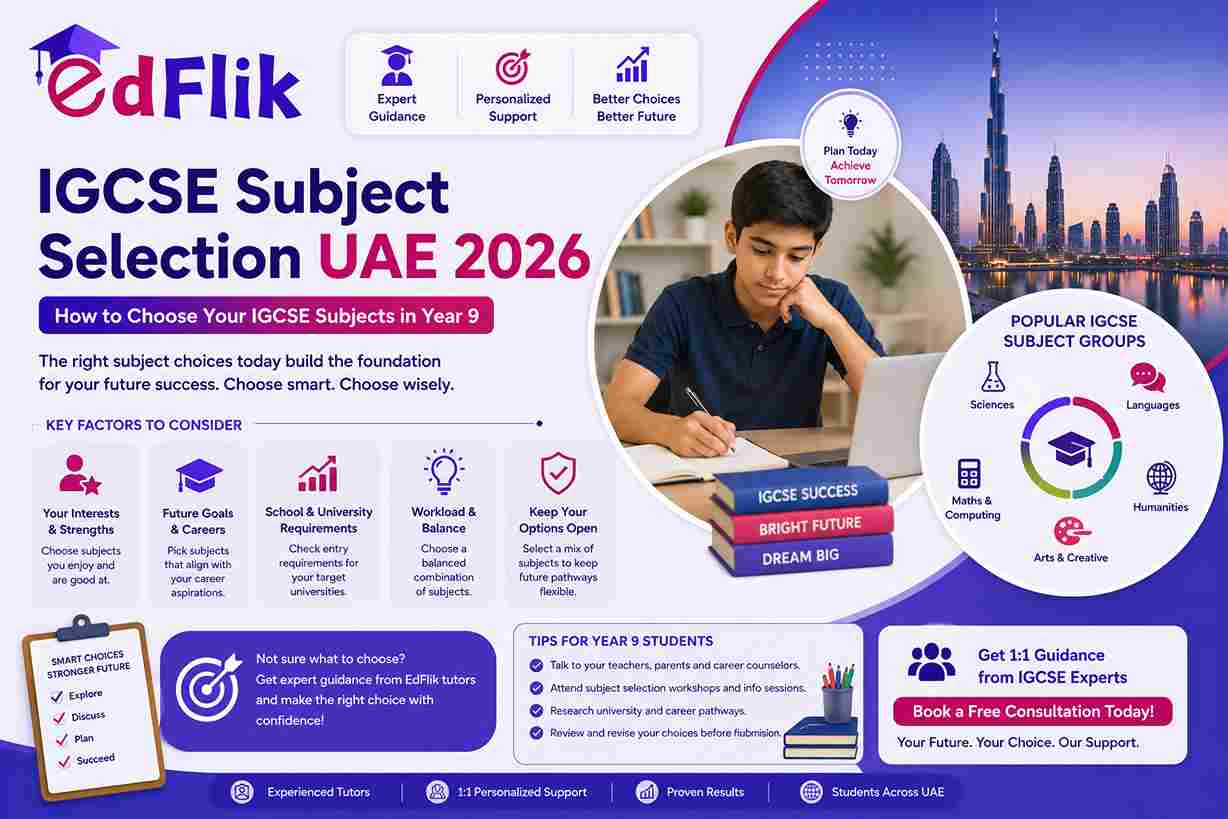
For Year 9 students across British curriculum international schools in the United Arab Emirates (UAE)—whether studying in Dubai, Abu Dhabi, Sharjah, or the Northern Emirates—the spring term marks a major academic milestone: IGCSE Subject Options Selection.
Transitioning from Key Stage 3 into Key Stage 4 (Years 10 and 11) is the first time students take active control over their academic trajectory. Choosing 8 to 10 International General Certificate of Secondary Education (IGCSE) subjects—spanning exam boards such as Cambridge Assessment International Education (CAIE), Pearson Edexcel, and Oxford AQA—is not merely an administrative exercise.
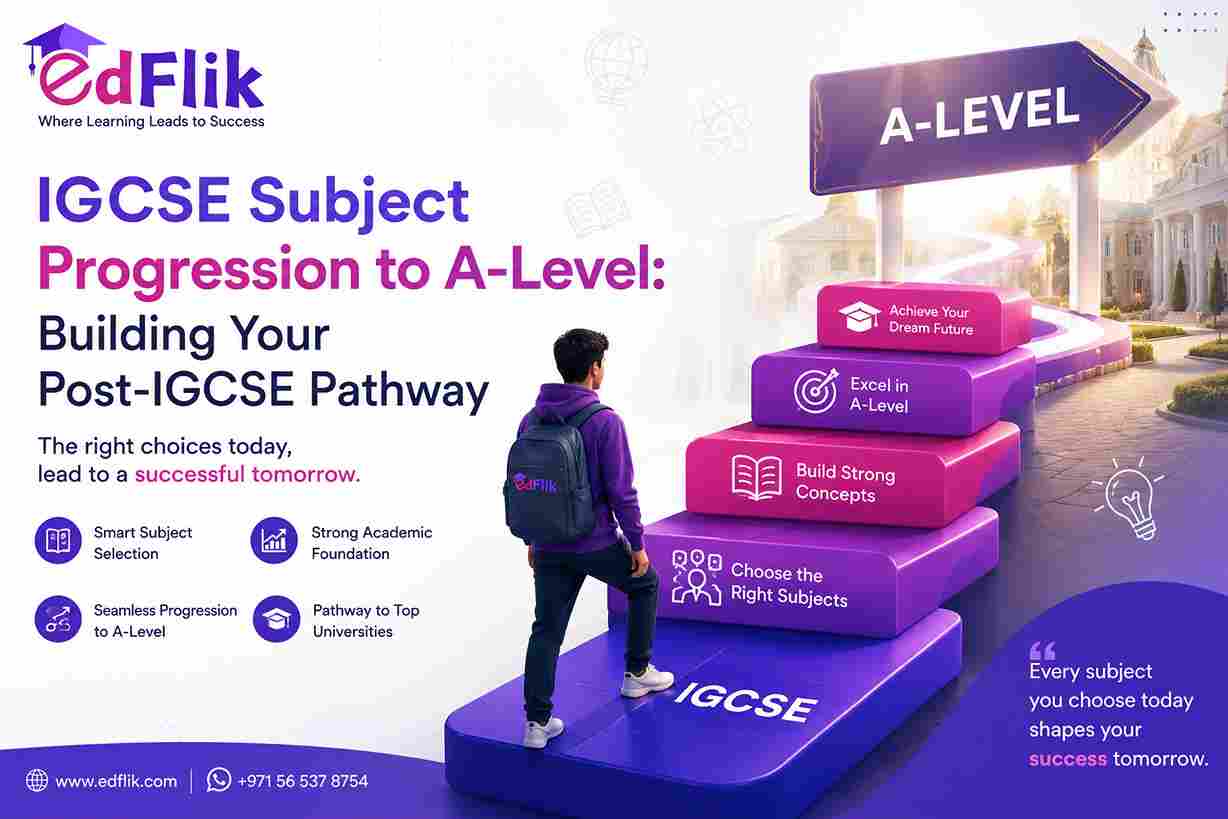
Your IGCSE subject choices directly shape your A-Level / IB Diploma subject options in Year 12, influence your competitiveness for top university admissions across the UK, UAE, US, and Canada, and align with university equivalency regulations set by the UAE Ministry of Education (MOE).
In this strategic masterclass guide, our expert academic advisors break down how IGCSE subject options work, analyze compulsory core subjects versus electives, expose common traps that limit future career choices, and provide a step-by-step decision framework to help UAE students and parents choose with confidence.
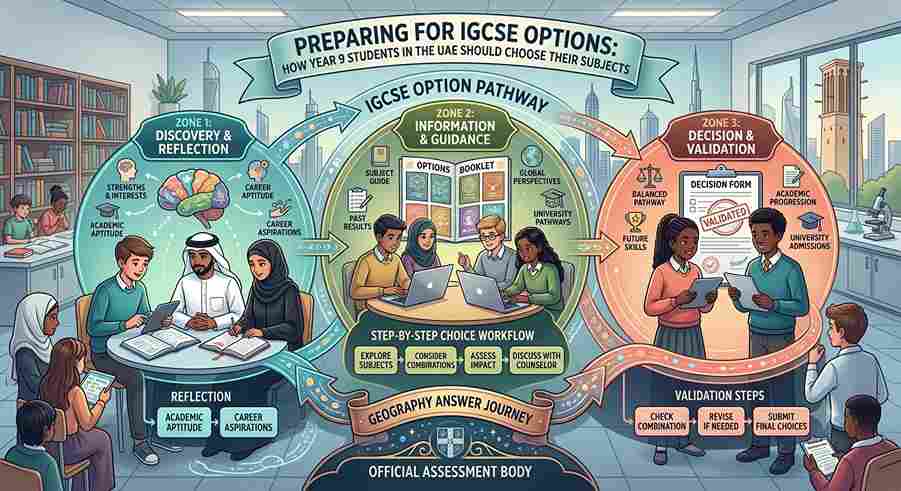
Part 1: How the IGCSE Options Process Works in UAE Schools
In British curriculum schools across the UAE, students sit their formal IGCSE examinations at the end of Year 11 (typically May/June or October/November exam series). The selection process begins in Year 9, where schools host Subject Options Evenings, publish options booklets, and collect final student selections.
                      THE IGCSE OPTIONS STRUCTURE
                                   |
      +----------------------------+----------------------------+
      |                                                         |
COMPULSORY CORE SUBJECTS                                OPTIONAL ELECTIVES
• English (Language & Literature)                      • Sciences (Triple vs. Double Award)
• Mathematics (Core / Extended)                        • Humanities (History, Geography, Econ)
• UAE Ministry Requirements                            • Creative & Technical (CS, IT, Art, Business)
  (Arabic A/B, Islamic Studies, Social Studies)
The Standard IGCSE Load in the UAE
Most British curriculum schools in Dubai and Abu Dhabi require or encourage students to sit between 8 and 10 IGCSE subjects. This balance ensures academic breadth while preventing workload overload.
Part 2: Compulsory Core Subjects vs. Electives
When filling out your options form, your subject choices are divided into two distinct buckets:
1. Compulsory Core Subjects
Every student must take core subjects, which form the academic baseline for all future qualifications:
- IGCSE Mathematics: (Cambridge 0580 / Edexcel 4MA1). Students are placed into either Core or Extended tiers. Extended Math is essential for students targeting STEM subjects at A-Level.
- IGCSE English: Usually split into IGCSE English Language (compulsory for all university entry) and IGCSE English Literature.
- UAE Ministry of Education (MOE) Mandatory Subjects:
- Arabic A (for Arab passport holders) or Arabic B (for non-Arab expats).
- Islamic Studies (for Muslim students).
- UAE Social Studies / Moral Education.(Note: Depending on whether a student requires official UAE Ministry High School Equivalency, Arabic and Islamic Studies play a crucial role alongside IGCSE passes).
2. The Science Stream: Triple Science vs. Double Award Science
One of the biggest choices Year 9 students face is deciding between Triple Science and Double Award Science:
| Feature | Triple Science (Coordinated/Separate) | Double Award (Combined Science) |
| Qualifications Awarded | 3 Distinct IGCSEs (Biology, Chemistry, Physics) | 2 Combined IGCSE Grades (e.g., 8-8 or 7-6) |
| Content Depth | Covers $100\%$ of the detailed syllabus for all 3 sciences | Covers roughly $\frac{2}{3}$ of the content of each science |
| Exam Volume | 6 Exam Papers (2 per science discipline) | 3 or 6 shorter combined exam papers |
| Best Suited For... | Students aiming for STEM careers, Medicine, Engineering, or A-Level Sciences | Students wanting a balanced science background while freeing up elective slots |
Advisor Recommendation: If a student is considering taking A-Level Physics, Chemistry, or Biology—or pursuing Medicine, Biomedical Science, or Engineering at university—Triple Science is strongly recommended.
Part 3: Selecting Your Elective Subjects (The Strategic Framework)
Beyond the core, students select 3 to 5 elective subjects spanning Humanities, Business, Languages, and Creative/Technical disciplines. To avoid closing doors to future careers, apply our 4-Step Selection Framework:
                  THE 4-STEP ELECTIVE SELECTION FRAMEWORK
                                     |
        +----------------------------+----------------------------+
        |                            |                            |
 1. APTITUDE & INTEREST      2. FUTURE CAREER PATHS      3. FACILITATING BALANCE     4. SUBJECT COMBINATIONS
 Select subjects you         Ensure prerequisites for    Maintain a mix of           Pair complementary subjects
 genuinely enjoy and excel   desired A-Levels/Degrees    analytical, numerical,      (e.g., Econ + Math,
 in during Year 9.           are satisfied early.        and essay subjects.         CS + Physics).
1. Aptitude and Interest
Choose subjects you enjoy and show strong academic aptitude for in Year 9. High grades ($8/9$ or $A^*$) in subjects you love look significantly better on university applications than mediocre grades ($5/6$) in subjects chosen purely because of peer pressure.
2. University and A-Level Prerequisites (Facilitating Subjects)
Certain A-Level and university degree pathways require specific IGCSE foundations:
- Medicine & Veterinary Science: Requires high grades in IGCSE Chemistry, Biology, Mathematics, and Physics.
- Engineering & Computer Science: Requires IGCSE Extended Mathematics and Physics; IGCSE Computer Science is highly advantageous.
- Business, Finance & Economics: IGCSE Economics and Business Studies provide excellent early exposure, but a strong performance in IGCSE Extended Mathematics is the true prerequisite for top university finance/econ programs!
- Law & Humanities: Requires strong performance in essay-based subjects like IGCSE English Literature, History, or Geography.
3. Subject Balance
Admissions officers at top universities (Russell Group in the UK, Ivy League in the US, and branch campuses in the UAE) favor a well-rounded academic profile. Aim for a balanced combination containing:
- At least one Humanity (History, Geography, Global Perspectives).
- At least one Business / Social Science (Economics, Business Studies, Psychology).
- At least one Creative / Technical (Computer Science, Design & Technology, Art & Design, Drama).
- A Modern Foreign Language (French, Spanish, German, Mandarin).
Part 4: Top 4 Traps Year 9 Students and Parents Must Avoid
- Selecting Subjects Based on Favorite Teachers or Friends: Choosing a subject because your best friend selected it or because you like your current Year 9 teacher. Teachers change yearly, and your friends will have different career paths!
- Assuming IGCSE Business Studies Is Required for a Business Degree: Believing that taking IGCSE Business Studies is mandatory to study business at university. Top business and finance degrees care far more about high grades in Mathematics and Economics!
- Dropping Extended Math Too Early: Switching from Extended Math to Core Math in Year 10 without trying. Core Math caps the maximum obtainable grade at a Grade 5 (Grade C), which automatically disqualifies a student from taking A-Level Mathematics or Physics.
- Ignoring UAE Ministry of Education (MOE) Equivalency Rules: For non-expats or students intending to study at UAE universities (or work in the UAE public sector later in life), failing to comply with MOE equivalency requirements regarding Arabic, Islamic Studies, and minimum IGCSE pass thresholds.
Preparing for IGCSEs in Dubai or across the UAE and aiming for top $8/9$ ($A^$) grades? EdFlik connects international school students with expert 1-to-1 online IGCSE tutors, helping you master subject choices, build strong exam techniques, and secure top university offers. *Book a Free Demo Class Today!
Frequently Asked Questions (FAQs)
Q1: What is the difference between Cambridge (CAIE) and Pearson Edexcel IGCSEs?
Ans: Both Cambridge and Edexcel IGCSEs are fully accredited, internationally recognized qualifications valued equally by universities worldwide. The main differences lie in exam paper structure, question formatting, and assessment windows (Cambridge holds exams in May/June and Oct/Nov, while Edexcel holds exams in May/June and Nov/Jan).
Q2: Can I change my IGCSE options after Year 10 starts?
Ans: Most UAE schools allow a narrow 2-to-3 week window at the start of Term 1 in Year 10 to request subject changes, provided space exists in the timetable class blocks. However, changing subjects later in the year is strongly discouraged because students miss crucial foundational coursework and syllabus content.
Q3: How many IGCSE subjects do top UK universities look for?
Ans: Top UK universities (such as Oxford, Cambridge, Imperial, LSE, and UCL) generally look for 8 to 10 strong IGCSE passes, with a high proportion of Grades 8 and 9 ($A^*$) in relevant core subjects, particularly English Language and Mathematics.
Q4: How does EdFlik support Year 9 and 10 IGCSE students in the UAE?
Ans: EdFlik connects international school students in Dubai, Abu Dhabi, and across the GCC with vetted, expert 1-to-1 online tutors specializing in Cambridge, Pearson Edexcel, and Oxford AQA IGCSE subjects. Our personalized coaching focuses on clarifying complex topics, building structured revision plans, mastering past-paper mark schemes, and boosting academic confidence.