Primary School Tutoring UAE 2026 — KS1 and KS2 Guide for Years 1 to 6 in Dubai and Abu Dhabi
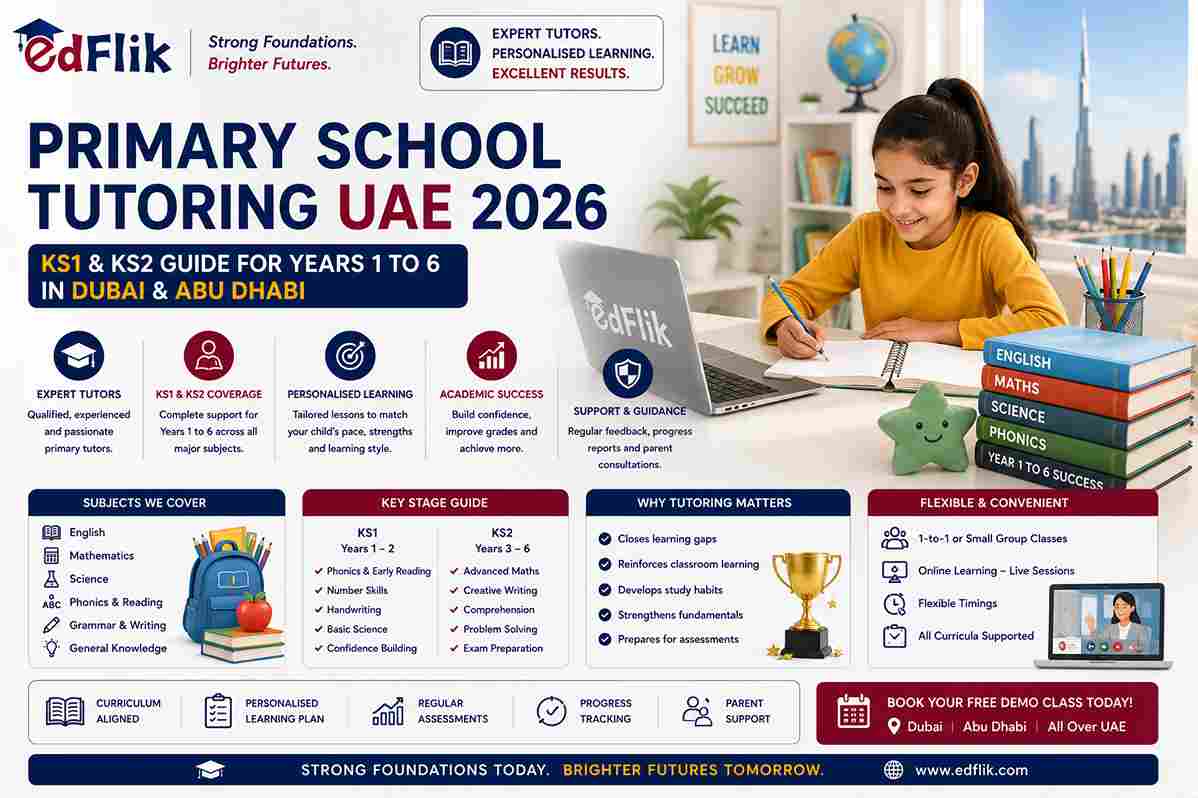
Primary school tutoring in UAE is most effective when it addresses foundational gaps early — before they compound into the harder-to-close gaps visible at KS3 and IGCSE. This guide covers what KS1 and KS2 children actually study in British curriculum UAE schools, the most common learning gaps that generate tutoring demand, and how to choose the right support for children in Years 1 to 6.
KS1 and KS2 — What British Curriculum UAE Schools Teach
|
Year |
Ages |
Maths Focus |
English Focus |
Other |
|
Year 1 (KS1) |
5-6 |
Number bonds
to 20; addition and subtraction; 2D and 3D shapes; simple measurement |
Phonics (all
single-letter sounds and common digraphs); reading simple decodable texts;
sentence writing with capital letters and full stops |
Exploration of
the world (basic science and geography) |
|
Year 2 (KS1) |
6-7 |
Addition and
subtraction to 100; beginning multiplication (2, 5, 10 times tables);
fractions (halves, quarters); money |
Phonics
completion; reading comprehension (inference at a simple level); narrative
writing with some description |
History and
geography topics; science (plants, animals, materials) |
|
Year 3 (KS2) |
7-8 |
Multiplication
and division; place value to 1,000; column addition and subtraction;
fractions of amounts |
Reading
comprehension with quotation evidence; introduction to structured paragraphs;
SPaG (spelling, punctuation and grammar) |
Science
(rocks, light, forces and magnets, plants); history; geography |
|
Year 4 (KS2) |
8-9 |
All times
tables to 12x12; decimals (1 and 2 decimal places); area and perimeter;
statistics (bar charts, pictograms) |
Persuasive
writing; newspaper reports; reading comprehension with language analysis at a
simple level |
Arabic;
coding/computing; wider reading across genres |
|
Year 5 (KS2) |
9-10 |
Fractions,
decimals, percentages (equivalence and conversions); prime and square
numbers; multi-step word problems; column multiplication |
Essay
structure (introduction, body, conclusion); creative writing with deliberate
effect; inference from non-fiction texts |
Space and
forces (science); coding projects; research skills |
|
Year 6 (KS2) |
10-11 |
Ratio and
proportion; algebra introduction; statistics (mean, pie charts); geometry
(angles, coordinates, circles) |
SATs/GL
assessment preparation; extended writing with varied sentence structure;
literary analysis at an introductory level |
CAT4
preparation (for UK boarding school or UAE Year 7 selective entry); secondary
school transition preparation |
The 4 Most Common Primary Learning Gaps in UAE
1. Times Tables — The Single Most Impactful Primary Gap
Not knowing times tables fluently — instantly, without counting — is the most common reason UAE KS2 children struggle with maths. Every subsequent maths topic from Year 4 onward (fractions, ratios, percentages, algebra) is significantly harder when multiplication facts must be recalculated rather than instantly recalled. The most effective intervention: 5-10 minutes of daily mixed times table practice for 8-12 weeks, not weekly 30-minute sessions.
2. Phonics — Early Reading Foundation
Children who have not mastered the complete phonics code by the end of Year 2 find reading laborious and tend to develop avoidance behaviours rather than reading habits. 1:1 phonics tutoring using systematic phonics sequences (not generic reading comprehension) is the most targeted intervention. The primary goal is decoding fluency — not comprehension — at this stage.
3. Place Value — The Hidden Maths Gap
Many UAE primary children can count and add within 100 but do not truly understand place value at higher numbers. This shows up as: difficulty with column addition/subtraction involving carrying/borrowing, confusion with decimals, and inability to estimate with confidence. Place value understanding is the foundation of all number work — it requires explicit teaching, not just practice of procedures.
4. Reading Comprehension at Inference Level
From Year 3 onward, UAE British curriculum schools expect children to answer reading comprehension questions that require inference — finding meaning that is implied but not directly stated in the text. UAE children who are fluent readers often struggle with inference because it requires reasoning about subtext rather than locating information directly on the page. This gap shows up in English assessments from Year 3 and compounds through KS3 IGCSE reading.
CAT4 Preparation at Year 5-6 — The UAE-Specific Primary Priority
UAE students sitting the CAT4 (Cognitive Abilities Test) for Year 7 entry to selective British curriculum schools (Dubai College, Repton, Kings, Brighton College, Nord Anglia) typically sit the assessment in Year 5 or Year 6. The CAT4 tests four cognitive batteries: Verbal Reasoning, Quantitative Reasoning, Non-Verbal Reasoning, and Spatial Reasoning. Targeted CAT4 preparation — particularly for Non-Verbal and Spatial Reasoning which are not standard school curriculum content — can meaningfully improve performance.
|
EdFlik
provides primary school tutoring for UAE children in Years 1-6 across Maths,
English, Arabic, phonics, and CAT4 preparation. Sessions are adapted to the
child's specific year group and gap. From AED 45 per session. Free
diagnostic. Book at www.edflik.com or WhatsApp +91 88788 96600. |
Frequently Asked Questions
Q: At what age should a child start tutoring in UAE?
When a specific, consistent gap appears — most commonly visible by Years 3 or 4 for Maths, or by Year 2 for phonics. Starting before Year 6 is almost always more efficient than waiting until KS3.
Q: What is the difference between KS1 and KS2 in UAE schools?
KS1 (Years 1-2, ages 5-7): foundational phonics, number sense, early writing. KS2 (Years 3-6, ages 7-11): complex comprehension, structured writing, multiplication mastery, fractions, decimals, percentages, grammar.
Q: What are the most tutored primary school subjects in UAE?
Maths is the most requested by a significant margin, followed by English reading and writing, then Arabic (compulsory at all UAE schools).
Q: Do UAE primary schools teach phonics?
Yes — British curriculum UAE schools follow systematic synthetic phonics programmes. Children are expected to master all phonemes by end of Year 1 and most digraphs by end of Year 2.
Q: How can I support my child's learning between tutoring sessions?
Daily reading together (10-15 minutes), daily maths fact practice (5-10 minutes of times tables and number bonds), and regular structured writing practice with specific feedback on capital letters, full stops, and vocabulary variety.