Private Tutor Permit in the UAE: Requirements, Eligibility, and Rules for 2026–2027
Last Updated: October 2026 | By EdFlik Academic Advisory Team
For educators, university scholars, and subject matter experts across the United Arab Emirates (Dubai, Abu Dhabi, Sharjah, and the Northern Emirates), private tutoring has transformed from an informal, unmonitored activity into a fully legal, regulated profession.
Jointly overseen by the Ministry of Human Resources and Emiratisation (MOHRE) and the Ministry of Education (MoE)—with local integration from authorities like the Knowledge and Human Development Authority (KHDA) in Dubai and the Abu Dhabi Department of Education and Knowledge (ADEK)—the Private Teacher Work Permit establishes a legal framework for educators while safeguarding academic standards and student welfare.
Whether you are a full-time school teacher seeking supplemental income, a university student offering coding lessons, an employed corporate professional tutoring STEM subjects, or a parent hiring a tutor, this comprehensive guide outlines the legal requirements, eligibility categories, step-by-step application procedures, code of conduct rules, and official JSON-LD schema markup.
Part 1: What is the UAE Private Teacher Work Permit?
The Private Teacher Work Permit is an official digital authorization issued by MOHRE and the Ministry of Education. It permits eligible individuals to offer paid private tuition—either face-to-face (at a student’s home or designated center) or online—to students across the UAE.
                 KEY HIGHLIGHTS OF THE UAE TUTOR PERMIT
                                   |
  • **Cost:** 100% Free of Charge (issued digitally by MOHRE).
  • **Validity:** 2 Years (renewable upon expiration).
  • **Processing Time:** 1 to 5 Working Days via UAE PASS.
  • **Student Capacity:** No limit on the number of students or group sizes.
  • **Delivery Mode:** Legal for both In-Person and Online Tutoring.
Important Legal Note: Providing private lessons for financial compensation without this official permit is a violation of UAE labor and residency laws. Unlicensed tutoring can result in fines up to AED 50,000 for unauthorized workers and penalize households hiring illegal labor.
Part 2: Who is Eligible to Apply? (6 Key Categories)
The 2026–2027 policy framework expands eligibility across six distinct individual applicant tiers:
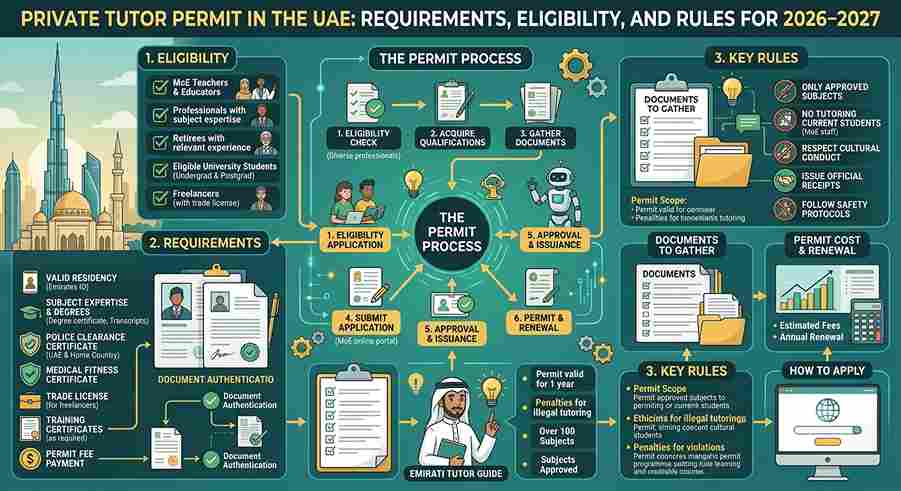
                     ELIGIBLE TUTOR PERMIT APPLICANT TIERS
                                       |
        +------------------------------+------------------------------+
        |                                                             |
1. REGISTERED SCHOOL TEACHERS                                  2. CORPORATE & GOVT EMPLOYEES
• Teachers in public or private schools.                       • Employed professionals in any sector.
• **Requirement:** Must submit an NOC from school.              • **Requirement:** Must submit an NOC from employer.
        |                                                             |
        +------------------------------+------------------------------+
                                       |
        +------------------------------+------------------------------+
        |                                                             |
3. UNEMPLOYED / HOMEMAKERS                                     4. UNIVERSITY STUDENTS
• Qualified individuals with a valid residency visa.           • Currently enrolled higher-education students.
• **Requirement:** Verified degree / diploma.                  • **Requirement:** Proof of enrollment letter.
        |                                                             |
        +------------------------------+------------------------------+
        |                                                             |
5. SCHOOL STUDENTS (AGED 15–18)                                6. GOLDEN VISA / FREELANCERS
• High schoolers teaching younger peers.                       • Independent residents on self-sponsored visas.
• **Requirement:** Parental consent + school report.           • **Requirement:** Valid residency + degree.
Part 3: Required Documents Checklist by Category
All applicants must hold a valid UAE Residence Visa and Emirates ID. Scans must be uploaded digitally via MOHRE channels with a white background.
Core Documents Required for Everyone:
- Passport Copy (valid for at least 6 months).
- Emirates ID Copy (front and back).
- Valid UAE Residence Visa Copy.
- Highest Educational Certificate / Attested Qualification (matching target subjects).
- Good Conduct Certificate (Police Clearance Certificate issued in the UAE).
- Signed Private Tutoring Code of Conduct Declaration.
Category-Specific Additional Requirements:
| Applicant Category | Additional Mandatory Document |
| School Teachers | Official No-Objection Certificate (NOC) signed by the school principal / management. |
| Government / Private Sector Employees | No-Objection Certificate (NOC) from current employer’s HR department. |
| University Students | Official Statement of Enrollment / Active Student Attestation from a licensed university. |
| School Students (15–18 Years) | Written Parent/Guardian Consent Form + Latest Academic Report Card. |
| Unemployed / Homemakers | No NOC required; qualification + valid residency visa govern approval. |
Part 4: Step-by-Step Application Process
The entire application is digital and completed through the Ministry of Human Resources and Emiratisation (MOHRE) portal or smart application:
                  THE 5-STEP ONLINE PERMIT APPLICATION
                                   |
  Step 1: Authenticate Profile   ---> Log into `mohre.gov.ae` or the MOHRE App using UAE PASS.
  Step 2: Select Service         ---> Choose "Issue Private Teacher Work Permit" under Services.
  Step 3: Complete Details       ---> Select target subjects, grade levels, and educational background.
  Step 4: Upload Clear Scans     ---> Attach core documents, category NOCs, and Police Clearance.
  Step 5: Sign Code of Conduct   ---> Electronically sign the 7-point MoE Code of Conduct and submit.
Once submitted, application review typically takes 1 to 5 working days. Upon approval, a digital permit with a QR code is generated and saved directly to your phone or MOHRE dashboard.
Part 5: The 7 Core Rules of the Private Tutoring Code of Conduct
To maintain educational integrity and protect students, all permitted tutors must comply with the official Ministry of Education Code of Conduct:
- Conflict of Interest Restriction: School teachers are strictly prohibited from offering paid private tutoring to students enrolled in their own school or classes.
- Curriculum Alignment: Teaching content must align with recognized UAE national or international curriculum standards (e.g., IB, IGCSE, American, MoE).
- Data Confidentiality: Tutors must protect student and family privacy, keeping personal and academic records confidential.
- Child Safety and Welfare: Absolute prohibition of verbal abuse, physical discipline, or improper communication across all channels (in-person, social media, messaging apps).
- Cultural Respect and Values: Tutors must refrain from promoting content or opinions that contradict UAE national identity, Islamic principles, or societal cultural values.
- Transparent Financial Agreements: Tuition fees must remain fair, reasonable, and clearly agreed upon in writing with parents/guardians prior to lessons.
- Prohibition of Fraud: Tutors must never complete assignments, coursework, or exams on behalf of students. Guidance must remain purely instructional.
Part 6: Individual Permit vs. Commercial Business License
It is essential to distinguish between teaching as an individual and operating a commercial business:
                INDIVIDUAL PERMIT VS. COMMERCIAL ENTERPRISE
                                     |
      +------------------------------+------------------------------+
      |                                                             |
PRIVATE TEACHER WORK PERMIT (MOHRE)                           COMMERCIAL TUTORING TRADE LICENSE
• Issued free to an individual person.                       • Required if opening a physical center or agency.
• Allows 1-on-1 and small group tuition.                    • Issued by DED/Free Zones + KHDA/ADEK approval.
• Invoicing under personal bank name.                         • Allows hiring employees and corporate branding.
Frequently Asked Questions (FAQs)
Q1: Is there any government fee to issue the Private Tutor Permit?
Ans: No. The permit itself is issued 100% free of charge by MOHRE. Your only indirect expenses are standard third-party fees for obtaining a UAE Police Clearance Certificate or local document attestations if required.
Q2: Can expats on a spouse or family sponsorship visa apply for this permit?
Ans: Yes! Dependent visa holders (sponsored by a spouse or parent) can apply as long as they hold valid residency and provide their educational qualifications.
Q3: What happens if an applicant's permit is rejected?
Ans: Rejections usually stem from document mismatches—such as uploading a degree in History while applying to teach High School Physics, or submitting a blurry Police Clearance scan. If rejected, applicants may fix the discrepancy and re-apply after a 6-month period.