SAT Reading and Writing Tutor Online: What to Look For
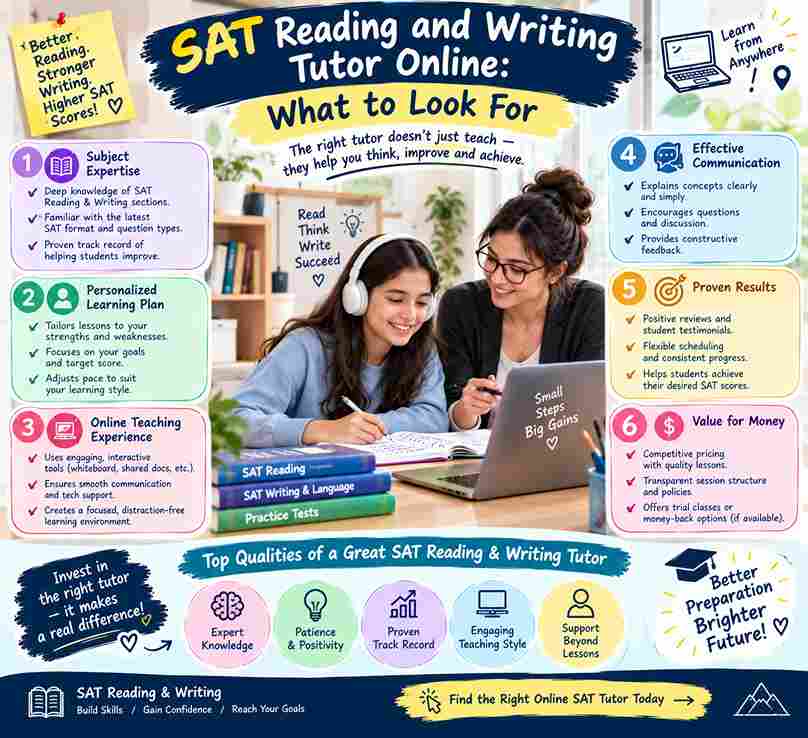
The SAT Reading and Writing section asks students to read short passages carefully, understand how they are built and make precise decisions about language. For some students, this feels like a natural extension of good reading habits. For others, the short passages and tight time limits feel unfamiliar, and even strong readers can lose confidence. A well-matched tutor can help your child build both skill and calm.
This guide is for UAE parents who are searching for SAT reading and writing support online. It explains what the section tests, how a good tutor works and what to ask before you book. Please check the current College Board specification for the latest details on format and question types, as these can change.
What the Reading and Writing Section Measures
The digital SAT Reading and Writing section is built around a few broad areas: craft and structure, information and ideas, and standard English conventions. In practice, this means students are asked to identify the central idea of a passage, find the evidence that supports a claim, understand how words are used in context, and recognise how sentences and paragraphs fit together.
Students also need to know the conventions of standard written English, including punctuation, sentence boundaries and agreement. These questions are often quick once a pattern is clear, but they can be confusing when a student has only memorised rules without seeing them in use. Good preparation links every rule to examples that show why it matters.
Reading Practice That Builds Accuracy
Strong SAT reading is less about speed and more about accuracy. Students who answer carefully often outperform those who skim. A tutor can teach a simple routine: read the question first to understand the task, read the passage with that task in mind, locate evidence in the text, and check that the chosen answer is directly supported rather than merely plausible.
Common mistakes include choosing an answer that is true in general but does not address the question, or picking a word that sounds right without checking the context. A tutor can help students notice these traps by discussing why the wrong options are tempting. Over time, this builds a habit of checking evidence and resisting quick guesses.
Parents can support reading at home by discussing news articles, essays or short stories together. Asking, "What is the writer's main point, and how do you know?" is excellent practice for the skills the section tests.
Grammar and Revision Support
Grammar is one of the most practical parts of the SAT Reading and Writing section. Questions often focus on punctuation, sentence structure, subject-verb agreement and the choice of transitions. Many students find these questions easier than they expected once they understand the logic behind each rule.
A good tutor teaches grammar through patterns rather than long lists. For example, they might show how a semicolon joins two complete sentences, or how a transition word signals contrast or cause. Revision support then comes from short, focused sets of questions that return to the same patterns until they feel automatic. This kind of repetition is much more effective than a single long session at the end of the week.
Reviewing Practice Tests Together
Practice tests are one of the best ways to see progress, but the score alone is not enough. The most valuable part of a practice test is the review. Students should look at each missed question and ask why they chose the wrong answer, whether they misread the passage, misunderstood the question or ran short on time.
Ask any tutor how they review practice tests with students. A good answer will describe a clear method for sorting mistakes, a focus on the most common errors and a plan for the next session. At EdFlik, lessons are one-to-one, so the review can be shaped around your child's results and their specific areas to strengthen.
A Practical Checklist for Parents
When you compare SAT reading and writing options, use this checklist:
- Ask which question types the tutor practises and how they match practice to the current College Board specification.
- Ask how grammar is taught, and whether it is linked to real examples from passages.
- Ask how practice tests are reviewed, and what your child will do with the feedback.
- Request a free trial class so your child can see how the tutor explains a passage.
- Confirm that lessons are one-to-one, so the pace and content can match your child's level.
- Set a steady weekly routine, with short sessions that are easy to keep up with.
- Keep a note of practice test results and common mistakes to track progress.
How EdFlik Can Help
EdFlik offers live, one-to-one online tutoring for students aged 3 to 18, including support for SAT reading and writing preparation. Lessons are about one hour long and are shaped around your child's reading level, grammar needs and practice test results. Working one-to-one means the pace, feedback and focus can be adjusted to your child as they progress.
Classes start from AED 45 per class. Parents receive monthly progress reports, so you can see how your child's reading, grammar and revision are developing. Free trial classes let your child meet a tutor and try the teaching style before you decide.
If you would like to explore SAT reading and writing support, book a free trial at www.edflik.com or email support@edflik.com. Tell us your child's target timeline, the sections they find hardest and the times that suit your family.
Conclusion
The SAT Reading and Writing section rewards careful reading, clear reasoning and a solid understanding of language conventions. With the right tutor, your child can learn to find evidence, spot common traps and apply grammar rules with confidence. Look for a plan that starts with your child's level, practises the question types that matter, reviews every practice test thoughtfully and keeps you informed. Start with a free trial, see how your child responds and build a routine that feels achievable week by week.
Frequently Asked Questions
Which question types are practised?
Preparation can cover the main areas of the Reading and Writing section, including central ideas, evidence, words in context, text structure and standard English conventions. Lessons are matched to your child's needs. Please check the current College Board specification for the latest question types and format.
How is grammar taught?
Grammar is taught through patterns and real examples rather than long lists of rules. Your child might learn how a semicolon joins two sentences or how a transition word signals contrast. Short, focused practice then helps these patterns become automatic under timed conditions.
Are practice tests reviewed with the student?
Reviewing practice tests is an essential part of effective preparation. Missed questions should be discussed carefully, so your child understands why an answer was wrong. Because EdFlik lessons are one-to-one, the review can focus on your child's own results and the areas that need the most attention.
How long does preparation take?
Preparation length depends on your child's starting level, goals and how much practice fits into the week. Rather than fixing a timeline, a tutor can agree a realistic plan with clear milestones and regular checkpoints. This keeps preparation focused and manageable for the whole family.
Can the tutor match my child's level?
Yes, one-to-one lessons allow the tutor to adjust content and pace to your child's level. The free trial class is a useful chance to show the tutor where your child is comfortable and where they need more support. From there, lessons can be planned around those needs.
More on American Curriculum, SAT & AP