Screen Time & Digital Study Habits for UAE Teens (13–18) — Building Focus in an Always-Online World
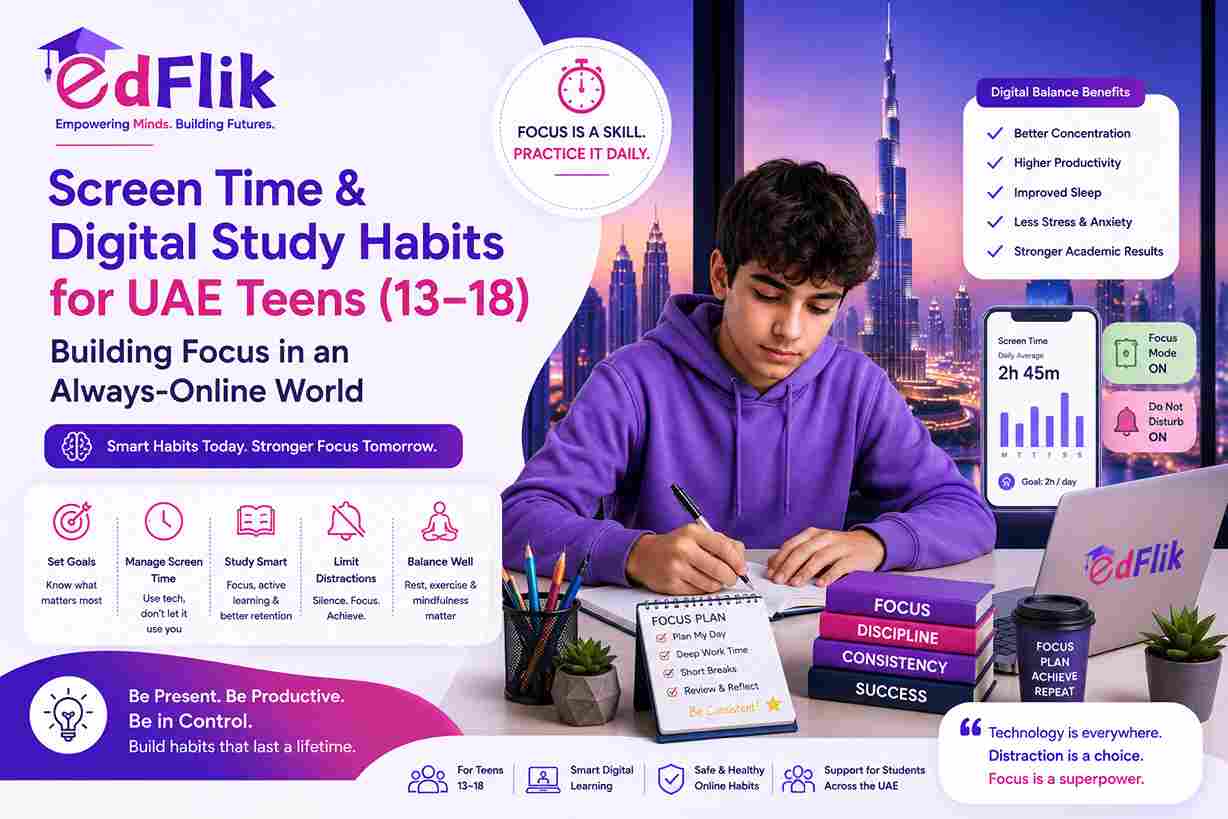
Most screen-time advice aimed at UAE parents is written for young children — session length for a five-year-old, age-appropriate content for early readers. Almost none of it addresses the much harder problem UAE parents of teenagers actually face: a 15-year-old whose schoolwork, revision, past papers, university research, *and* social life all happen on the same laptop or phone, often within the same hour.
For IGCSE, IB, and A-Level students in Dubai, Abu Dhabi, and Sharjah, the device is not the distraction from studying — it is the study tool itself. That distinction changes what "healthy screen time" actually means at this age, and most generic advice does not account for it.
## Why the Younger-Child Screen Time Model Doesn't Apply to Teens
Advice built around limiting total screen hours works reasonably well for a primary-age child, where recreational screen use and academic screen use are largely separate activities. By the time a student reaches Grade 9 and beyond, that separation has mostly disappeared:
- Past paper practice happens on Cambridge or IB digital platforms
- Revision notes are built in Notion, Google Docs, or Quizlet
- Homework is submitted through school portals
- University research happens on the same browser as everything else
A blanket "two hours a day" rule is not just impractical for this age group — it actively conflicts with how modern examination boards expect students to work. The more useful question for UAE parents of teens is not *how much* screen time, but *what kind*, and how well-separated the academic and recreational modes actually are on the same device.
## The Real Problem: Switching Cost, Not Total Hours
Cognitive research on task-switching consistently shows that the cost of moving between an academic task and a social or entertainment app is not the few seconds it takes to switch — it is the extended recovery time needed to return to the same depth of focus afterward. For a UAE student doing IB Physics past papers with a phone notification arriving every few minutes, the total time lost to switching costs across a two-hour revision session can be substantial, even if the phone itself is only glanced at for seconds each time.
This is the specific problem worth addressing with teens directly, rather than the total-hours framing: **it is not that they are on screens too much — it is that academic and recreational screen use are not physically or structurally separated.**
## Practical Separation Strategies That Work for UAE Teens
- **Different devices for different modes, where possible.** A student who does past paper practice on a laptop with the phone in another room performs a fundamentally different kind of session than one working with the phone face-up beside the keyboard.
- **App-level blocking during defined study blocks**, using built-in screen time tools (both iOS and Android have native versions) rather than relying on willpower alone — removing the decision point removes most of the problem.
- **A visible, physical "study mode" signal** — even something as simple as a specific desk lamp on, or noise-cancelling headphones in, can create a psychological switch that supports focus without needing to change the device itself.
- **Batching, not banning, social use** — rather than eliminating social media during revision periods (which tends to produce resentment and covert use), agree on specific windows where it is fully allowed, so restriction during study blocks feels bounded rather than absolute.
- **Involving the student in designing the system**, not just enforcing rules on them — UAE teens preparing for IGCSE, IB, or A-Level exams respond far better to a system they helped design than to a parent-imposed restriction, particularly by Grade 10 and above.
## Sleep, Exam Season, and the UAE-Specific Pattern
UAE exam seasons — particularly the IGCSE May/June series and IB May exams — coincide with periods when students are already managing significant stress, and screen use late at night is one of the most common ways that stress manifests, whether through late-night revision on a screen or late-night scrolling as a stress release. Blue light exposure close to bedtime measurably affects sleep onset, which in turn affects next-day concentration during exactly the period when concentration matters most. A practical, non-punitive fix that works well with older teens: a shared family agreement that all screens (including revision ones) stop by a fixed time, with any remaining revision done on paper — which has the added benefit of matching the handwritten format of the actual exam.
## Where Live Online Tutoring Fits Into This Picture
A reasonable objection UAE parents raise is that online tutoring adds to a teen's total screen time. In practice, live 1:1 tutoring is a different category of screen use to passive content consumption — it involves sustained, interactive, adult-guided attention, which is closer in cognitive demand to an in-person lesson than to scrolling. The more useful comparison is not "screen time versus no screen time" but the *quality* of attention within that time. A focused 45-minute live tutoring session with a tutor who is actively questioning and correcting a student produces meaningfully different outcomes to the same 45 minutes spent passively rewatching a recorded video lecture, even though both are technically "screen time."
## Frequently Asked Questions
**Q: Should UAE parents still limit total screen time for teenagers preparing for IGCSE or IB exams?**
A: Total hours matter less at this age than the separation between academic and recreational screen use — a student doing focused, uninterrupted academic work for two hours is in a very different position to one doing the same two hours with constant app-switching, even if the total time is identical.
**Q: Does live online tutoring count as harmful screen time?**
A: Live, interactive 1:1 tutoring involves sustained active attention closer to an in-person lesson than to passive content consumption, and is generally considered a different category from recreational or passive screen use.
**Q: What is the single most effective screen habit change for exam season?**
A: Physically separating the device used for social and entertainment apps from the device or space used for revision, even temporarily, tends to produce the largest improvement in focus quality during UAE exam seasons.
**Q: How does EdFlik structure its online sessions to support focus rather than screen fatigue?**
A: EdFlik's live 1:1 sessions use active questioning, a shared digital whiteboard, and real-time correction rather than passive video content, and session lengths are matched to age and attention span, with monthly progress reports shared with parents.
*EdFlik provides live, 1:1 online tutoring for students aged 3–18 across all seven emirates, covering IB, IGCSE, A-Level, American, ICSE, SAT, AP, and MOE curricula. Sessions start from AED 45. Free trial class available at [www.edflik.com](https://www.edflik.com).*