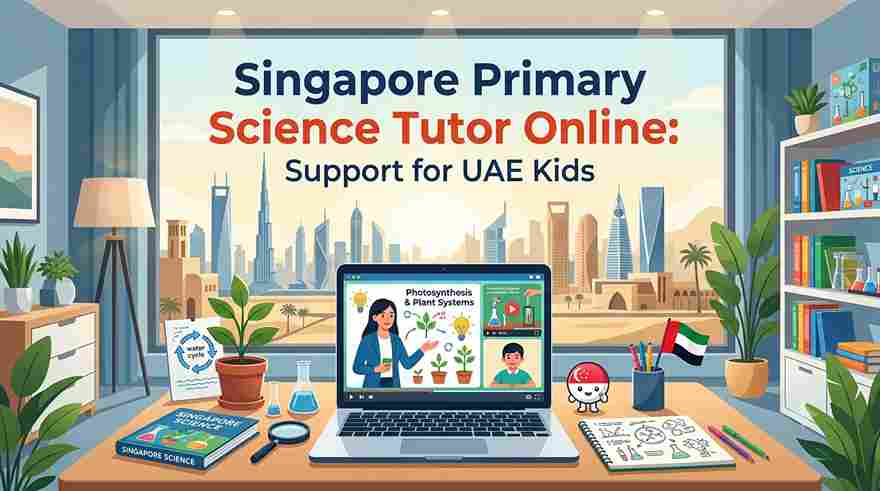
Singapore Primary Science Tutor Online: Support for UAE Kids
Science is one of the most exciting subjects in primary school. Children start to ask big questions about plants, materials, forces and the world around them. Yet many young learners also find it hard to explain what they have observed, or to answer a question in the right format. If your child follows the Singapore primary curriculum and you are looking for gentle, encouraging support from home, this guide is for you. At EdFlik, we love seeing children discover that science can be fun.
What Primary Science Covers
Singapore primary science builds understanding across a few broad areas, including living things, materials, energy and the environment. Children learn to observe carefully, ask questions, carry out simple investigations and record what they find. They also learn to use scientific vocabulary, such as "dissolve", "evaporate" or "habitat", in their answers.
Because the course develops skills step by step, a strong foundation in the early years makes later learning much easier. Please check the current official syllabus with your child's school, as topics and emphasis can change from year to year.
Why Children Find Some Topics Tricky
Most children are curious about science, but they can get stuck in a few common places:
- Remembering key terms and using them correctly in a sentence.
- Explaining why something happened, not only what happened.
- Reading a diagram or table and pulling out the important information.
- Planning a fair test, where only one thing changes at a time.
These are learnable skills. They grow with patient explanation, hands-on thinking and plenty of encouragement.
How a One-to-One Lesson Can Help
In a classroom with many children, a shy learner may stay quiet even when they have a good idea. In a one-to-one lesson, your child has time to think aloud, try an answer and hear feedback straight away. The tutor can use simple examples from everyday life, such as kitchen experiments or a walk in the garden, to make ideas concrete.
Young learners also respond well to a steady routine. A tutor can start each lesson with a short recap, move to a new idea, and finish with a question your child can answer confidently. This rhythm builds a sense of achievement.
Simple Science Habits at Home
You do not need a laboratory to help your child think like a scientist. Try a few of these ideas together:
1. Ask questions. "What do you think will happen if we add more water?"
2. Predict and check. Let your child guess an outcome, then see what happens.
3. Describe what you see. Encourage full sentences, such as "The ice melted faster in the sun because it was warmer."
4. Keep a notebook. A simple page with a date, a question and a drawing helps children review their learning.
5. Read together. Non-fiction books about animals, weather and space build vocabulary naturally.
Keep these activities short and playful. A ten-minute session once or twice a week is often enough to keep curiosity alive.
Building Scientific Vocabulary Without Pressure
New words are at the heart of primary science, and children often learn them best when they meet them in context. Rather than asking a child to memorise a list, try linking each word to something they can see or touch. "Evaporate" becomes the puddle that disappears after a sunny morning. "Habitat" becomes the place where a snail lives in the garden. Once a word has a picture attached, it is far easier to remember.
A tutor can reinforce this by asking your child to use new words in a full sentence, then explain what they mean in their own language. Gentle repetition over several lessons helps the word move from "I have heard that" to "I can use it confidently". Celebrate every time your child uses a new word correctly, even if they are still learning how it fits into a sentence.
Observing and Explaining Like a Scientist
Observation is the first step in every investigation. Children can practise it at home by looking closely at something ordinary, such as a leaf, a cup of water or a piece of fruit, and describing what they notice. Ask them to use all their senses where it is safe, and to say what changed over time.
Explaining is the next step. A simple structure helps: "I observed ___. I think this happened because ___." Children who practise this pattern often find it easier to answer exam-style questions, and they also gain the confidence to share ideas in class. Your tutor can help your child build this habit one lesson at a time.
Keeping Science Fun Through the School Year
Children stay motivated when science feels like part of everyday life rather than a separate subject. Weekends are a natural time for small experiments, such as watching which materials let light through, or noticing how the weather changes across a week. Keep a shared list of questions on the fridge or in a notebook, and invite your child to add to it. When a question is answered, they can draw a picture of what they found.
Balance is important too. Some weeks may be busy with tests or activities, and that is perfectly normal. A short, relaxed activity is better than a long session that leaves everyone tired. The goal is steady curiosity, not perfect scores every time.
Checklist: Questions to Ask a Tutor
- How do you introduce new scientific vocabulary, and how do you check it has stuck?
- Do you use hands-on examples or diagrams in lessons?
- How do you help children explain their answers in full sentences?
- How will you keep me updated on progress?
- Which board or resources do you use, and how do they fit with school work?
How EdFlik Can Help
At EdFlik, we offer live, one-to-one online tutoring for children and teens aged 3 to 18. Classes are about one hour, and pricing starts from AED 45 per class. For younger learners, we aim for lessons that feel warm and friendly, with plenty of time for questions and discovery.
Every new family can book a free trial class. It is a simple way to meet a tutor, talk about your child's interests and see how a science lesson feels. There is no pressure to continue. If the trial suits your child, you can then choose a plan that fits your family's routine.
Ready to explore science together? Book a free trial class at www.edflik.com or email support@edflik.com, and we will help you find a time that works.
Conclusion
Primary science is a wonderful chance for children to be curious, ask questions and discover how things work. With gentle support, a few simple habits at home and a tutor who makes learning feel friendly, your child can grow in confidence. Start small, celebrate every good question, and enjoy the journey together.
Frequently Asked Questions
What does primary science cover in Singapore?
Singapore primary science covers areas such as living things, materials, energy and the environment. Children learn to observe, investigate and explain what they find. Check the current official syllabus with your child's school for the latest topics.
What is the Singapore primary science programme like for children?
It builds scientific thinking step by step, from observing and questioning to recording results and explaining them clearly. The focus is on curiosity and understanding, with plenty of practical examples that connect to everyday life.
How does a tutor teach science topics?
A tutor usually starts with a short recap, introduces one idea using simple examples, and checks understanding with questions. Younger learners often benefit from hands-on activities, diagrams and time to talk through their thinking.
What age should a child start?
Children can enjoy science from a very young age through play and observation. Formal primary science starts at school age. Your tutor can suggest suitable activities based on your child's age and interests.
How do I start a free trial?
Visit www.edflik.com or email support@edflik.com to book a free trial class. You can meet a tutor, talk about your child's interests and goals, and see how a science lesson feels. There is no pressure to continue, so you can decide once you have seen the lesson.
More on Online Tutoring in the UAE