
Solving Differential Equations and Parametric Differentiation in Edexcel IAL Pure Math 4
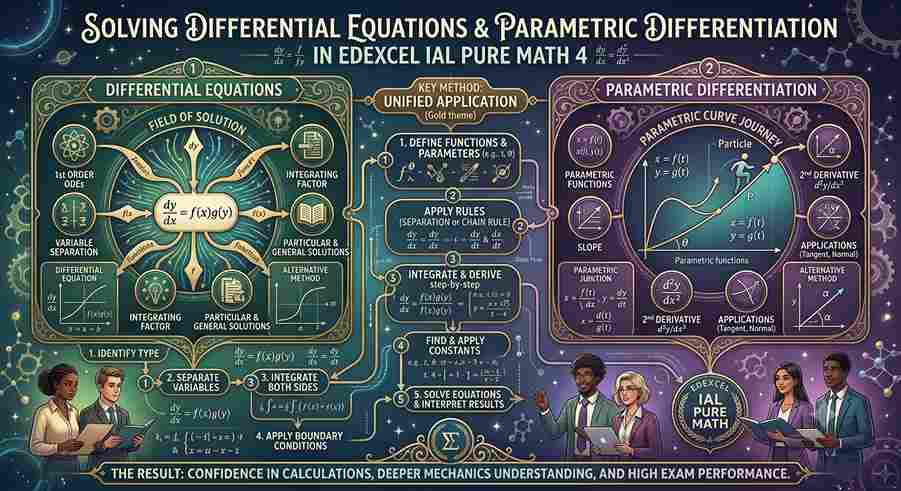
Last Updated: October 2026 | By EdFlik Education Team
For international high school students completing the Pearson Edexcel International Advanced Level (IAL) Mathematics pathway, Pure Mathematics 4 (P4) represents the pinnacle of high school calculus. Building upon the integration and differentiation techniques developed in $P_1, P_2,$ and $P_3$, the $P_4$ module introduces two of the most heavily weighted, multi-step calculus topics on the specification: Parametric Differentiation and First-Order Differential Equations with Separable Variables.
Featured prominently in the second half of the $P_4$ paper, these two topics routinely account for 15 to 20 marks out of the total 75 marks. They test not only your core calculus fluency, but also your ability to execute long algebraic manipulations, apply implicit chain rules, integrate using partial fractions or trigonometric identities, and evaluate boundary conditions to find specific particular solutions.
In this comprehensive, exam-focused masterclass guide, our expert Edexcel IAL mathematics educators break down the core formulas, provide step-by-step problem-solving frameworks, expose common examiner traps, and share strategies to help you secure an $A^*$ grade on $P_4$.
Part 1: Parametric Differentiation in $P_4$
In standard Cartesian geometry, curves are defined by explicit functions of the form $y = f(x)$. However, many complex curves—such as circles, ellipses, hyperbolas, and cycloids—are expressed much more elegantly using a third independent variable called a parameter (usually $t$ or $\theta$), where:
$$x = f(t) \quad \text{and} \quad y = g(t)$$
                      PARAMETRIC CALCULUS WORKFLOW
                                   |
    +------------------------------+------------------------------+
    |                                                             |
FIRST DERIVATIVE (Gradient)                    SECOND DERIVATIVE (Concavity)
Find dy/dt and dx/dt                           Apply the Parametric Chain Rule
dy/dx = (dy/dt) / (dx/dt)                      d²y/dx² = [d/dt (dy/dx)] / (dx/dt)
1. The First Derivative ($\frac{dy}{dx}$)
To find the gradient ($\frac{dy}{dx}$) of a parametric curve at a given parameter value $t$, apply the Chain Rule:
$$\frac{dy}{dx} = \frac{\frac{dy}{dt}}{\frac{dx}{dt}} \quad \text{provided } \frac{dx}{dt} \neq 0$$
Step-by-Step Example:
Find the gradient of the curve defined by $x = 3t^2 + 1$ and $y = 2t^3 - 4t$ at $t = 2$.
- Differentiate $x$ with respect to $t$: $\frac{dx}{dt} = 6t$
- Differentiate $y$ with respect to $t$: $\frac{dy}{dt} = 6t^2 - 4$
- Apply the Chain Rule:$$\frac{dy}{dx} = \frac{6t^2 - 4}{6t}$$
- Evaluate at $t = 2$:$$\left.\frac{dy}{dx}\right\vert{}_{t=2} = \frac{6(2)^2 - 4}{6(2)} = \frac{24 - 4}{12} = \frac{20}{12} = \frac{5}{3}$$
2. Tangents and Normals to Parametric Curves
Edexcel $P_4$ examiners frequently ask for the equation of a tangent or normal line to a parametric curve in exact Cartesian form ($ax + by + c = 0$):
- Equation of Tangent:$$y - y_1 = m_T (x - x_1) \quad \text{where } m_T = \left.\frac{dy}{dx}\right\vert{}_{t=t_1}$$
- Equation of Normal:$$y - y_1 = m_N (x - x_1) \quad \text{where } m_N = -\frac{1}{m_T}$$
Where $(x_1, y_1) = (f(t_1), g(t_1))$ are the coordinates evaluated at $t = t_1$.
3. The Second Derivative ($\frac{d^2y}{dx^2}$) — The Ultimate Exam Trap!
Finding the second derivative of a parametric function is one of the single most common places where $P_4$ students lose marks!
The Golden Rule for Parametric Second Derivatives:
$\frac{d^2y}{dx^2}$ is NOT simply $\frac{d/dt (dy/dt)}{d/dt (dx/dt)}$! You MUST differentiate $\frac{dy}{dx}$ with respect to $t$, and then divide by $\frac{dx}{dt}$ again.
$$\frac{d^2y}{dx^2} = \frac{d}{dx}\left(\frac{dy}{dx}\right) = \frac{\frac{d}{dt}\left(\frac{dy}{dx}\right)}{\frac{dx}{dt}}$$
Part 2: Differential Equations with Separable Variables
A first-order differential equation is an equation involving an independent variable $x$, a dependent variable $y$, and the first derivative $\frac{dy}{dx}$. In $P_4$, all differential equations are solved using the method of Separation of Variables.
                  SEPARATION OF VARIABLES PROCESS
                                 |
   General Form: dy/dx = f(x) g(y)
                                 |
   Step 1: Separate Variables  --->  (1 / g(y)) dy = f(x) dx
   Step 2: Integrate Both Sides --->  ∫ (1 / g(y)) dy = ∫ f(x) dx + C
   Step 3: Apply Boundary Conditions to Find Constant 'C'
1. The 4-Step Solution Method
Step 1: Rearrange and Separate Variables
Move all terms containing $y$ (including $dy$) to the left-hand side, and all terms containing $x$ (including $dx$) to the right-hand side:
$$\frac{1}{g(y)} \, dy = f(x) \, dx$$
Step 2: Integrate Both Sides
Add integral signs to both sides and integrate:
$$\int \frac{1}{g(y)} \, dy = \int f(x) \, dx$$
(Note: Combine the constants of integration into a single constant $C$ on the right-hand side).
Step 3: Apply Boundary Conditions (Find Particular Solution)
If initial conditions are provided (e.g., $y = y_0$ when $x = x_0$), substitute them into the integrated equation immediately to find the numerical value of $C$.
Step 4: Express $y$ Explicitly in Terms of $x$
Rearrange the equation to make $y$ the subject ($y = f(x)$), taking care when applying exponential or logarithmic operations.
2. High-Yield Exam Example: Real-World Modeling Problem
A liquid is cooling in a container. The rate of decrease of its temperature, $\theta \, ^\circ\text{C}$, after time $t$ minutes is modeled by the differential equation:
$$\frac{d\theta}{dt} = -k(\theta - 20)$$
where $k$ is a positive constant. Given that $\theta = 100$ when $t = 0$:
Solution Walkthrough:
- Separate Variables:$$\frac{1}{\theta - 20} \, d\theta = -k \, dt$$
- Integrate Both Sides:$$\int \frac{1}{\theta - 20} \, d\theta = \int -k \, dt$$$$\ln\vert{}\theta - 20\vert{} = -kt + C$$
- Apply Initial Conditions ($t = 0, \theta = 100$):$$\ln\vert{}100 - 20\vert{} = -k(0) + C \implies C = \ln 80$$
- Substitute $C$ and Solve for $\theta$:$$\ln\vert{}\theta - 20\vert{} = -kt + \ln 80$$$$\ln\vert{}\theta - 20\vert{} - \ln 80 = -kt$$$$\ln\left(\frac{\theta - 20}{80}\right) = -kt$$Take exponentials on both sides:$$\frac{\theta - 20}{80} = e^{-kt}$$$$\theta - 20 = 80e^{-kt} \implies \theta = 20 + 80e^{-kt}$$
Part 3: Essential Integration Techniques Required in $P_4$ Differential Equations
Solving differential equations in $P_4$ requires deploying advanced integration techniques learned earlier in $P_3$ and $P_4$:
- Partial Fractions: Used when the $y$-side contains a polynomial denominator that can be factored (e.g., $\frac{dy}{dx} = y(1 - y) \implies \int \frac{1}{y(1 - y)} \, dy = \int \left(\frac{1}{y} + \frac{1}{1 - y}\right) \, dy$).
- Logarithmic Integrals ($\int \frac{f'(x)}{f(x)} \, dx = \ln\vert{}f(x)\vert{} + C$): Frequently appears when separating variables with fractional terms.
- Integration by Parts ($\int u \, dv = uv - \int v \, du$): Used when the $x$-side involves products of algebraic and trigonometric/exponential functions.
Part 4: Top 4 Traps That Cost Students Marks in Edexcel P4
- Errors in Parametric Second Derivatives: Differentiating $\frac{dy}{dx}$ with respect to $t$ but forgetting to divide by $\frac{dx}{dt}$ at the final step when calculating $\frac{d^2y}{dx^2}$.
- Forgetting the Constant of Integration ($+ C$): Omitting $+ C$ during integration or adding it at the very end after rearranging for $y$. $+ C$ must be introduced at the exact moment integration occurs!
- Mishandling Logarithms with $+ C$: Incorrectly expanding $e^{-kt + C}$ as $e^{-kt} + e^C$ instead of $e^{-kt} \cdot e^C = A e^{-kt}$.
- Mixing Up Negative Signs in Rate Equations: Missing the negative sign in decay or decrease models (e.g., writing $\frac{dh}{dt} = k(h - 5)$ instead of $\frac{dh}{dt} = -k(h - 5)$ when height is decreasing).
Preparing for Pearson Edexcel IAL Pure Math 4 exams and aiming for an $A^$ grade? EdFlik connects international school students globally with expert, 1-to-1 online IAL math tutors, helping you master differential equations, parametric calculus, vectors, integration techniques, and past-paper exam strategies. *Book a Free Demo Class Today!
Frequently Asked Questions (FAQs)
Q1: How do I know whether to use degrees or radians in $P_4$ parametric calculus?
Ans: In all A-Level calculus (differentiation and integration), angles must be in radians. Using degrees invalidates standard derivative rules like $\frac{d}{dx}(\sin x) = \cos x$. Always set your calculator to RADIAN mode!
Q2: What is the difference between a general solution and a particular solution of a differential equation?
Ans: A general solution contains an arbitrary constant ($+ C$ or $A$) and represents a family of curves. A particular solution uses specific boundary conditions (given values for $x$ and $y$) to calculate the exact numerical value of $C$, representing a single specific curve.
Q3: Can a parametric curve be converted back into Cartesian form?
Ans: Yes! Eliminating the parameter $t$ using algebraic substitution or trigonometric identities (e.g., $\sin^2 t + \cos^2 t = 1$ or $\sec^2 t - \tan^2 t = 1$) allows you to convert parametric equations $x = f(t), y = g(t)$ into a Cartesian equation $y = f(x)$.
Q4: How does EdFlik support Edexcel IAL Pure Math 4 students?
Ans: EdFlik connects international school students worldwide with vetted, expert 1-to-1 online tutors specializing in Pearson Edexcel IAL Pure Mathematics ($P_1–P_4$), Mechanics ($M_1–M_3$), and Statistics ($S_1–S_3$). Our personalized coaching focuses on clarifying complex calculus concepts, practicing past-paper questions, and mastering exam techniques under timed conditions.