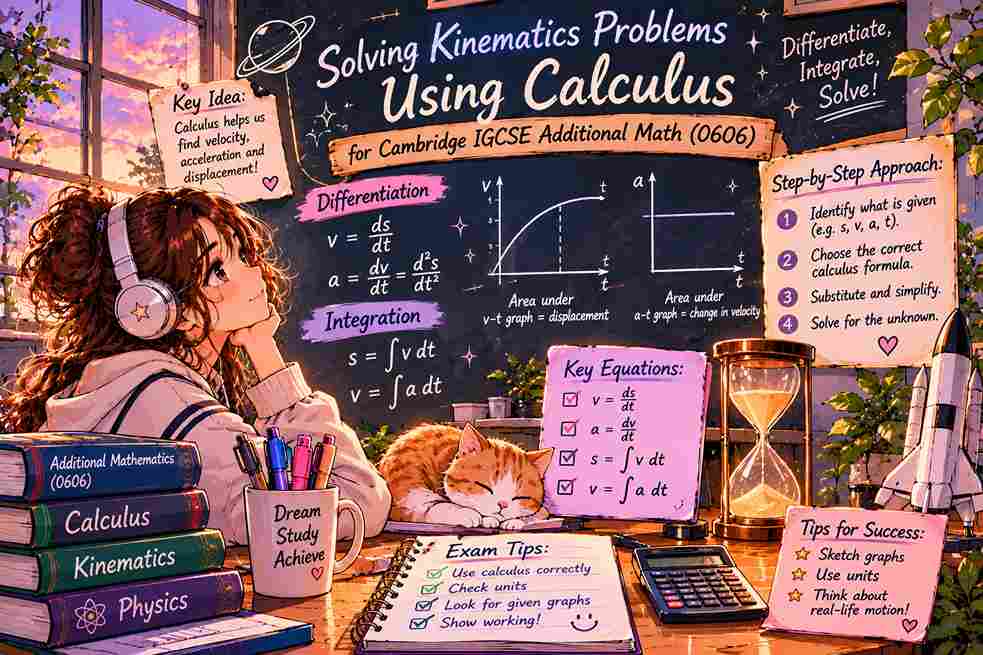
Solving Kinematics Problems Using Calculus for Cambridge IGCSE Additional Math (0606)
By EdFlik Team | November 19, 2026
For high-achieving secondary students across Dubai, Abu Dhabi, Sharjah, and the Northern Emirates enrolled in Cambridge IGCSE Additional Mathematics (0606), the Kinematics topic represents the bridge between pure calculus techniques and real-world physical motion.
Unlike standard IGCSE Mathematics (0580/0980) or basic Physics kinematics—which rely heavily on constant-acceleration SUVAT equations ($v = u + at$, $s = ut + \frac{1}{2}at^2$) or simple straight-line travel graphs—Cambridge Additional Mathematics (0606) demands using differentiation and integration to analyze particle motion where acceleration varies with time ($t$).
Whether a student aims for an $A^*$ in Add Maths to prepare for A-Level Mathematics (9709 / Further Maths) or IB Diploma Math Analysis and Approaches (AA HL), mastering calculus-based kinematics is non-negotiable.
However, Add Maths kinematics exams are notorious for subtle traps: forgetting the constant of integration ($+c$), confusing displacement with total distance traveled, or misinterpreting when a particle comes to instantaneous rest versus reverses direction.
This comprehensive masterclass guide breaks down the core calculus relationships in Cambridge IGCSE Additional Mathematics (0606), provides a step-by-step problem-solving framework, walks through full exam-style worked examples, highlights frequent mark-scheme traps, and includes 100% copy-paste JSON-LD schema markup.
Key Takeaways
- Differentiate to Move Forward, Integrate to Move Backward: Given displacement $s(t)$, differentiating once gives velocity $v(t)$ and twice gives acceleration $a(t)$. Conversely, integrating $a(t)$ gives $v(t)$, and integrating $v(t)$ gives $s(t)$.
- Never Forget $+c$ When Integrating: Every indefinite integration step in kinematics introduces an arbitrary constant ($c$). Always substitute boundary conditions (such as initial velocity at $t = 0$ or displacement at a known instant) to solve for $c$.
- Displacement $\neq$ Total Distance Traveled: Displacement is a directed quantity (positive or negative relative to a fixed origin $O$). Total distance requires splitting the integral at any time $t$ where velocity $v = 0$ (turning points) and summing positive magnitudes.
- Instantaneous Rest vs. Reversing Direction: A particle is at instantaneous rest when $v = 0$. It reverses direction when $v$ changes sign (crosses the $t$-axis), provided acceleration $a \neq 0$ at that instant.
Part 1: The Calculus Relationship Between $s$, $v$, and $a$
In Cambridge IGCSE Additional Mathematics (0606), a particle moves along a straight line so that its displacement ($s$) from a fixed origin $O$, velocity ($v$), and acceleration ($a$) are functions of time ($t \ge 0$).
                 CALCULUS KINEMATICS FLOWCHART (0606)
                                   |
        Differentiate w.r.t. t (d/dt)     Differentiate w.r.t. t (d/dt)
   Displacement (s) -------------------> Velocity (v) -------------------> Acceleration (a)
         ^                                     ^                                     |
         |                                     |                                     |
         +------- Integrate w.r.t. t (∫ dt) ---+------- Integrate w.r.t. t (∫ dt) <-+
Core Mathematical Definitions:
- Velocity:$$v = \frac{ds}{dt}$$
- Acceleration:$$a = \frac{dv}{dt} = \frac{d^2s}{dt^2}$$
- Displacement from Velocity:$$s = \int v \, dt$$
- Velocity from Acceleration:$$v = \int a \, dt$$
Understanding how rate of change connects curves and slopes helps students check whether their algebraic derivatives and integrals make physical sense before moving to the next question.
Part 2: Essential Motion Keywords & What They Mean Mathematically
Cambridge 0606 exam questions test whether students can translate everyday phrasing into exact equations or inequalities:
| Exam Phrase | Mathematical Meaning | Typical Question Type |
| "Initially" / "At rest initially" | $t = 0$ (and if "at rest", $v = 0$ when $t = 0$) | Finding integration constant $+c$ |
| "At the origin $O$" | $s = 0$ | Finding when a particle passes/returns to $O$ |
| "Comes to instantaneous rest" | $v = 0$ | Finding maximum/minimum displacement or turning time |
| "Reverses direction" | $v = 0$ and $v$ changes sign | Splitting total distance calculation |
| "Maximum / minimum velocity" | $\frac{dv}{dt} = a = 0$ (check sign change of $a$) | Finding peak speed or slowest speed |
| "Decelerating" / "Retarding" | $v$ and $a$ have opposite signs ($va < 0$) | Speed decreasing over an interval |
Crucial Distinction: "At Rest" vs. "Maximum Displacement"
Students often confuse $v = 0$ with $s = 0$. When a particle reaches its furthest point from the origin before turning back, its velocity is zero ($v = 0$)—not necessarily its displacement. Substituting that value of $t$ back into $s(t)$ gives the maximum displacement.
Part 3: Step-by-Step Problem-Solving Protocol for 0606
Follow this structured 4-step workflow for structured kinematics questions in Cambridge 0606 Paper 1 or Paper 2:
                 4-STEP 0606 KINEMATICS SOLUTION PROTOCOL
                                    |
  Step 1: Identify Given & Target ---> Note whether you are differentiating (s → v → a)
                                       or integrating (a → v → s), plus boundary values.
  Step 2: Apply Calculus + Constants -> Differentiate cleanly or integrate and solve for +c
                                       using given conditions at specific times t.
  Step 3: Solve Key Conditions      ---> Set v = 0, a = 0, or s = k as requested by the prompt.
  Step 4: Check Distance vs. Disp.  ---> Split intervals at v = 0 when asked for total distance.
Part 4: Full Exam-Style Worked Examples
Worked Example 1: Differentiation, Instantaneous Rest, and Deceleration
Question: A particle moves in a straight line such that its displacement $s$ meters from a fixed origin $O$ at time $t$ seconds ($t \ge 0$) is given by:
$$s = t^3 - 9t^2 + 24t - 10$$
Find: (a) an expression for the velocity $v$ of the particle at time $t$,
(b) the values of $t$ when the particle is at instantaneous rest,
(c) the acceleration of the particle when $t = 4$.
Step-by-Step Solution:
(a) Expression for velocity $v$: Differentiate $s$ with respect to $t$:
$$v = \frac{ds}{dt} = 3t^2 - 18t + 24$$
(b) Times when the particle is at instantaneous rest: Set $v = 0$:
$$3t^2 - 18t + 24 = 0$$
Divide through by $3$:
$$t^2 - 6t + 8 = 0$$
Factorize:
$$(t - 2)(t - 4) = 0$$
So the particle is at instantaneous rest at $t = 2\text{ s}$ and $t = 4\text{ s}$.
(c) Acceleration when $t = 4$: Differentiate $v$ with respect to $t$ to get acceleration $a$:
$$a = \frac{dv}{dt} = 6t - 18$$
Substitute $t = 4$:
$$a = 6(4) - 18 = 24 - 18 = 6\text{ m s}^{-2}$$
Worked Example 2: Integration, Constants ($+c$), and Total Distance Traveled
Question: A particle starts from rest at a fixed point $O$ when $t = 0$. Its acceleration $a\text{ m s}^{-2}$ at time $t$ seconds is given by:
$$a = 12t - 24$$
Find: (a) the velocity $v$ of the particle in terms of $t$,
(b) the displacement $s$ of the particle from $O$ in terms of $t$,
(c) the total distance traveled by the particle during the first $4$ seconds ($0 \le t \le 4$).
Step-by-Step Solution:
(a) Velocity $v$ in terms of $t$: Integrate $a$ with respect to $t$:
$$v = \int (12t - 24)\,dt = 6t^2 - 24t + c_1$$
Since the particle starts from rest when $t = 0$, we have $v = 0$ at $t = 0$:
$$0 = 6(0)^2 - 24(0) + c_1 \implies c_1 = 0$$
Therefore:
$$v = 6t^2 - 24t$$
(b) Displacement $s$ from $O$ in terms of $t$: Integrate $v$ with respect to $t$:
$$s = \int (6t^2 - 24t)\,dt = 2t^3 - 12t^2 + c_2$$
Since the particle starts at $O$ when $t = 0$, we have $s = 0$ at $t = 0$:
$$0 = 2(0)^3 - 12(0)^2 + c_2 \implies c_2 = 0$$
Therefore:
$$s = 2t^3 - 12t^2$$
(c) Total distance traveled for $0 \le t \le 4$: First, find when $v = 0$ in the interval $0 \le t \le 4$:
$$6t^2 - 24t = 0 \implies 6t(t - 4) = 0$$
Within $0 < t < 4$, there is no sign change of $v$ ($v < 0$ for $0 < t < 4$, meaning it moves steadily in the negative direction from $t = 0$ to $t = 4$, coming to rest right at $t = 4$).
Calculate displacement at $t = 0$ and $t = 4$:
- At $t = 0$: $s(0) = 0\text{ m}$
- At $t = 4$: $s(4) = 2(4)^3 - 12(4)^2 = 128 - 192 = -64\text{ m}$
Because the particle moves monotonically in one direction over $0 \le t \le 4$, the total distance traveled is:
$$\text{Total Distance} = \vert{}s(4) - s(0)\vert{} = \vert{}-64 - 0\vert{} = 64\text{ m}$$
(Note: If a problem has a turning point at $t = 2$ inside the interval $0 \le t \le 4$, you must compute $\vert{}s(2) - s(0)\vert{} + \vert{}s(4) - s(2)\vert{}$ separately so negative displacement doesn't cancel out distance!)
Part 5: Top 4 Exam Traps That Cost Add Maths Students Marks
- Omitting Integration Constants ($+c$): Integrating $a(t)$ or $v(t)$ without $+c$ loses method and accuracy marks whenever initial or boundary conditions are non-zero. Always write $+c$ immediately upon integrating.
- Mixing Up Displacement and Distance: Subtracting $s(0)$ from $s(t_{\text{end}})$ directly when the particle turns around mid-interval. Always check where $v = 0$ first.
- Using SUVAT When Acceleration Isn't Constant: Equations like $s = ut + \frac{1}{2}at^2$ only apply when $a$ is constant. In Cambridge 0606, whenever $a$ is a function of $t$, you must use calculus.
- Dropping Units in Final Answers: Cambridge mark schemes regularly penalize missing or incorrect units (such as $\text{m}$, $\text{m s}^{-1}$, or $\text{m s}^{-2}$). Always check units before moving on.
For expert 1-on-1 online tutoring support to master Cambridge IGCSE Additional Mathematics (0606), A-Level Pure Mathematics, and past-paper problem solving across the UAE, book a class on EdFlik.
Frequently Asked Questions (FAQs)
Q1: Can I use SUVAT formulas in Cambridge IGCSE Additional Mathematics (0606) kinematics questions?
Ans: Only when the problem explicitly specifies constant acceleration (or when differentiating/integrating yields a constant value for $a$). Whenever acceleration is given as a variable expression in terms of $t$ (such as $a = 4t - 6$), you must use calculus.
Q2: How do I know if a particle is slowing down or speeding up in Add Maths 0606?
Ans: Compare the signs of velocity ($v$) and acceleration ($a$) at that time $t$. If $v$ and $a$ have the same sign (both positive or both negative), the particle is speeding up. If $v$ and $a$ have opposite signs (one positive, one negative), the particle is slowing down / decelerating.
Q3: Why is kinematics in Add Maths (0606) so important for A-Level or IB Math?
Ans: Kinematics combines polynomial, trigonometric, exponential, and logarithmic differentiation and integration with physical interpretation. Mastering it builds the exact analytical habits required for A-Level Mechanics, Pure Mathematics, and IB Diploma Math AA.