Structuring Extended Responses in IB Psychology Paper 1: Biological and Cognitive Approaches
Last Updated: September 2026 | By EdFlik Education Team
For students enrolled in the International Baccalaureate (IB) Diploma Programme (DP) Psychology course (Standard Level and Higher Level), Paper 1 is the ultimate test of psychological knowledge, critical thinking, and structured essay writing. Specifically, Section B of Paper 1 requires students to write a comprehensive, 22-mark extended response question (ERQ) from either the biological approach, cognitive approach, or sociocultural approach.
Many students possess a solid understanding of biological and cognitive theories, neurotransmitters, localization of brain function, or models of memory, yet fail to score a top grade (6 or 7). Why? Because they structure their responses like standard high school essays rather than adhering to the strict IB command terms and markbands.
In this comprehensive, in-depth guide, our expert IB Psychology tutors break down the anatomy of a 22-mark ERQ, how to tackle command terms (Evaluate vs. Discuss vs. Contrast), and proven strategies to maximize your marks for the biological and cognitive approaches.
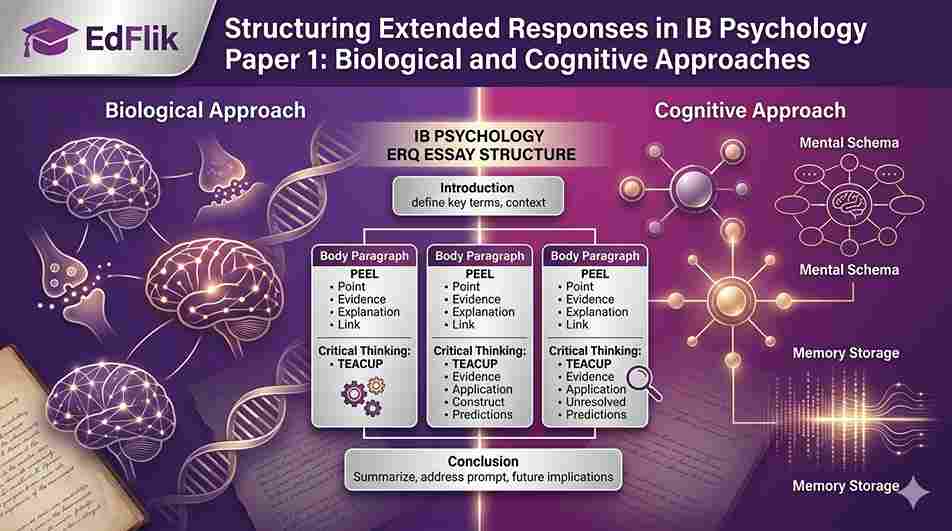
Part 1: The Anatomy of a 22-Mark IB Psychology ERQ
An IB Psychology ERQ is marked out of 22 marks, divided across three distinct assessment criteria:
- Criterion A: Knowledge and Comprehension (9 marks): Accurate, relevant psychological terminology, theories, and empirical studies.
- Criterion B: Critical Thinking (9 marks): Evaluating theories, discussing methodological strengths/limitations of studies, considering ethical considerations, culture, and alternative explanations.
- Criterion C: Organization (4 marks): A clear, coherent structure with a structured argument that directly addresses the prompt.
To secure a top band in Criterion C, your essay must never feel like a random brain-dump of studies. Every paragraph must serve a clear purpose in answering the prompt.
Part 2: Biological Approach — Core Concepts and Structuring
The biological approach examines how physiological processes, brain structures, neurotransmitters, hormones, and genetics influence human behavior. Common ERQ topics include localization of function, neuroplasticity, neurotransmission, and the influence of genetics on behavior.
1. Key Biological Theories and Landmark Studies
When writing an ERQ on the biological approach, your studies must be directly linked to the theory. For example:
- Localization of Function: Use Maguire et al. (2000) (taxi drivers and the hippocampus) or HM (Milner, 1966).
- Neuroplasticity: Use Draganski et al. (2006) (jugglers) or Rosenzweig and Bennett (1972) (animal models of environmental enrichment).
- Genetics and Behavior: Use Twin Studies like Bouchard et al. (1990) (Minnesota Twin Study) or Kendler et al. (2006).
2. Tailoring Critical Thinking (Criterion B) for Biology
High-scoring critical thinking for biological essays involves specific evaluative angles:
- Methodological Critique of Studies: Are lab experiments ecologically valid? Do correlational studies (like twin studies) fail to establish clear cause-and-effect because of shared environments?
- Reductionism: Discuss whether reducing complex human behaviors (like depression, aggression, or intelligence) down to mere neurotransmitters or gene variants ignores cognitive, social, and environmental factors.
- Ethical Considerations: Animal research (e.g., Rosenzweig) raises animal welfare concerns; genetic research can lead to stigmatization or genetic determinism.
Part 3: Cognitive Approach — Core Concepts and Structuring
The cognitive approach investigates internal mental processes such as memory, thinking, perception, attention, and decision-making, alongside the interaction between cognition and emotion.
1. Key Cognitive Theories and Landmark Studies
Common ERQ topics include models of memory, schema theory, constructive memory, and cognitive biases in decision-making:
- Models of Memory: The Multi-Store Model of Memory (Atkinson & Shiffrin, 1968) or Working Memory Model (Baddeley & Hitch, 1974). Use supporting studies like Glazner and Cunitz (1966) (primacy-recency effect).
- Schema Theory: Bartlett (1932) ("War of the Ghosts") or Anderson and Pichert (1978) (homebuyer/burglar perspective study).
- Decision Making / Thinking: Dual-Process Model of Thinking (Kahneman's System 1 and System 2) using studies like Wason's Four Card Problem or Tversky and Kahneman (1974).
2. Tailoring Critical Thinking (Criterion B) for Cognition
For cognitive ERQs, your critical evaluation should focus on:
- Ecological Validity: Many cognitive experiments are conducted in artificial laboratory environments with abstract tasks (e.g., memorizing trigrams or lists of words). Do these reflect real-world cognitive processing?
- Cultural Bias: Are cognitive models (like schema theory or multi-store memory) culturally universal, or were they developed primarily using Western, Educated, Industrialized, Rich, and Democratic (WEIRD) samples?
- Methodological Strengths: Controlled lab experiments allow for high replicability and control of confounding variables.
Part 4: Mastering IB Command Terms in Paper 1
The way you structure your essay depends heavily on the command term used in the prompt:
- Evaluate: Weight the strengths and limitations of a theory or study, concluding with an overall appraisal of its validity or usefulness. (Requires a balanced 50/50 split of pros and cons).
- Discuss: Offer a considered and balanced review of a topic, exploring multiple perspectives, theories, or arguments.
- Contrast: Give an account of the differences between two or more items or concepts, referencing both throughout.
Part 5: Top 4 Strategies to Score a 7 in IB Psychology Paper 1
- Integrate Studies Seamlessly (The TEA Framework): When discussing a study, never just summarize the plot. Use the TEA approach: Theory link, Experimental design/procedure (briefly), and Application to the prompt.
- Explicitly Signpost Critical Thinking: Use clear evaluative signposts in your paragraphs, such as "A major methodological limitation of this study is...", "From an ethical perspective...", or "A counter-argument to this theory is...".
- Manage Your Time Effectively: In Paper 1, you have 2 hours to answer three short-answer questions (SAQs) and one extended response question (ERQ). Aim to spend roughly 45 to 50 minutes drafting and planning your ERQ.
- Avoid Irrelevant Study Dump: Examiners can instantly spot when a student is reciting a memorized essay rather than answering the specific prompt. Always tie your study back to the exact wording of the question in your concluding sentences.
Struggling to master IB Psychology ERQs, structure your essays, or memorize key studies? EdFlik offers expert, 1-to-1 online tutoring customized specifically for the IB Diploma Programme, helping you build analytical confidence and secure a Grade 7.Book a Free Demo Class Today!
Frequently Asked Questions (FAQs)
Q1: How many studies should I include in a 22-mark Paper 1 ERQ?
Ans: Generally, aiming for two well-detailed, highly relevant studies that are deeply evaluated is far more effective than hastily rushing through four or five superficial study summaries. Depth always beats breadth in IB Psychology.
Q2: Do I need to write an introduction and conclusion for an ERQ?
Ans: Yes. A strong introduction should define key terms, outline the scope of the essay, and state your thesis/direction. A concise conclusion should summarize your main arguments without introducing new evidence.
Q3: Can I use the same study for both the biological and cognitive approaches?
Ans: Only if the study legitimately straddles both approaches (e.g., cognitive neuroscience studies that look at biological brain imaging during cognitive tasks like memory retrieval). However, it is usually much safer to use distinct, dedicated studies for each approach to clearly satisfy Criterion A.
Q4: How can EdFlik help me achieve a Grade 7 in IB Psychology?
Ans: EdFlik connects you with experienced, certified 1-to-1 online tutors specializing in the IB DP Psychology curriculum. Our tutors guide you through structuring ERQs, refining critical thinking arguments, and mastering past paper markbands.