Switching from American to British Curriculum in the UAE: How to Bridge the Academic Gap
Last Updated: October 2026 | By EdFlik Education Team
The United Arab Emirates boasts one of the most vibrant and diverse international education ecosystems in the world. From premier British curriculum schools in Dubai and Abu Dhabi to top-tier American institutions, families frequently relocate across emirates or switch educational systems due to corporate relocations, scholarship opportunities, or shifting long-term university aspirations.
Among all educational transitions, moving from an American Curriculum (Common Core / AP) to a British Curriculum (IGCSE / GCE A-Levels) is one of the most profound shifts a student can experience. While both systems ultimately lead to world-class higher education, their underlying philosophies, assessment structures, and pedagogical pacing are vastly different.
Without a strategic transition plan, students can experience "academic culture shock," struggling with unfamiliar exam board mark schemes, rigorous terminal testing, and specialized subject frameworks. In this comprehensive masterclass guide, our expert educational consultants break down the core differences, identify critical academic gaps, and provide a step-by-step roadmap to ensure a seamless transition.
Part 1: Structural Differences — American vs. British Systems
To bridge the academic gap successfully, you must first understand the structural and philosophical divergence between the two systems.
1. Grade Levels and Age Alignment
Navigating year and grade equivalents can be confusing for parents during a mid-term switch:
- Primary School: American Grade 4 aligns roughly with British Year 5 (Key Stage 2).
- Middle School / Lower Secondary: American Grade 8 aligns with British Year 9.
- High School / Upper Secondary: American Grade 10 marks the transition into AP/IB or upper high school, whereas the British system enters the critical two-year IGCSE / GCSE cycle (Years 10 and 11), culminating in external board exams.
2. Assessment Philosophy: Continuous GPA vs. Terminal Linear Exams
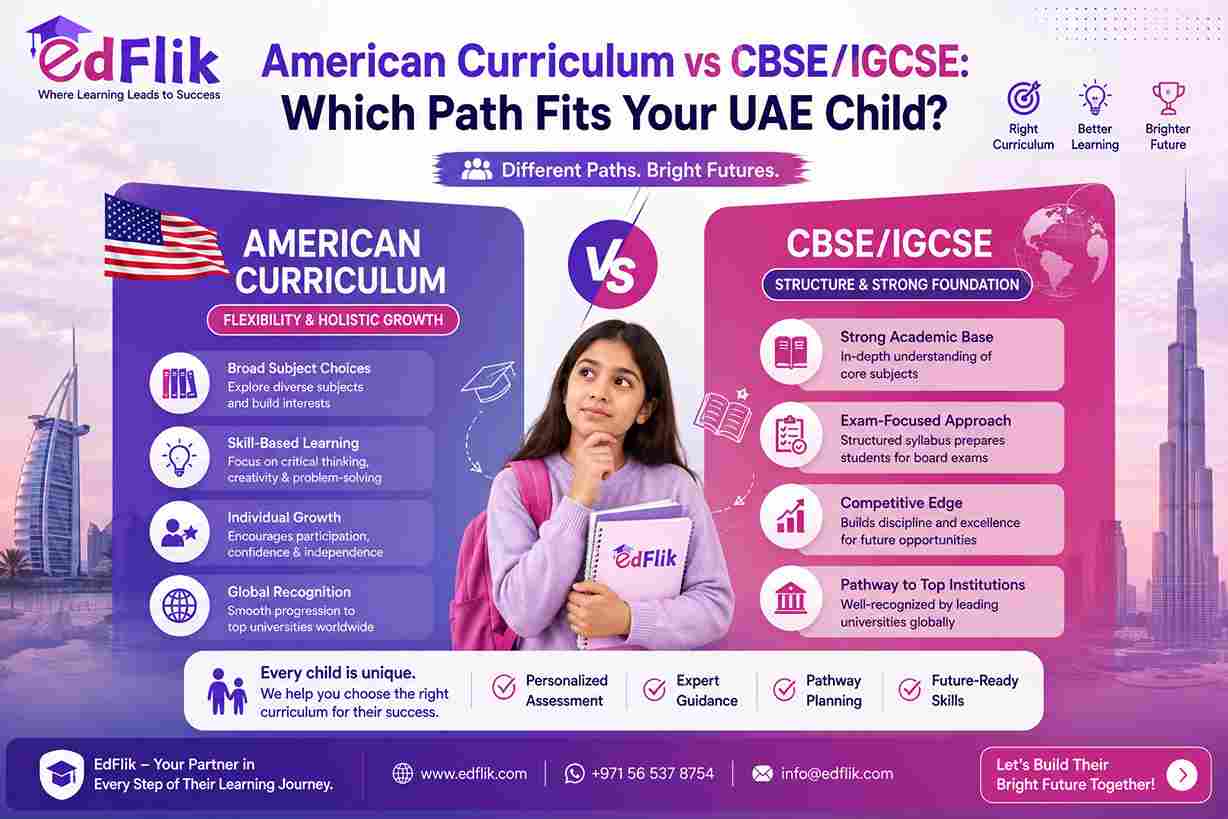
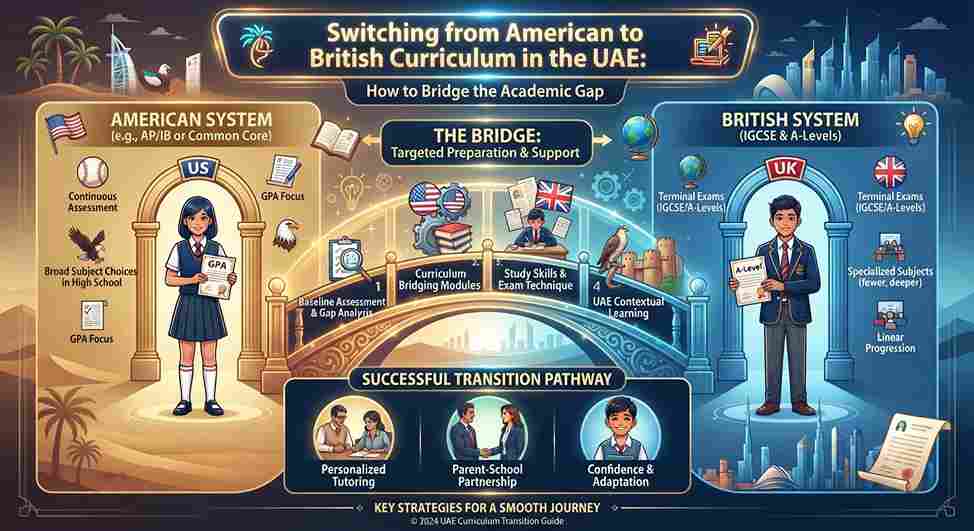
- The American System: Relies heavily on continuous assessment. Grades are typically accumulated through regular quizzes, homework assignments, class participation, projects, and periodic tests throughout the semester, culminating in a cumulative Grade Point Average (GPA).
- The British System: Is historically linear and exam-driven. While coursework or practical endorsements exist in certain subjects, a student's final qualification grade is determined almost entirely by high-stakes external board exams (Cambridge or Edexcel) taken at the end of Year 11 (IGCSE) and Year 13 (A-Levels). Daily homework rarely counts toward the final certificate.
3. Breadth vs. Specialization
- American Curriculum: Emphasizes breadth. High school students study a wide array of subjects simultaneously (math, English, science, history, foreign languages, arts, and electives) right up until graduation.
- British Curriculum: Progresses toward rapid specialization. After completing 8 to 10 IGCSE subjects at age 16, students narrow their focus dramatically down to just 3 or 4 A-Level subjects in Years 12 and 13, diving into university-level depth early.
Part 2: The Core Academic Gaps Students Encounter
When students transition from an American framework to a British international school in the UAE, they frequently encounter three distinct academic hurdles:
1. The Mathematical Rigor and Non-Calculator Gap
American math curricula often integrate concepts progressively and permit calculator use across broad problem sets. In contrast, British IGCSE and A-Level mathematics place immense emphasis on rigorous algebraic manipulation, multi-step proof derivation, exact numerical forms (surds and fractions), and dedicated non-calculator examination papers (such as Edexcel IAL or Cambridge Paper 1).
- The Gap: Students accustomed to relying on graphing calculators for basic arithmetic can struggle with mental math agility and rigorous algebraic factoring under timed conditions.
2. Science: Coordinated/Combined vs. Separate Sciences
In many American middle and high schools, general science integrates earth science, life science, and physical science into broad thematic units. In the British system, students in Key Stage 4 transition immediately into distinct disciplines (Biology, Chemistry, and Physics) or take a rigorous Double/Triple Award IGCSE track.
- The Gap: Students may lack foundational laboratory technique rigor, precise chemical equation balancing, and familiarity with specific command words used in British practical exam papers (Criterion B/C or Paper 6 alternative-to-practical).
3. English and Humanities: Analytical Writing and Mark Scheme Discipline
American language arts frequently reward personal voice, creative expression, and reflective commentary. British IGCSE English Language and Literature, however, demand tight, highly structured analytical responses governed by strict mark schemes.
- The Gap: Students often write overly narrative essays lacking the sharp, evidence-based PEEL (Point, Evidence, Explanation, Link) paragraph structure required by Cambridge and Edexcel examiners.
Part 3: A 4-Step Action Plan for Parents and Students
If your child is making the switch, follow this practical framework to bridge the gap within their first term:
Step 1: Conduct an Honest Diagnostic Assessment
Before classes begin, request sample past-paper questions from the target British school for your child's specific year group. Reviewing a past IGCSE math paper or English comprehension insert will immediately reveal whether your child needs remediation in algebra, essay structuring, or scientific terminology.
Step 2: Master British Exam Terminology and Command Words
British exam boards are notoriously specific about what they expect when they use verbs like state, explain, evaluate, deduce, or discuss. Purchase official revision guides (such as CGP or Oxford publisher books) early so your child becomes familiar with the exact phrasing used in mark schemes.
Step 3: Build Non-Calculator Mathematical Confidence
Encourage your child to practice math problem-solving without reaching for a digital or graphing calculator. Rebuilding fraction fluency, index laws, and mental factorization prevents panic during non-calculator exam modules.
Step 4: Secure Targeted Transition Tutoring
The first three months of a curriculum switch are critical. Enlisting a specialized tutor who understands both American foundations and British examination boards can bridge knowledge gaps in weeks rather than semesters, preserving your child's academic confidence and GPA/exam trajectory.
Switching curricula across international schools in Dubai, Abu Dhabi, or the UAE? EdFlik connects students globally with expert, 1-to-1 online tutors specializing in British IGCSE, GCSE, and A-Level curricula, helping your child bridge academic gaps and achieve top $A^$ grades.*Book a Free Demo Class Today!
Frequently Asked Questions (FAQs)
Q1: Is it harder to transition from American to British, or British to American?
Ans: Transitioning from American to British is generally considered more challenging due to the abrupt shift toward high-stakes terminal board exams, specialized subject choices, and rigorous mark scheme requirements.
Q2: Will my child lose a year when switching from an American school to a British school in the UAE?
Ans: Generally, international schools in the UAE align grade and year levels based on age. A child finishing American Grade 8 will typically enter British Year 9. However, schools may recommend diagnostic testing to place the student correctly if significant curriculum gaps exist.
Q3: How do universities view students who switched high school curricula?
Ans: University admissions teams (in the UK, US, UAE, and globally) are very accustomed to international mobility. Provided your child demonstrates strong academic performance (such as solid IGCSE/A-Level grades or AP scores) and explains the transition context in personal statements, university prospects remain exceptionally strong.
Q4: How does EdFlik support students changing international curricula?
Ans: EdFlik connects students worldwide with vetted, experienced 1-to-1 online tutors specializing in curriculum transitions, bridging foundational gaps in mathematics, sciences, and humanities for a seamless adaptation.