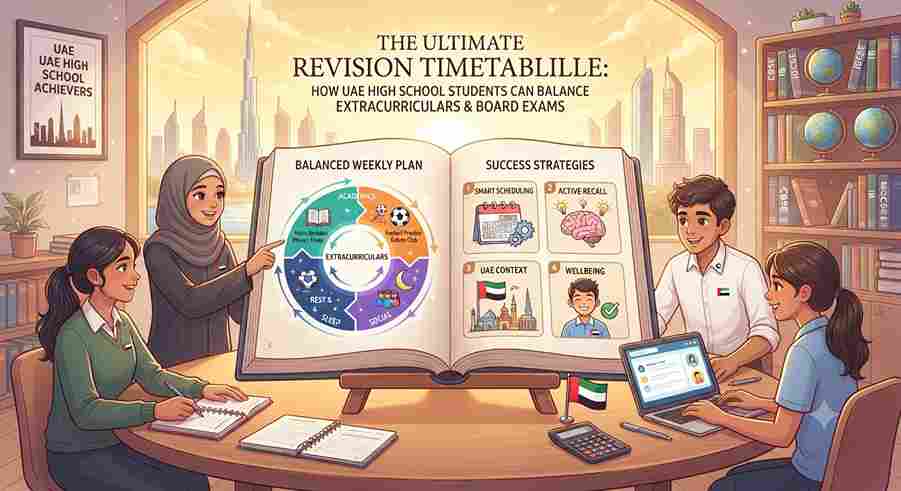
The Ultimate Revision Timetable: How UAE High School Students Can Balance Extracurriculars and Board Exams
Last Updated: September 2026 | By EdFlik Education Team
For high school students living and studying in the UAE—whether enrolled in British schools (IGCSE, International A-Levels), American schools (AP, Common Core), or the International Baccalaureate (IB DP)—life is fast-paced and wonderfully diverse. From Model United Nations (MUN) conferences and varsity sports matches to robotics clubs, piano recitals, and community service, UAE schools offer incredible opportunities for holistic personal development.
However, when exam season rolls around, many high-achieving students hit a wall. They try to maintain their rigorous extracurricular schedules while simultaneously facing mountain-sized piles of past papers, chemistry equations, calculus proofs, and essay deadlines. The result? Burnout, cramming, and missed academic potential.
The good news? You do not have to choose between being a well-rounded student with vibrant extracurriculars and scoring top grades on your board exams. You just need a smarter system. In this comprehensive guide, our expert academic coaches break down how to design a sustainable revision timetable that balances high-performance studying with extracurricular commitments.
Part 1: The Myth of "Hustle Culture" and Why Strict Timetables Fail
Before diving into scheduling tactics, we need to address a common student trap: the perfectionist timetable.
Many students design revision schedules that look like military boot camps—allocating 14 hours of continuous studying with no breaks, no sleep, and zero time for hobbies. By day three, exhaustion sets in, the plan breaks down entirely, and the student feels guilty and overwhelmed.
Sustainable Study Rules:
- Energy Management > Time Management: You can sit at a desk for six hours, but if your brain is fried, you will retain almost nothing. Quality focused study beats quantity unfocused staring every single time.
- Extracurriculars as Cognitive Resets: Physical activity, creative arts, or team sports are not distractions from studying—they are crucial mental breaks that lower cortisol, boost endorphins, and improve cognitive retention.
Part 2: Step-by-Step Guide to Building Your Balanced Timetable
Creating a revision timetable that survives contact with real life requires strategy, flexibility, and honesty about your weekly commitments. Follow these four steps to build your custom schedule:
Step 1: Map Your Non-Negotiables First
Before scheduling a single minute of chemistry or calculus, block out your fixed weekly commitments:
- School hours (including travel time).
- Mandatory extracurricular practices (e.g., swim team practice on Tuesday/Thursday afternoons, debate club on Wednesday).
- Family time, prayer times, meals, and at least 8 hours of sleep per night.
Step 2: Categorize Your Subjects Using the "Traffic Light" System
Not all subjects require equal attention. Review your current mock grades or past paper scores and categorize your subjects:
- Red Subjects (High Priority): Topics or subjects where you are struggling or sitting below your target grade. These need frequent, short-burst revision sessions.
- Yellow Subjects (Moderate Priority): Subjects you understand reasonably well, but need regular past paper practice to maintain consistency.
- Green Subjects (Maintenance): Subjects where you consistently score high marks. These require minimal maintenance review.
Step 3: Implement the "Time-Blocking" and Pomodoro Techniques
Instead of open-ended blocks like "Study Math all Saturday," use specific time-blocking combined with the Pomodoro Technique (25 minutes of intense, distraction-free study followed by a 5-minute break).
- Example: Saturday 10:00 AM – 11:00 AM: Physics Mechanics past paper questions (Pomodoro blocks of 25 mins work + 5 mins rest).
Step 4: Protect Your Extracurriculars (With Boundaries)
If you play varsity football or lead your school's robotics team, keep doing it! However, during peak exam months (January to May), you may need to scale back temporarily. For instance, instead of attending every single club meeting, negotiate a reduced role for a few weeks without dropping out entirely. Your extracurricular mentors will understand that board exams take precedence.
Part 3: Sample Weekly Revision Schedule for a UAE High Schooler
Here is what a balanced, realistic weekly template looks like for a student balancing school, extracurriculars, and board exam prep:
| Day | Morning / School | Afternoon (Extracurriculars) | Evening Study Block (90 mins total) |
| Monday | School (7:30 AM - 3:00 PM) | Piano Lesson (4:00 PM - 5:00 PM) | 6:30 PM - 8:00 PM: Chemistry Kinetics (Red Subject) |
| Tuesday | School (7:30 AM - 3:00 PM) | Swim Practice (4:00 PM - 6:00 PM) | 7:30 PM - 8:30 PM: English Literature Essay Planning |
| Wednesday | School (7:30 AM - 3:00 PM) | Model UN Club (3:30 PM - 5:00 PM) | 6:30 PM - 8:00 PM: Calculus Derivatives (Red Subject) |
| Thursday | School (7:30 AM - 3:00 PM) | Relax / Family Time | 6:00 PM - 7:30 PM: Physics Past Paper Questions |
| Friday | School (Half Day) | Football Match (4:00 PM - 6:00 PM) | Light review / Flashcards (30 mins) |
| Saturday | Free Morning | Robotics Workshop (2:00 PM - 5:00 PM) | 10:00 AM - 12:30 PM: Timed Mock Practice Paper |
| Sunday | Rest / Prep for Week | Catch up on hobbies / Family outing | 5:00 PM - 7:00 PM: Weekly review & planning |
Part 4: Top 4 Productivity Hacks for Busy Students
- Active Recall over Passive Reading: Reading a textbook three times is an inefficient use of your precious time. Use active recall methods like flashcards (Anki or physical cards) and blurting (writing down everything you know about a topic from memory on a blank sheet of paper).
- Ditch the Phone: Put your smartphone in another room or use focus apps (like Forest or Freedom) during your study blocks. Multitasking while studying doubles your preparation time.
- Utilize Commutes Wisely: If you ride a school bus or carpool in Dubai, Abu Dhabi, or Sharjah traffic, use that time to listen to educational podcasts, review vocabulary flashcards, or read through history notes.
- Ask for Help Early: If you are falling behind in a subject because of extracurricular fatigue, don't wait until mock exams to panic. Getting targeted academic support early saves hours of frustration.
Struggling to balance your board exam revision with extracurricular activities? EdFlik offers expert, 1-to-1 online tutoring customized specifically for IGCSE, A-Level, IB, and AP curricula, helping you study smarter, save time, and achieve your dream scores.Book a Free Demo Class Today!
Frequently Asked Questions (FAQs)
Q1: Should I quit my extracurriculars during exam season?
Ans: Usually, no. Complete cessation of hobbies can lead to increased stress and burnout. Instead, practice smart moderation—temporarily reducing your time commitment to extracurriculars while maintaining the ones that keep you mentally refreshed.
Q2: How many hours a day should I study outside of school during exam prep?
Ans: Quality matters far more than quantity. On school days, 1.5 to 2.5 hours of focused, distraction-free revision is plenty if done consistently. On weekends, 3 to 4 hours spread across morning and afternoon blocks is sustainable.
Q3: What is the best method to avoid burnout when studying for multiple board subjects?
Ans: Subject-switching (interleaving). Instead of studying Chemistry for 5 straight hours, break your study sessions into 45-minute blocks covering different subjects (e.g., Math, then English, then Physics). This keeps your brain engaged and prevents cognitive fatigue.
Q4: How can EdFlik help me manage my time and prepare for board exams?
Ans: EdFlik connects you with experienced, certified 1-to-1 online tutors who specialize in international curricula. Our flexible online tutoring sessions fit smoothly around your extracurricular schedule, helping you master difficult concepts efficiently in half the time.